













“I am also all for personal freedom and would not wish anybody to dictate to me what to wear or what not. Yet recently I realized that there is already a strict dress code in force that especially students of both sexes have to follow whether they like it or not.” – Maria Wirth
Some time ago much was made in the media of a dress code order by some Kanpur Colleges. Female students were not allowed anymore to wear jeans or other western attire. A lot of eve teasing had happened right at the gate of the colleges and the management felt that the way the students dressed, encouraged eve teasing. The media took up the cause. They felt that it was an infringement on the personal freedom of the students and quoted some girls who supported this view. The new dress code sans jeans was called draconian – a strong word.
I am also all for personal freedom and would not wish anybody to dictate to me what to wear or what not. Yet recently I realized that there is already a strict dress code in force that especially students of both sexes have to follow whether they like it or not, and no media takes up their cause.
I was waiting for a Vikram, as the noisy three wheelers which can accommodate up to ten passengers are called in Dehradun. A young woman, dressed in jeans and T-Shirt, entered the Vikram together with me and sitting there she complimented me on wearing a salwar kameez. “It looks good on you”, she remarked and I said “And it is so comfortable.”
“Yes, it is true. I would also like to wear it, but my friends in college will make fun of me”, she replied.
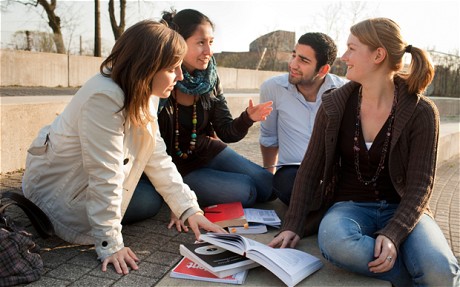 I felt reminded of my student days in Hamburg in the 70s. “Peer pressure” was even then an unquestionable authority. Nobody dared to disobey it if one did not want to be considered old fashioned. Blue jeans, preferably a black pullover and sneakers were then the dress code for students – male and female. Well, this was actually not bad for us, as Germany is a cold country and anyway we had only the option between trousers and skirts. Both were tight at the waist and uncomfortable while sitting in the classroom. We had not discovered the ingenuity of a garment that can be adjusted like a salwar or a sari for that matter.
 In the 80s, when jeans and sneakers became popular in India, I was astonished that youngsters were voluntarily sweating it out even in the heat of the Delhi summer. I would not have dreamt of wearing jeans in that climate. In those days very few girls were wearing jeans, but in the last 20 years an amazing job of promoting this attire was done. I had not quite realized it, but after the remark of my fellow traveller in the Vikram, I looked around. It was amazing: each and every girl who seemed from a ‘better off’ background wore jeans. Some might feel more comfortable in a salwar kameez, but then, the dress code has to be followed, even if it means to be uncomfortable or to snub one’s parents.
Once for example I was in a bus. A mother in a sari and her daughter in low waist jeans and a top that did not reach where the jeans started entered. The girl sat next to me, the mother on the opposite side. The bus got full. A young man planted himself firmly next to the girl looking intently down on her. She felt obviously uncomfortable and gave him angry looks. And though she kept pulling at her top there was no way she could close that gap between top and jeans. I sensed that the mother was not happy with the way her daughter dressed and wondered what type of discussions would be going on in their home. Yet peer pressure got the better of the daughter. Frankly, I felt she would have looked better in a salwar kameez. Not everyone looks good in jeans. Those who do will also look good in any other dress and those who don’t will in all likelihood look better in a salwar kameez.
Recently I saw four girls coming towards me. Three of them wore jeans and T-shirt and one a white salwar kameez with a colourful dupatta. That girl clearly stood out. Well, maybe I am just old fashioned. Or maybe a westerner is better placed of taking up the cause of freedom from peer pressure, as the pressure is mainly about following western mores: “Now, after seeing you wearing a salwar kameez I will also take courage to wear it”, the girl in the Vikram told me before she left. I don’t know whether she actually found the courage. – Maria With Blog, 6 April 2014

Filed under: india | Tagged: college students, dress code, dupatta, india, indian students, jeans, jeans ban, peer pressure, salwar kameez, western dress |








 BHARATA BHARATI
Its related to the inferiority complex, which is now imbibed into the character of every citizen of this nation. “My culture is not that good as western, my languages are not that sound as English, the traditional dresses are not that stylish as western”. Infact, I have this point of view that, the GOI, itself is responsible for such an attitude. English and English culture as a whole is given importance everywhere. It’s not youth’s fault to think likewise. India must have a strict National Language Regime. Similarly, mam, you are aware of this fact and also, I read this in one of your articles, that instead of learning the Indian Psychology, today the education system teaches Western Psychology to Indian students, despite of proving the practicality, time and again. Same thing. The concept is “Inferiority”. \
I have also written a blog on similar topic emphasizing this “inferiority” as a concept.
Be yourself, Be Indian.
http://varungoyalindia.wordpress.com/2013/09/18/will-india-rise/
LikeLike
Jeans have always had a stigma attached to them. Perhaps it is because they were originally poor man’s / workman’s / juvenile delinquent’s (rowdy’s) clothing.
Fifty years ago nobody was allowed to wear jeans in the Canadian high school I attended. My parents did not allow me to own a pair either. I bought my first pair of jeans after leaving the family house. Some years later, I sold the faded, ragged pants in New Delhi for Rs 500. It was a lot of money in 1967. The buyers were ecstatic at their good luck in getting authentic faded, torn jeans from the West.
En route to India, riding the Orient Express from Paris to Istanbul, I helped Yugoslav students smuggle jeans from Italy to Ljubljana in Slovenia. The students would distribute the jeans they had bought in Trieste among the British and American train passengers at the Yugoslav border, and after we had passed through customs collect them again. This was to avoid paying the exorbitant tax Yugoslavia levied on ‘decadent’ western clothing.
Attitudes have not changed very much today (though Gujarat cloth mills now produce the best denim in the world for export to the West).
None of the five colleges in the Tamil Nadu town where I stay allows students to wear jeans. They are warned the first time they are caught wearing jeans on campus, fined the second time, and expelled the third time!
LikeLike