









 “Representatives of the Hindu community … wrote to all the chief ministers of the four provinces [about the occupied temples] but have not received a response yet…. [They] urged the government to hand over these religious places to the Hindu community to mitigate their resentment and fear of being forced to leave their homeland.” – Zahid Gishkori
 Out of 428 minorities’ places of worship in the country, 408 have been converted into toy stores, restaurants, government offices and schools after 1990, a survey has found.
Another shocking figure disclosed in the survey conducted by the All Pakistan Hindu Rights Movement (PHRM) was that only 20 Hindu temples out of the 428 places of worship are operational.
“The remaining places of worship have been leased for commercial and residential purposes by the Evacuee Trust Property Board (ETPB), said PHRM Chairman Haroon Sarab Diyal. The 135,000 acres of land owned by around four million Hindus is now under ETPB’s control.
Representatives of the Hindu community also wrote to all the chief ministers of the four provinces but have not received a response yet, Diyal added. He urged the government to hand over these religious places to the Hindu community to mitigate their resentment and fear of being forced to leave their homeland.
Sharing documents with The Express Tribune, he revealed that Kali Bari Hindu Temple has been rented out to a Muslim party in Dera Ismail Khan. This historic temple is being used as Taj Mehal Hotel, he added.
The documents also allege that Frontier Constabulary officials, with the help of the ETPB, occupied the Shamshan Ghat, also in Dera Ismail Khan. The Hindu community is unable to cremate their dead because of the unavailability of Shamshan Ghat and is forced to bury them in a graveyard shared my members of other faiths.
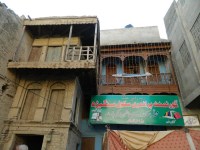 A Hindu temple in district Bannu, Khyber-Pakhtunkhwa, is now a well-known sweets shop. Meanwhile, the Holy Shiv Temple in Kohat has been converted into a government primary school.
Government Girls High School, Peshawar Cantt, now stands where a historical Hindu temple used to be; other historic temples such as the Asamai temple has been closed down in the K-P capital.
Meanwhile, Guru Duwara Gali, a Sikh religious place, has been converted into a garments shop in Abbottabad.
In the federal capital, Islamabad, the Raam Kunde Complex of Temples at SaidPur Model village is now a ‘picnic site’. A second temple at Rawal Dam, Islamabad, has been shut down and the Hindu community believes that it is going to dilapidate day by day without being handed over to them.
In Punjab, a Hindu temple was demolished and reconstructed as a community centre in Rawalpindi, while in Chakwal, ten famous temples collectively known as Bhuwan are being used by the local Muslim community for commercial purposes, despite being handed over to the Hindus.
“Even if we have control of the temples, local residents dump oil drums, utensils and animals around them,” complained Diyal.
 However, Religious Affairs Minister Sardar Yousaf assured that the Evacuee Trust has already been directed to gather the data pertaining to all religious places owned by minority communities. “At least, [all this] did not happen during our government’s tenure,” he said when he was informed of the survey’s findings. “I’ll take up this matter with minorities’ leaders. It’s a serious matter.”
A committee will be constituted to address these concerns, he routinely added. – The Express Tribune, 25 March 2014
» Zahid Gishkori is a reporter for the national desk of The Express Tribune in Islamabad who tweets @ZahidGishkori

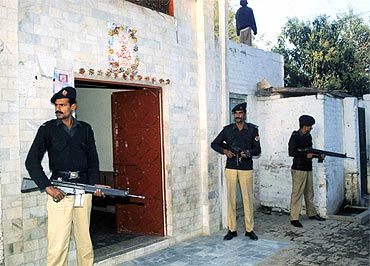
ABOVE: Hindu temple without signage or symbols in Saidpur, Pakistan. BELOW: Hindu temple burned down by Muslim bigots in Larkana, Pakistan.
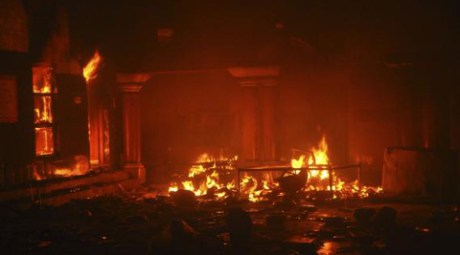

Hindu temple burned by bigots in Pakistan – PTI
March 29, 2014: A Hindu temple has been desecrated and set on fire by unidentified persons in Pakistan’s southern Sindh province, two weeks ahead of an annual fair at the holy site. The caretaker of the temple of Hindu deity Hanuman, in Latifabad town told police that three men came on Friday to offer prayers.
“But after offering prayers they first broke a statue of Hanuman and then sprayed kerosene oil and set it on fire,” said a police official. Darshan, the interim caretaker of the temple, said the attackers ran away when he called for help.
The miscreants had covered their faces, thus could not be identified, he added. The attack came weeks ahead of the April 14 fair organised at the temple every year. Around 500-600 scheduled caste Hindu families inhabit the locality the temple is situated in. They staged protests at several places in the city.
 The initial investigations suggest the attack is not related to any communal strife. The local Deputy Superintendent of Police and Station House Officer have been suspended and an FIR has been lodged against three unidentified attackers, said DIG Sanaullah Abbassi.
On March 15, a frenzied mob had set on fire a temple and a dharamshala [rest house] in Larkana over alleged desecration of a holy book, prompting authorities to impose a curfew in the area. Hindus are the largest minority in Pakistan, but make up only about two per cent of the country’s 180 million population.
Most Hindus live in Sindh province, where there have been several instances of alleged abduction and forced conversion of women from the minority community. – The Indian Express, 29 March 2014
Filed under: india | Tagged: All Pakistan Hindu Rights Movement, anti-hindu, dimmitude, hindu, hindu temples, hinduism, human rights, islam, islamic fundamentalism, islamic iconoclasm, minorities in pakistan, pakistan, pakistan hindus, psychological warfare, religion, sindh, sindh province, temple-breaking |




 BHARATA BHARATI
mr. srinivasan, hats off to you! till now, nobody dared to declare thus: ” the terms ‘election, people’s representatives, president, secularism etc.’ are meaningless” — you are quite right !
LikeLike
The solution to many of these ills is with the Hindus only; they must become strong and strong; the Dalits should be treated with dignity; in fact they must be honoured by the so called upper class people; does not mean reserve for them Government jobs and dilute the quality of Governance or education; all of them must be members of the RSS; the Hindus must have a King, who must be committed to Hinduism and to the welfare of the Hindus; the terms ‘election, people’s representatives, president, secularism etc.’ are meaningless; every body within the country and outside is freely using these terms only to keep the Hindus down and indirectly force the Hindus to shed off their customs and traditions and adopt what they offer!
LikeLike
Brief story of the only Hindu majority area in Pakistan: Tharparkar District, Sindh — World Hindu News — 27 March 2014
Tharparkar desert in Sindh is the largest desert of Pakistan and the eighteenth largest in the world with an area of 22,000 square kilometres. The population of Tharparkar is 1.5 million. This is the only district in Pakistan where more than 50 percent of the population are Hindus. The government has not conducted a proper census after 1998 although analysts say that the population of Hindus in this district is near 0.8 million. Out of this population more than 0.68 million are Dalits, who are more vulnerable than the Dalits of other districts. Tharparkar district is divided into four talukas, Nangarparkar, Chhachhro, Diplo and Mithi, with its headquarters in Mithi city. There are about 2,400 villages in district Tharparkar, which are highly populated with Dalit communities. The percentage of upper caste Hindus in this district is only 15 percent like that of Sindh overall. The land in Tharparkar is highly fertile but unfortunately most of it is desert, so that production of crops depends on rains during summer. Rains fall from mid-June to mid-August each year. For the last ten years there have been drought conditions in Tharparkar due to which 50 percent of the overall population migrated to barrage areas to find food, because during droughts it becomes hard for them to even find water to drink, leave alone for growing crops. Before this drought there have been problems of diseases in animals, first with peacocks and then with sheep — the majority of these animals died. Sheep is standard livestock for the Thari people and many were highly affected by disease in the district. As per reports in the media, more than 5,000 sheep died due to diseases in several areas of Tharparkar, which resulted in increases in the selling price of sheep. Most of the people of Tharparkar tried to escape to save their livestock but a few did not because they did not want to leave their lands.
During drought-like situations in Tharparkar, the majority of people in the agricultural workforce eat meals of red pepper or onion and sometimes rabri (a mixture of milk or curd and boiled grains). Their life is very simple; they are kind-hearted people and never think to harm others. During elections they don’t know who to vote for and usually cast their votes on the direction of their Mukhya (village chief). The literacy rate is low and most people who move during droughts to barrage areas find any labour they can. In this way the education of their children is neglected and because of a lack of money most children are pulled out of school after a few years anyway. In its last survey, the Pakistan Hindu Seva also found for some years now upper-caste Banyas and Pathans have begun a business of looting the poor farmers by providing them with loans of food against which they extract massive interest later when crops are harvested, in this way keeping the poorer people without food security. As a result of this and other poverty factors, many pregnant women do not get proper medical treatment and food so that their babies are born with abnormalities or susceptibility to diseases and early deaths. Another fact that several people in Tharparkar told the Pakistan Hindu Seva team was that in many villages people resorted to drinking saline water due to which hundreds of children, men and women face abdominal problems, while the colour of their teeth also becomes yellow from long use of this water.
Even though the drought in Thar has been ongoing for ten years, the government has not considered this issue serious and the problem has been growing each year. People of Tharparkar support the PPP because they remember the sacrifices of the Bhutto family but they nonetheless think that the reign of dictator Pervez Musharraf remained a golden time for them, when they were given paths to economic improvement. Many of them miss that time when they felt there was greater equality and no one was given superiority; their honour was safe and their lands and homes were safer. The current administration in Tharparkar under the PPP Sindh government, as members of Makhdoom families, have little idea about the life of Tharparkar and its people.
As per reports, more than 130 children have died due to malnutrition and disease in Tharparkar district. Soon after it was reported in the media that several NGO and government officials reached there to prevent further losses. Each year hundreds of social development programmes are initiated in Tharparkar with donations from international development groups but no programme is properly implemented and most become prey to corruption so that the issues of unemployment, lack of education, and health continue to grow. Tharparkar is considered the most backward area of Pakistan so that funds from international donors are in the millions of dollars. The government issues budgets for development, but it almost all goes to corrupt leaders and does not reach the affected people. But it is heartening to note that the deaths of dozens of innocent children have opened the eyes of the Pakistani public and large amounts of support from private aid organisations and the public, both through Islamic charities and others, have been coming in, without any hint of discrimination.
Speaking about Thar most people there told the Pakistan Hindu Seva that they are not beggars and that if they find employment, the Tharparkar district government and the Sindh government won’t need to help them during drought periods as they would be able to handle it themselves.
However the major problem is finding employment even though they are very hardworking people. Making smaller dams to stop water wastage during rain can also stop the need for migration and prevent drought in Tharparkar. The government and other development organisations must create economic resources for the people of the area to find proper employment and create economic possibilities for them to assist them in leading a formal and permanent life in Tharparkar, so they can educate their children and grow. Then they can make Tharparkar the peaceful, heavenly place it has the potential to become.
LikeLike