







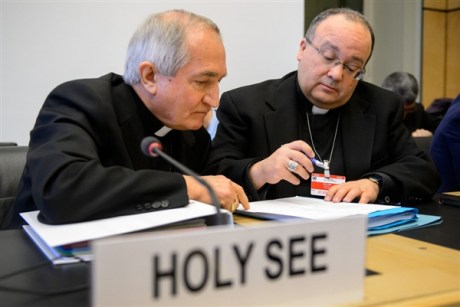
 The Vatican has come under blistering criticism from a UN committee for its handling of the global priest sex abuse scandal, facing its most intense public grilling ever over allegations that it protected paedophile priests at the expense of victims.
Monsignor Charles Scicluna, the Vatican’s former sex crimes prosecutor, acknowledged that the Holy See had been slow to face the crisis but said that it was now committed to doing so. He encouraged prosecutors to take action against anyone who obstructs justice—a suggestion that bishops who moved priests from diocese to diocese should be held accountable.
 “The Holy See gets it,” Msgr Scicluna told the committee. “Let’s not say too late or not. But there are certain things that need to be done differently.”
He was responding to a grilling by the UN committee over the Holy See’s failure to abide by terms of a treaty that calls for signatories to take all appropriate measures to keep children from harm. Critics allege the church enabled the rape of thousands of children by protecting paedophile priests to defend its reputation.
The committee’s main human rights investigator, Sara Oviedo, was particularly tough, pressing the Vatican on the frequent ways abusive priests were transferred rather than turned in to police. Given the church’s “zero tolerance” policy, she asked, why were there “efforts to cover up and obscure these types of cases”.
Another committee member, Maria Rita Parsi, an Italian psychologist and psychotherapist, pressed further: “If these events continue to be hidden and covered up, to what extent will children be affected?”
The Holy See ratified the convention in 1990 and submitted a first implementation report in 1994. But it didn’t provide progress reports for nearly two decades. It only submitted one in 2012 after coming under criticism following the 2010 explosion of child sex abuse cases in Europe and beyond.
Victims groups and human rights organisations teamed up to press the UN committee to challenge the Holy See on its abuse record, providing written testimony from victims and evidence outlining the global scale of the problem.
Their reports cite case studies in Mexico and Britain, grand jury investigations in the US, and government fact-finding inquiries from Canada to Ireland to Australia that detail how the Vatican’s policies, its culture of secrecy and fear of scandal contributed to the problem.
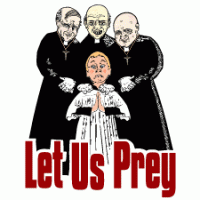 The Holy See has long insisted that it wasn’t responsible for the crimes of priests committed around the world, saying priests aren’t employees of the Vatican but are rather citizens of countries where they live and subject to local law enforcement. It has maintained that bishops were responsible for the priests in their care, not the pope.
But victims groups and human rights organisations provided the committee with the Vatican’s own documentation showing how it discouraged bishops from reporting abusers to police.
Committee member Jorge Cardona Llorens, a Spanish international law professor, demanded to know how the Vatican would create “specific criteria” for putting children’s interests first, because there weren’t any yet in place.
Msgr Scicluna said the Holy See wanted to be a model for how to protect children and care for victims.
“I think the international community looks up to the Holy See for such guidance. But it’s not only words, it has to be commitment on the ground.”
He added: “The states who are cognizant of obstruction of justice need to take action against citizens of their countries who obstruct justice.” Msgr Scicluna, a Maltese bishop, has previously said bishops who failed to do the right thing with paedophile priests must be held accountable.
“I think it’s time for the church to stop this secrecy,” Teodoro Pulvirenti, who said he was abused by a priest, told The Associated Press in New York. “I believe the church puts too much its reputation before the victims and you know the pain of this abuse that we carry. That’s why I was so excited when I heard about this final meeting between the Vatican representatives and the UN.” – MSN News, 16 January 2014

Benedict XVI defrocked nearly 400 priests in two years – BBC News
Close to 400 priests were defrocked in only two years by the former Pope Benedict XVI over claims of child abuse, the Vatican has confirmed.
The statistics for 2011 and 2012 show a dramatic increase compared with previous years, according to a document obtained by the Associated Press (AP).
The file was part of Vatican data collected for a UN hearing on January 16, 2014.
It was the first time the Holy See was publicly confronted over the sexual abuse of children by clergy.
Church officials at the hearing in Geneva faced a barrage of hard questions covering why they were withholding data and what they were doing to prevent future abuse.
 Victims’ advocates complained there was still too little transparency.
Vatican spokesman Federico Lombardi initially said the AP report had been based on a mistaken reading of data.
But he later retracted his statement, confirming to the BBC that the story was correct.
The latest statistics reveal the number of priests defrocked in 2011 and 2012 was more than double the 171 priests removed in 2008 and 2009, when the Vatican first provided figures.
The Vatican also sent another 400 cases to either be tried by a Church tribunal or to be dealt with administratively, AP reports.
Benedict, who was elected in 2005, took the helm as the scandal of child sex abuse by priests was breaking.
The Vatican initially rejected the report, but later confirmed the figures
The flood of allegations, lawsuits and official reports into clerical abuse reached a peak in 2009 and 2010, which observers say may explain the spike shown in the document.
 The Holy See is a signatory to the UN Convention on the Rights of the Child, a legally binding instrument which commits it to protecting and nurturing the most vulnerable in society.
It ratified the convention in 1990 but after an implementation report in 1994 it did not submit any progress reports until 2012, following revelations of child sex abuse in Europe and beyond.
 Last month, the Vatican refused a request from the UN’s Committee on the Rights of the Child for data on abuse, on the grounds that it only released such information if requested to do so by another country as part of legal proceedings.
In a homily on Thursday, Benedict’s successor, Pope Francis, called abuse scandals “the shame of the Church”.
He announced in December that a Vatican committee would be set up to fight sexual abuse of children in the Church. – BBC News, 18 January 2014
Filed under: india | Tagged: benedict xvi, child rape, child sex abuse, christianity, paedophile priests, pope, rape, religion, roman catholic church, roman catholic priest, sex scandal, UNICEF, vatican, vatican sex scandal |







 BHARATA BHARATI
Chicago archdiocese hid decades of child sex abuse – The Washington Post – Associated Press – January 21, 2014
CHICAGO — After a 13-year-old boy reported in 1979 that a priest raped and threatened him at gunpoint to keep quiet, the Archdiocese of Chicago assured the boy’s parents that, although the cleric avoided prosecution, he would receive treatment and have no further contact with minors.
But the Rev. William Cloutier, who already had been accused of molesting other children, was returned to ministry a year later and went on to abuse again before he resigned in 1993, two years after the boy’s parents filed a lawsuit. Officials took no action against Cloutier over his earliest transgressions because he “sounded repentant,” according to internal archdiocese documents released Tuesday that show how the archdiocese tried to contain a mounting scandal over child sexual abuse.
For decades, those at the highest levels of the nation’s third-largest archdiocese moved accused priests from parish to parish while hiding the clerics’ histories from the public. The documents, released through settlements between attorneys for the archdiocese and victims, describe how the late Cardinals John Cody and Cardinal Joseph Bernardin often approved the reassignments. The archdiocese removed some priests from ministry, but often years or decades after the clergy were known to have molested children.
While disturbing stories of clergy sexual abuse have wrenched the Roman Catholic Church across the globe, the newly released documents offer the broadest look yet into how one of its largest and most prominent American dioceses responded to the scandal.
The documents, posted online Tuesday, cover only 30 of the at least 65 clergy for whom the archdiocese says it has substantiated claims of child abuse. Vatican documents related to the 30 cases were not included, under the negotiated terms of the disclosure.
The records also didn’t include the files of former priest Daniel McCormack, who pleaded guilty in 2007 to abusing five children and whose case prompted an apology from George and an internal investigation of how the archdiocese responds to abuse claims.
But the more than 6,000 pages include internal communications between church officials, disturbing testimony about specific abuses, meeting schedules where allegations were discussed, and letters from anguished parishioners. The names of victims, and details considered private under mental health laws were redacted.
Cardinal Francis George said in a letter distributed to parishes last week that the archdiocese agreed to turn over the records in an attempt to help the victims heal. “I apologize to all those who have been harmed by these crimes and this scandal,” George wrote.
Officials in the archdiocese said most of the abuse detailed in the files released Tuesday occurred before 1988, none after 1996, and that all these cases ultimately were reported to authorities.
But victims’ lawyers argue many of the allegations surfaced after George assumed control of the archdiocese in 1997, and some of the documents relate to how the church handled the cases more recently.
“The issue is not when the abuse happened; the issue is what they did once it was reported,” said Chicago attorney Marc Pearlman, who has represented about 200 victims of clergy abuse in the Chicago area.
When a young woman reported in 1970 that she’d been abused as a teen, for example, Cody assured the priest that the “whole matter has been forgotten” because “no good can come of trying to prove or disprove the allegations.”
Accused priests often were quietly sent away for a time for treatment or training programs, the documents show. When the accused clerics returned, officials often assigned them to new parishes and asked other priests to monitor them around children.
In one 1989 letter to Bernardin, the vicar for priests worries about parishioners discovering the record of the Rev. Vincent E. McCaffrey, who was moved four times because of abuse allegations.
“Unfortunately, one of the key parishioners … received an anonymous phone call which made reference by name to Vince and alleged misconduct on his part with young boys,” wrote vicar for priests, the Rev. Raymond Goedert. “We all agreed that the best thing would be for Vince to move. We don’t know if the anonymous caller will strike again.”
When the archdiocese tried to force accused clergy into treatment or isolate them at church retreats, some of the priests refused, or ignored orders by church administrators to stay away from children.
Church officials worried about losing parishioners and “potential priests” over abuse scandals. “This question I believe is going to get stickier and stickier,” Patrick O’Malley, then-vicar for priests, wrote in a 1992 letter.
Then, in 2002, a national scandal about dioceses’ failures to stop abusers consumed the American church. U.S. bishops nationwide adopted a toughened disciplinary policy and pledged to remove all guilty priests from church jobs in their dioceses.
But for many victims, it was too little and too late.
“Where was the church for the victims of this sick, demented, twisted pedophile?” one man wrote in a 2002 letter to George about abuse at the hands of the Rev. Norbert Maday, who was imprisoned in Wisconsin after a 1994 conviction for molesting two boys. “Why wasn’t the church looking out for us? We were children, for God’s sake.”
Associated Press reporters Jason Keyser, Don Babwin and Michael Tarm contributed.
LikeLike
Pope Benny defrocked 400 child-raping priests during his tenor. But there are another 4000+ waiting in the wings to have their ‘frocks’ removed for the same crime! And the Catholic Church in India has not yet even admitted that there is a problem—never mind addressing it! When priest-abused children in India begin to tell their stories—and bring lawsuits—not even the pro-Catholic government in Dilli will be able to save the Church.
LikeLike