









“Individually, many of the Hindu traditions lack the means and expertise to stand up on their own against the might of the West. Hence, there is a need for a collective front to engage with the West. However, we do not have to whitewash our differences to put up a unified face in front of other religions. So, it is important to develop a terminology that respects and represents the diverse philosophical streams that make up Hinduism.” – Srinivas Sudhindra
Amidst the globalization of diverse philosophies, Hindus are trying to establish a unique place for themselves. This requires a unique terminology that explains Hinduism, not in a Western framework but on its own terms. Some of our leaders are attempting such a representation of Hinduism, but the ground beneath them is shaky. Their efforts invite ridicule, as they have chosen a terminology which discounts or entirely disregards major streams of Hindu thought. Thus, individual streams of Hinduism are ignoring or just talking at each other. For unity to succeed, leaders must use a terminology that is inclusive and respectful of the diverse branches that make up the tree of Hinduism.
In current definitions of Hinduism, the dominant terminology is that of Advaita, as defined by Shankara’s Mayavada: “brahma satyam, jagat mithya, jivo brahmaiva na parah” (loosely translated as “God alone is real, the world is illusory, the individual is none other than God”). This has become part of the de facto popular definition of the Hindu worldview. Wikipedia says, “It is the Smarta view that dominates the view of Hinduism in the West as Smarta belief includes Advaita belief and the first Hindu saint who significantly brought Hinduism to the West was Swami Vivekananda, an adherent of Advaita.”
Swami Vivekananda was one of the earliest to try to project Hinduism as a unified and consistent philosophy. At the Ethical Society, Brooklyn, New York, 1894, he said, “We believe in a God, the Father of the universe, infinite and omnipotent. But if our soul at last becomes perfect, it also must become infinite. But there is no room for two infinite unconditional beings, and hence we believe in a Personal God, and we ourselves are He.”
Swami Vivekananda was selling Advaita not as Advaita but as Hinduism. He mostly ignores the other diverse Hindu streams, such as the Vaishnavite, Saivite and Shakta sampradayas. In truth, many Hindu traditions are vehemently opposed to Shankara’s concepts of Mayavada and identity of the individual with Brahman. Each stream of Hinduism has its own unique, rich traditions (some much older than Shankara) and a right to stand on its own. Advocate Shankara’s Advaita all you want, but do not reduce the term “Hinduism” to mean just his form of Advaita. Shankara’s Advaita alone does not hold the copyright over the term Hinduism.
However, in influential circles, it is the Advaitins who hold most positions of power. Consider the recent “Hindu Good News” initiative, which claims to speak on behalf of all Hindus. “And we, every one of us, are endowed with the same potential as Jesus, to uncover this divinity within ourselves in the here and now—without the need for someone else’s past sacrifice.” This again endorses the “jivo brahmaiva na parah” view of Advaita in a subtle and indirect way. The words “same potential” here is not agreeable to other Hindu traditions. It ignores the Vedic hierarchy of beings, the distinction between and among devatas, rishis and manavas, etc. The intent which got lost in translation is that the nature of one’s Atman is the same as everyone else’s, i.e., Sat, Chit and Ananda. But while Hindus agree on the nature of Self, traditions differ on whether or not every individual has the same potential for moksha.
When the non-Advaita traditions enter into a conversation about Hinduism, they are forced to do one of the following: i) ignore their own beliefs, i.e., multiplicity of Atman or the reality of the material world; engage in incoherent conversations where the speaker and audience have a different understanding of the terminology used; declare that they do not belong to Hinduism! Their attempt to communicate their beliefs is doomed to failure. They are marginalized and forgotten in the mainstream debate comparing Hinduism with other religions.
Individually, many of the Hindu traditions lack the means and expertise to stand up on their own against the might of the West. Hence, there is a need for a collective front to engage with the West. However, we do not have to whitewash our differences to put up a unified face in front of other religions. So, it is important to develop a terminology that respects and represents the diverse philosophical streams that make up Hinduism.
To develop such a terminology, scholar and writer Rajiv Malhotra suggests that we avoid terms that have differences within a homogeneous group (in this case, Hinduism) and select terms that point to differences between heterogeneous groups (i.e., Western religions). Based on such criteria, the terminology for Hinduism might better include/exclude the following.
Not Maya but Ajnana: Avoid using terms like maya but talk about ajnana (ignorance) being the condition of Atman/Jiva in this world. This concept is mostly interpreted the same by all Hindus and also differs from the Abrahamic concept of humans as sinners.
Not Unity but Sat-Chit-Ananda: Avoid phrases like “Unity of Brahman with Atman” to explain Moksha, a concept with varying interpretations. Instead, talk about the nature of a liberated Atman as Sat, Chit and Ananda, something we all agree on.
Not Advaita but Antaryamin: Avoid using concepts like “Single/Multiple Atman” (a contentious subject among Hindus). Instead, speak of the Antaryamin nature of God, as the omnipresent Divine Indweller of every being, to contrast our faith with Abrahamic religions where God is in Heaven and not within the Soul, i.e., not omnipresent.
Not Mithya but Yuga Chakra: Avoid phrases like “The world is mithya/illusion,” which is specific to Shankara’s philosophy. Talk instead about our common, accepted view of the cyclic nature of the world, creation, maintenance, destruction, in contrast to the Abrahamic concept of linear time with emphasis on just the creation aspect.
Such a change in approach can serve two purposes: It can unite Hindus and at the same time provide a platform to critique the West. Developing an inclusive language for Hinduism is a must, before entering into a dialogue with the West. The language of Hinduism must reflect the ethos on which it is built, i.e., unity in diversity. – Hinduism Today, October/November/December 2013
› Srinivas Sudhindra is a software engineer in Bengaluru.
Filed under: india | Tagged: hindu sampradayas, hinduism, philosophy, sanatana dharma, unity in diversity |






Well said.
LikeLike
I follow your posts on many forums. Your understanding of problems amazes me. Wish I could have your email. I can be reached at muralichrome@gmail.com
LikeLike
The Bharata Bharati editor titled this article, changing it from HT’s “How Can Hindus Unite?” to “How Hindus can unite”.
There is no reason to take offence at the HT sub-title. As there are different Advaita Vedanta expositions, there is also Adi Shankara’s—or the Shankaran—exposition.
The Advaitic terminology used in today’s Hindu discourse has been popularised by all the mahatma’s who have gone abroad since Vivekananda’s and Ram Tirtha’s time. The terminology is liberal and non-sectarian, so it is attractive to foreigners. Those who object to it are usually sectarian Vaishnavite schools. ISKCON, a self-declared non-Hindu cult, also objects to Advaitic terminology, as indeed do the sectarian Shaiva Siddhantins of Hawaii and Tamil Nadu.
In public discourse that includes various Hindu sampradayas, a liberal, generic Hindu terminology that all parties understand is required. So far only Shankara’s Advaita has been able to supply this terminology (with some limitations).
Srinivas Sudhindra makes a very good point and Hindus of all persuasions should consider finding and using a more universal and inclusive terminology in their discourse.
LikeLike
Shankaran Advaita. That is what the subheading says in Hinduism Today.
That is the phrase that first caught my eye. Shankaran Advaita. The form of the adjective immediately grated on my sensibility. Shankaran? Adi Shankaracharya made adjectival as Shankaran? There was a flippancy, nay, an air of disrespect that offended the eye.
I do not know if it was the sub-editor amongst the monks of Kauai who chose the article’s subhead (“The common language of Hinduism must depart from the dominance of Shankaran Advaita”) as it does not repeat in the Bharata Bharati post of Sudhindra Srinivas.
Be that as it may, reading through the article I found more reasons why the article might have been titled “How Hindus can disunite” rather than the way the title has been set.
I rather like R. Nanjappa’s call to practical action in contradistinction to the tendency for philosophical debate. But action without ideas (if you do not want to call it philosophy) is as unsettling as ideas without action.
The solution perhaps lies in resisting the itch to rush to the press (or the Internet !) before, at least, 20 years of contemplation on the ideas of Sanatana Dharma.
I recommend a keen ear into the flowing and superlatively distilled essence of Shri Vellukudi Krishnan Swamy’s Tamil-Sanskrit exposition of the distinction between Advaita, Visishta Advaita and Dvaita darshanas where each is the first among equals…
LikeLike
I am an ordinary Hindu. I believe in both worship-Saakaar and Nirakar.
LikeLike
You appear to be Arya Samaj? But you are promoting polytheism. How can that be?
LikeLike
On the issue, I want to suggest an article “Difference between polytheism and monotheism” written on chakranews.com and “How to organise Hindu” on Hinduministry.wordpress.com
LikeLike
Mr Shaastra Sevaka, (or is it Mr Sachin Dave?)
Rebuttal? The article and the comment refer to 2 different things. I haven’t got a single feedback on the main thrust of the article i.e. developing a common vocabulary. Instead its all bruised egos on the idea of not equating Advaita to Hinduism.
If Advaita is not summarised by “brahma satyam, jagat mithya, jivo brahmaiva na parah” then may be you should talk to experts from Advaita Mutts to counter it.
Yes the article derives on Mr Malhotra’s seminal work and I acknowledge it in the article. It is precisely pointing to problems with additional vocabulary and explanations being developed on the basis of a common terminology and the need to include non-Advaita ideas into a “Hinduism” vocabulary.
LikeLike
Mr. Srinivas, your unnecessarily rash response to a respectful rebuttal of your article is not keeping with the traditions of sanAtana dharma.
Mr. Nanjappa has only sought clarifications from you about your equation of advaita = mAyAvAda. By not responding to his respectful request and throwing a few more questions, you show the same disrespect and dismissiveness that you are attributing to your intellectual opponents. I don’t know how far you will be able to unite Hindus with this sort of approach.
All that we Hindus request of you, Mr. Srinivas, is to kindly read the original sources and base your arguments on them. In case you are not competent enough (as is almost amply clear from your original article and the response to Mr. Nanjappa), please accept the fact and save us from another saviour (you). Anyone who wants to do even an iota of work for the “unification” of Hindu society will do well to have a great amount of patience and humility, not cocksureness based on borrowed wisdom (that of Mr. Malhotra).
LikeLike
In order to achieve the unity you describe, Hindus must unite politically, i.e. they must vote in a block for a leader and government that will do the fundamental things—rightly listed by you—Hindus want done in India. Hindus have not had their own leader since Independence.
Hindus have never been doctrinally or philosophically united and it has never been demanded culturally (though different sects have quarrelled over doctrine).
But lets not forget that Srinivas Sudhindra is making a very specific point about vocabulary when discussing Hinduism generally, and there is no doubt that a commonly accepted religious terminology would be useful in uniting Hindus politically.
LikeLike
I am afraid we are straying from the idea of Hindu Unity. We can never unite on the basis of philosophy- any philosophy. Let me propose a different approach.
I. Many thinkers have thought of world unity- but mainly on the basis of political, religious or some other ideology.. All of them only ended up dividing the world further.
In the meantime, the space missions revealed to the people in a dramatic way how they are already bound together-occupying the small SPACESHIP EARTH IN A VAST, BOUNDLESS UNIVERSE. The communications revolution further made them realise that the world is but a global village. Various political, religious and other ideologies still contend for peoples’ mind and heart, but all thinking people know in the heart of their hearts that humanity is bound together in spite of every thing. Unity need not express itself as external uniformity.
I there fore propose that it is only necessary for Hindus to realise their global position.- how precarious it is, to make them unite.
There are about 2 billion Christians living in some 200 countries. They form the majority in 126, and are minorities in 71.
The 1.57 billion Muslims live in about 230 countries. They have overwhelming majority in 50. 2/3 of them live in some 10 countries. The majority of them live in Asia- NOT THE MIDDLE EAST. Muslim population in India is the third largest in the world.
About i billion Hindus form the fourth largest religious group in the world but 95% of them live in India.They formed substantial portion in Pakistan and Bangladesh,which were carved out of India, but have been decimated there.
BUT INDIA IS NOT A HINDU COUNTRY- IT IS OFFICIALLY SECULAR. There is in fact no Hindu country in the world today- the last of them Nepal having been declared Secular, So, I billion Hindus are really stateless persons- they are mere residents in India legally. They cannot call any country .their own ie Hindu.
If we draw a picture of the world, and mark the countries where the different religions/faiths are practiced in different colours, we will realise with a shock how small India is and how strongly surrounded by other faiths- Christianity, Islam, Buddhism, Chinese.
IF THIS FACT ALONE CANNOT UNITE THE HINDUS, EVEN GOD CANNOT.
II. Hindus are apologetic about the so called divisions among them. And they blame their philosophies or some other thing for this. This is absolutely uncalled for.
1. Every religion in the world is divided into numerous divisions- Christianity, Islam or Buddhism. It is only Hindus who think of them as monoliths. The divisions among them and internal animosity are far worse than among the Hindus. Only, they are all united in one thing- converting others. ( Buddhists excluded). For that matter, even political parties have groups within them. So,this is a non-issue, so long as we don’t come to blows.
2. Hardly 5% of the people know or bother about the philosophies. This is a pastime of the arm-chair elite and this does not affect the common people- the vast majority.
And this leads to my next proposition.
III. All those who call themselves Hindus tacitly follow the following IN PRACTICE.
– Belief in the Veda( which includes the Upanishads) which is NON-SECTARIAN.
– Belief in Brahman as the Ultimate Principle of the Universe
– Identitiy between Brahman-Atman, how so ever it is conceived
– Belief that the world- samsara- is transitory and has to be transcended. ( Even those who hold the philosophical position that the world is Real concede that the world has to be transcended!- so the dispute about the Reality about the world is meaningless for religious practice)
– belief in Karma and rebirth
– Belief in Avatara
-Belief in Adhikaribheda
– Belief in Varnasrama dharma
– Belief that women have a distinct role as Sahadharmini and so are different from, but not inferior to, men – what is called Stree dharma
– Belief in temple worship and murti puja.
Note:
1,In the modern era, many reformers and reformed groups have arisen, interfering with one or the other of these factors. But they are on the fringes, unless backed by political power. But even then the result is curious. eg. the govt. wants to abolish castes ( which in any case are different from varna) but identify castes as backward and extend concessions to them, adding to the number of such castes all the time and thus perpetuating it. Even Muslims and Christians in India follow caste- which is well documented and they too want reservation. The core of the practices continue.
2. Due to spread of education and employment among women and ideas like women’s lib ( or post that stage) , stree dharma is naturally dying. But no Hindu group will acknowledge it openly- else we will not persist with Hindu marriage rites! Registered marriage would do.
3. All may not agree on all the elements. Most will not even be aware of them unless they reflect.
So when the bottle is so full, why should our people continue to see only the perceived empty portion- like philosophical diversity? No philosophy ever united a people anywhere in the world at any time in history. Every philosophy has only undergone more and more divisions..Preoccupation with philosophy is just a mental illness.So, chuck the philosophies and seek unity in practice. This is what we already do. When thousands sit and listen to a Morari Bapu for over 3 hours day after day, in sun, rain or cold, is it philosophy at work? Are we not already united? Only, we do not know how to convert that unity into practical action.
This is mainly because we have been trained after Independence to be diffident about calling ourselves Hindus openly and acting on that basis. Our people do not have a clear idea of the true nature or the historical role of the two religions that pose organised threat to us-Islam and Christianity.. Our leaders , Gandhi downwards, who themselves did not understand them, interpreted them according to their own fancy, based on some cliche like’ all religions are true’. Some self-styled modern gurus and outfits, with world wide ambitions, also joined in. This is the image that is carried by most Hindus.This is the real danger. Like Sankara’s Maya, it veils what is true, and projects what is not true. We have to get rid of this.
IV. I propose the following for practical action:
1. Hindus have to get India declared as a Hindu country- at least HINDU SECULAR. Hindus have always been historically secular. We don’t need any one’s certificate. To talk of Hindu unity without a country to call our own is sheer nonsense. Even the Jews who are just 28 million got one.
2. WE must build Ram Temple at Apdhya. Muslims own records. ASI and Allahabad High Court have all recognised the existence of a former temple there. We should not engage in vain disputes with non believers as to whether Rama was a historical figure. Who has ever proved that Christ was a historical figure? But what has it to with practical Christianity?
3. We must recover Kashi and Mathura fully.
4. We must recover Hindu temples from govt. control and looting.
5 We must restore to the Pandits their ancestral homes in Kashmir and end the special status of Kashmir which is a stamp of imbecility on the Hindus
There are other areas like countering the anti-Hindu stance of.the English media, arresting the official atttempts at falsification of history. ensuring ban on cow slaughter, enforcing common civil code or freeing Hindu law from govt. control and interference, safeguarding the interests of Hindu minorities in other countries, effective handling of Islamic terrorism, stopping the infiltration of muslim refugees into India, recognising and deepening our eternal bonds with our Sikh brethren, restoring the national element in our education system etc. All these require serious thinking and sustained action.
If these things will not unite the Hindus and keep them united, I do not know what will, ever.
Let us leave philosophy to the idlers and concentrate on what can be done on the basis of the common areas we already have.
Our leaders (politicians) cheated the Hindus during the struggle for Independence. Thereafter, they kept the Hindus divided by political devices like caste-based reservation, linguistic division of the country, etc. Politicians of all hues and affiliations are weathercocks and betray principles for power. Let us be wary of them and develop independent leadership. Recently, Lord Krishna united all the even self declared secular politicians when Russia attempted to ban the Gita.. Let us hope the same spirit and power will enter all our people and activate them. Chuck the philosophies, and promote the unity which is already there..
LikeLike
Thank you again, Sri Srinivas. Of course, you are entitled to have your opinion. But it will be equally preposterous to conclude that no one else is entitled to have his own, or that every body else should simply fall in line. Since, the discussion is traveling off the path, I think our engagement will hardly yield any result. Excuse me. Regards.
LikeLike
It would be preposterous of us to be kind or polite to SV. He would not have wanted it this way either! If we as Hindus dont fight it out with a common understanding, our fight is going to fizzle out and end in internal contradictions, much like what is happening today. SV was successful because he had a strong underlying worldview that he advocated. No movement is going to succeed without a good foundation.
LikeLike
Thank you again! For us, the Hindus, unity is a compulsion and polemics are an option. Unity is not a deal. We need not agree first to a set of terms and conditions before we collaborate. I believe nothing should prevent us to be a little kind / polite to the Sanyasin.
LikeLike
Thank you. Still Swami Vivekananda needs pleading, and a good lot of it in defense of his worth in modern India!
LikeLike
Yes, of course there were good parts. He was a great man and a great nationalist who could motivate the masses. But like many great men he carried within him contradictions and he was also a man of his times, overly impressed with and influenced by Christianity and the British. His mistakes have to be openly acknowledged so that they can be corrected. This should not in any way be understood as demeaning to his legacy.
LikeLike
Polemics to some could be a pastime and intellectually could even bewildering! But to say: “The author very rightly points out that Vivekananda taught his bastardised version of Advaita Vedanta as representing the whole of Hinduism, not just a school within Hinduism”, is something that flies over the heads of ignorant people like me if not impolite! If important discussions like this could be written in a manner easier to understand, the people would certainly benefit.
LikeLike
Agreed. But there are good parts in what he did too. The idea and the bravery of a Sanyasi standing up for motherland. His ideas on confluence of science and Indian philosophy. Approaches on how he defended Hinduism against Christianity. That he did this by conflating Advaita with Hinduism is sad. We need to identify the good parts and improve upon the mistakes.
LikeLike
Thank you very much for your responses, Srinivas.
I agree with you that a neutral terminology is needed when discussing Hinduism.
Vivekananda’s non-discriminating Neo-Vedantic universalism and the terminology that goes with it has not served the Hindu interest. It has left Hindus wide open to exploitation and abuse by their Christian interlocutors—who now quote Vivekananda back to them!
Lets not forget that it was Vivekananda who invited Christian missionaries into every Indian village. That was his Neo-Vedanta in action. We now have the missionaries and do not know how to get rid of them—though they are destroying the very culture that gave them life in the first place.
Karl Popper said “If we extend unlimited tolerance even to those who are intolerant, if we are not prepared to defend a tolerant society against the onslaught of the intolerant, then the tolerant will be destroyed, and tolerance with them.”
Neo-Vedanta has extended unlimited tolerance to the intolerant and left the tolerant with no defence. That is why we don’t need it. But unfortunately Neo-Vedanta is what the world knows best about Hindu thinking, and this is what has to change.
LikeLike
Just to clarify a slight nuance here: Advaita like all living traditions has the right to evolve and be legitimate. If Neo-Advaita is on offshoot of it, so be it. The issue here is not whether Vivekananda’s Advaita is a legitimate one or not. That is for authentic Advaitins and Mutts to own up or leave. Either ways, they cannot claim sole copyright over the term Hinduism.
LikeLike
In an ideal world, yes. Various Dharma streams today are not in that place. If you don’t think that we as Hindus have a need to come together given today’s situation, then this article is not for your worldview. But if you do, what would be the terms and conditions under which we can collaborate? That is the premise of this article.
LikeLike
To counter this attitude is precisely why I wrote this article. An Advaitin and a Tatvavadin can argue till the sun sets forever. That is not the point of this article. Are you, as an advaitin, ready to show mutual respect to other streams of Hinduism? If you do, what language should you use to prove that respect? If Hinduism as thought of in the popular culture today excludes non-Advaita streams, why should they identify themselves as Hindus? Arent you condescending when you say that Advaita just includes all other Hindu streams in a big umbrella? You are just ignoring and disrespecting countless Hindus who follow different streams in opposition to Advaita.
Forget me reading direct sources of Shankara, if you even put in a tenth of the effort to read even a derived source of Bhaskara, Ramanuja, Madhva, Chaitanya, etc. you would not be so dismissive of the worldviews put forward by these great thinkers.
We have our differences and the same can be fought in a different platform. Given the challenges that Hinduism faces today, there is also a need for a common platform for Hindus to come together and put up a unified front. Put yourself in a non-Advaitin’s shoes and ask if you would like to work with a person with the above attitude towards fellow Hindus. What can you ‘give and take’ to achieve a common goal? Or is it just ‘my way or the highway’?
LikeLike
Yes sir, I agree we can be satisfied with ‘Hinduism’ as the practical or working name.
LikeLike
Thank you for this. You have demonstrated exactly why Advaita Vedanta should not have been simplified and popularised in the West by Vivekananda in the first place.
To say “Our religion is not Hinduism – it is Sanatana Dharma” is being pedantic. It does not contribute to the desire for unity among Hindus, who today require a universally accepted name for their religion. “Hinduism” is recognised everywhere and is used by everybody, so why quibble about it (as so many Hindus like to do).
From where does the term “Sanatana Dharma” originate? What Veda does it appear in as a designator for Vedic religion? I am told it doesn’t appear in any Veda. So how and where did it come to be accepted as the “true” designator for Vedic religion?
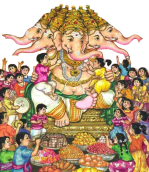
Yes, the banyan tree image was wrongly captioned. The editor was not applying his mind. The caption has now been corrected.
LikeLike
It is good that youngsters are getting interested in the subject. Sri Sudhindra starts on the right note but harps on the wrong points, based on incomplete understanding.
1. First , let us get one thing straight. The image of the banyan tree is apt but it does NOT represent unity in diversity but diverse expression of the unity; the tree with all its parts is an organic whole. It provides for unending expansion.
2. Our religion is not Hinduism – it is Sanatana Dharma. Its philosophical base is Vedanta- which includes every system of philosophy. Why search for a new name then-except for a novelty?
3. Sri Sudhindra seems to be allergic to Advaita. Sankara was not the author, originator or initiator of Advaita.; he was only the first philosopher to present a systematic framework for Vedanta based on prastanatraya..Nor is Sankara’s system the only expression or form of Advaita.
4. Sankara’s is NOT MAYAVADA. You can call someone Mayavadin if he holds that maya is the ultimate truth. Sankara holds that Brahman alone is the ultimate truth. Is he a BRAHMAVADIN or mayavadin then? To call Sankara’s system mayavada is intentional or uninformed misuse of language. I challenge Sri Sudhindra to quote one sentence directly from Sankara’s works to show that he held up maya as the ultimate truth – in which case alone it can be called mayavada.
5. Most people writing on the subject do not go to the original works of Sankara, but rely on secondary sources. These sources quote passages according to their convenience or design and then comment on them. They never quote Sankara fully on any topic. Sri Sankara’s views lie scattered in his comments on prastanatraya and it takes some reading – provided we know Sanskrit. Recently, Sudhakshina Rangaswami has come up with an admirable and comprehensive selection from Sankara’s own writings based on standard English translations. (‘Roots of Vedanta’, Penguin, 2012). This is a convenient place to start knowing what exactly did Sankara say or mean.
6.The antagonism perceived between Sankara’s Advaita and other systems is the work of arm chair academics – Foreign and their Indian imitators/followers. The truth perceived by real savants is entirely different. To quote but one such source: “The conceptions of Ramanuja are contained in those of Shankara and are transcended by them…..Ramanuja affirms against Shankaracharya truths which the latter never denied on their own level……The perspective of Shankara goes beyond that of Ramanuja, not merely in respect of its form, but in respect of its very basis.” (Frithjof Schuon: LANGUAGE OF THE SELF,1998, p.27-28)
To quote again: “The insights of the Upanishadic sages embody monistic, pluralistic and theistic strands which have given rise to the differing philosophical views of the Reality. Sankara’s ingenuity lay in subsuming them all within the framework of Advaita by adopting a philosophy of standpoints. So, plurality is real from the empirical standpoint while, at the transcendental level, the Reality is non-dual.” (Sudhakshina Rangaswami. op cit p.16)
So all those who imagine that Sankara denied or opposed other systems are searching for a black cat in a dark room which is not there.
7. Sankara’s system is admired not because it has been vigorously propagated with missionary zeal but all serious thinkers know that there cannot be two infinities. And it is the one which accords well with the spirit of modern science, which searches for unity as the basis of existence. Has not modern physics come up with some such vision in its search for the ultimate nature of matter? Did not Einstein seek a Unified Field Theory all his life?
8. The tension between Advaita and other systems at a theoretical level is because Sankara’s Advaita is pure philosophy, while all other systems are basically theologies which masquerade in philosophical attire.. Sankara’s system can support any theology.
But this tension is resolved immediately we come to practice. Advaita cannot be practiced as such – it is but the overall attitude, and is the end where all practice culminates in experience. We all start with the obvious experience of an outside world.ie dwaita. it is in trying to understand this that we transcend it in practice. Thus there is lot of dwaita and other elements in actual practice- like it used to take lot of money to keep the Mahatma in poverty. The actual spiritual practices of all streams of Vedanta are more or less the same. Especially in Bhakti yoga, they all involve the same nine steps enunciated by Narada in his sutras or those expounded by Prahlada in Bhagavata.. Do not the adherents of all streams go to the same temples and utter the same names if not the mantras and stotras?
9. All philosophical systems have their inherent limitations. It is because they are trying to reduce to language an experience of Reality which is beyond all expression. Those who have seen the Truth in all faiths all over the world at all times and in all climes merely fall silent or resort to imagery, symbol, parable, etc And they are all united, speak with one voice!. It is called the philosophia perennis.. It is only the philosophers..who invoke language and land themselves and us in endless argumentation. Our image of the ultimate Jnani is Dakshinamurti who but smiles in silence!
The problem, if any, with Sankara’s system is not the so called mayavada but the less than absolute place accorded to Bhakti. For Sankara as a philosopher, it is only Jnana which leads to liberation directly. Bhakti may lead to Jnana and so is useful, but it is not absolute. Jiva, Jagat and Iswara belong to the same level and there are equally valid. So long as one believes in one self as a separate entity, one will have to take the Jagat too as a reality and then has to admit an Iswara who created it. But when one REALISES his true nature, who sees the world or even Iswara? It is just this which is not palatable to the other schools. The bhakti schools hold Bhakti as the fifth purushartha – above even mukti! They quote from Vishnupurana where Bhagavan says he is prepared to grant even mukti, but not Bhakti easily! While such disputes will go on in theory, we see in the life of Sages like Ramakrishna and Ramana how they were reconciled or even avoided. it is only cult-builders who get stuck.
10. We Hindus are already united: we are all Vedantins and our actual religious and spiritual practices are more or less the same. The problem is that may be 90% of our people do not know this. Our modern education divides us further in the name of specialisation. So, we are like people having butter in the hand but searching for ghee elsewhere or wearing the chain but seeking it everywhere else. We have to remind ourselves of the unity which is already there-not invent it.
11. But Sri Sudhindra makes a very important point. We need an appropriate language and other instruments. Supping with the devil, we need a long spoon. Rajiv Malhotra is doing just that – providing us with many long spoons and teaching us how to talk to Americans and others in their own language, employing their own logic. Over the years, many Indians and organisations like the RK Math have played into the hands of our very detractors. This is where we have to concentrate.
12. One more reflection. What divides Hindus is not our philosophical system – most of us do not know any philosophy any way. What REALLY, EFFECTIVELY divides us is this BLESSED LINGUISTIC DIVISION OF INDIA. It makes every Indian an outsider and a second class citizen out side the state where his own language is spoken. I have lived in 7 states for 35 years and experienced what it means. India has been historically one. The British destroyed that natural unity and substituted political unity. Our so called free secular govt has destroyed both the natural unity by its perverted secularism and the real political unity by the linguistic organisation of states. In 1905, when Bengal was divided, the whole country reacted. When lakhs of Hindus have been driven out of Kashmir, what have Hindus in other states done? When people of Indian origin speaking Tamil are troubled in Sri Lanka, do we regard it as an Indian problem or Tamilian problem? When Sikhs are mistreated in Australia or US, what do we Hindus do? Let us examine our conscience. It was the Sikh Gurus who gave up their lives to save us. What have we done in return? We have lost our national identity and that is what divides us.
LikeLike
article wonderfully pokes and pricks hindus.here slight different perception need attention.fear is not from others and west but serious problem is our own erosion from our own roots and our own concepts.modern hindus are inclined towards being aped westerner.others need no any discourse or preaching but we our ownselves need serious guidence for our restored beliefs.
LikeLike
Neo-Vedanta was invented by Swami Vivekananda, not by any Westerner. If Westerners repeat it, thinking it represents Hinduism, it is because Vivekananda and the RKM have taught it to them. Our gallivanting godmen abroad also continue to teach it because it brings in trusting disciples and bags of money.
The author very rightly points out that Vivekananda taught his bastardised version of Advaita Vedanta as representing the whole of Hinduism, not just a school within Hinduism.
See Frank Morales essay exposing the whole problem of Neo-Vedantic universalism here.
Advaita Vedanta was considered nastika by traditional Vedic Brahmins for many centuries—if not till today.
LikeLike
You are speaking about that potpourri called neo-Advaita invented by Westener with little understanding of the real tradition of Advaita, Dvaita etc. But I wonder what is the need of mixing together the different branches of the great Tree of the Hindu spirituality? Let everybody connect himself to the Sanatana Dharma according to his own capacity and intellectual development.
Why dilute the vocabulary of the Great Rishis and Gurus that taught the Truth, and create an intermediary between themselves and the devotee?
LikeLike
The article of Sri Sudhindra is beautiful and thought provoking, only if we, the Hindus are inclined to think at all. Our ancient civilization is still continuing to exist only because of its rich culture. Few, including Hindus, rarely understand Sanatan Dharma. Swami Vivekananda made it clear that the theme of Hinduism is humanity. Every person is born as a amritashya putra and is potentially divine, provided he undergoes the prescribed procedures as detailed in our scriptures. We must join the gym and undergo the exercise regimen till we elevate ourselves to the level of divinity. We Hindus must understand it, practice the said spiritual disciplines, gain self confidence and earn a sense of dignity we deserve! This implies that our first need is an unflinching unity. The Hindus cannot live at the mercy of others.
LikeLike
Thats a nice inclusive approach which should endear to all the different Hindu communities and views. Kudos for this lateral thinking.
LikeLike