











 “This systematic destruction of India’s internal security apparatus is not only for vote-bank politics as most commentators are suggesting. … It has a larger dimension which is evident from the nervousness displayed by the dispensation with regard to ISI, Hafiz Saeed and David Headley. … Were they used to stage 26/11 to counter Jehadi terror by creating the specter of ‘Hindu Terror’? Are the services of the ISI and LeT being obtained to influence vote-bank politics? Is the LeT and the ISI asking too much in return? These are questions which readers must ponder upon.” – R.S.N. Singh
 Col. Purohit of the Military Intelligence was implicated for his association with ‘Abhinav Bharat’, an organization labeled by the authorities as progenitor of so-called ‘Hindu Terror’. It is another matter that more than 50 officers of the army in the Court of Inquiry have vouched for the fact that he had kept all the relevant authorities in loop regarding his infiltration into the said organization. The officer also had very successfully infiltrated the Indian Mujahideen (IM) and was regularly invited by the Maharastra ATS to conduct lectures on IM and LeT. A fortnight before 26/11, Col Purohit was arrested. As a consequence the Military Intelligence of India was intimidated and paralysed. Was it to facilitate the attack on Mumbai by the LeT?
Now there is an attack on the core of internal security, i.e. Intelligence Bureau of India. Its sin being that it provided ‘specific intelligence’ with regard to the plans by an itinerant module comprising four LeT terrorists, two Pakistanis and also an Indian woman Ishrat Jahan to kill the Chief Minister of a state of Union of India. It is another matter that this Chief Minister happens to be Narendra Modi. The dispensation in Delhi seems to convey ‘death to Modi, long live LeT’. The love or fear of LeT has impelled the quarters to consciously wreck the internal security apparatus of the country.
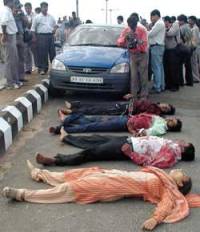 Even as the embers of the targeting of the IB fly in and outside the country, an Inspector of Punjab Police, Surjit Singh, has claimed that he has carried out 83 fake encounters at the behest of his bosses during the ‘Sikh Freedom Movement’. The timing of the smote on the conscience and the moral churning process of this Inspector clearly indicates the identity of his benefactors. The ISI’s desperate bid to revive militancy in Punjab through its strategic arm LeT has been widely reported in the media. This seems to be yet another attempt by the ISI and LeT to destroy the security apparatus in Punjab so as to make uncontested in-roads. The targets have been carefully selected i.e the Military Intelligence, the Intelligence Bureau and the state police forces, which includes the Gujarat Police, where nearly a dozen officers have been hounded and intimidated by the Center. The only officer who has found favour of the Center was the one demanding a Black Berry phone from a political party to settle political scores. The common enemy of these agencies is the LeT. It is the same LeT (Markaz-e-Taiba), which has received Rs. 61 million by the Punjab government in Pakistan as grant-in-aid in the current fiscal. The tragedy is that it is not only Pakistan establishment which grovels to the head of LeT, Hafiz Saeed, but the Indian establishment as well. The love or fear of LeT has impelled the quarters to consciously wreck the internal security apparatus of the country. Ishrat Jahan, a 19-year-old girl from Mumbai was killed with LeT terrorists in Ahmedabad in an encounter on 15 June 2004. The family members in hindsight allege that Ishrat was abducted by the IB. It is queer that once she went missing her family members did not deem it fit to lodge an FIR with the Mumbai Police. Their inaction and silence on the issue can also be construed that the links with LeT run much deeper and wider. The dispensation by attacking the Special Director of the Intelligence Bureau, Rajendra Kumar, has attacked the core of India’s internal security intelligence. All for whom, but the LeT! Mr Rajendra Kumar’s failing has been his being professional and conscientious. In that he acquired intelligence from ‘sources’, informed the higher-ups in Delhi, which includes his seniors and in-turn the Ministry of Home Affairs. His main failing however was that, in the process, he was not saving a Chief Minister but Narendra Modi. If he had acted in the same manner to save the life of some privileged ‘democratic-monarchs’ of the country, he would have been awarded Padma Vibhushan and in the case of highest monarch a Bharat Ratna. After all the same dispensation rewarded Mr Brajesh Mishra with Padma Vibushan for his Boston rescue operation of the ‘Yuvraj’. Readers with little research can know the truth.
 Never before in the history of India, an IB or R&AW official was asked to submit before the CBI for interrogation on professional matters. Is it a ploy to unravel the entire intelligence framework of the country? This author who served with R&AW would have preferred to kill himself rather than submit to the CBI for interrogation of sensitive matters that are vital to Indian security interests. If this author was the head of the IB, the Special Director would have reported to the CBI over his dead body. The CBI has absolutely no competence to interrogate an IB and R&AW official on matters of internal and external security. By sheer level of politicization, the mediocre content of the job of the CBI, it is ill-equipped to deal with IB and R&AW officials.
If the CBI cannot be trusted with Arushi murder case or the Nithari case pertaining to Moninder Singh Pandher, what is its credibility! The whole world knows the truth in these cases sans the CBI. Can the Prime Minister at the current stage of his life cross his heart and vouch that he does not know the truth in these two cases? How has suddenly the CBI become the repository of the national conscience, which includes the IB and the R&AW?
The IB has been pitted against the CBI. In the case of blasts in Malegaon in 2006, the NIA has been pitted against the Maharastra ATS and the CBI. And earlier in Col Purohit’s case the Mahrastra ATS was pitted against the Military Intelligence. The effect of the orchestrated attrition is already beginning to tell.
 This systematic destruction of India’s internal security apparatus is not only for vote-bank politics as most commentators are suggesting. Of course the Modi-phobia is a factor but not the sole reason. It has a larger dimension which is evident from the nervousness displayed by the dispensation with regard to ISI, Hafiz Saeed and David Headley. Do they know too much? Were they used to stage 26/11 to counter Jehadi terror by creating the specter of ‘Hindu Terror’? How does David Headley have the gumption to abuse Indian interrogators? Are the services of the ISI and LeT being obtained to influence vote-bank politics? Is the LeT and the ISI asking too much in return? These are questions which readers must ponder upon.
While the readers do so, their benchmark should be the fact that if Ajmal Kasab had not developed cold feet and caught alive, all preparations has been made to label 26/11 as act of ‘Hindu Terror’. Books to this effect were pre-written and the choice of the Chief Guest decided. Till today nobody has questioned as to how an unconstitutional authority was in direct communication with the Maharastra ATS Chief Hemant Karkare, and eliciting sensitive security details. If this politician cannot explain this he should be treated like any other terrorist.
For matters of national security the relationship between all the intelligence organizations of the States and the Center is both vertical and horizontal. Flow of intelligence is not only from top to down but in the reverse order too. Moreover, there is lateral sharing as well. The multiplicity of agencies has its benefits in terms of overlap, corroboration and coverage. By targeting the IB, the Military Intelligence, the state security apparatus of Gujarat and the previous Maharastra ATS, the dispensation has intimidated the entire intelligence network of India. India is now an open and defenseless target. The traitors as of now have prevailed!
 No intelligence official now will provide or share information with the same degree of sincerity and patriotism. The Indian intelligence community is now a scared community. Nationalism and patriotism have become criminal attributes. Things have gone so anti-national that the most sensitive information was being leaked by the CBI pertaining details of Ishrat Jahan case and there were media houses flaunting documents which should have been only for the consumption of Prime Minister and the Home Minister. The Pakistan or the ISI connection of some of these news channels and journalists is too well-known.
Ishrat Jahan and her associates were nothing but tools of proxy war by Pakistan. Anybody with a modicum of understanding of terrorism will understand that the role of Ishrat was to act as suicide bomber, as revealed by David Headley. There are any number of such modules waiting to strike. Rajiv Gandhi too was eliminated by eliciting the services of one such suicide bomber through the aegis of LTTE. This could not have happened without unsuspecting facilitators within.
Indians should realize that this is an era of proxy wars. A civilized country to retain its civility has to fight with uncivilized ‘proxy soldiers’, the kind of Ishrat Jahan. In this proxy war, which is also referred to as ‘intelligence wars’, the role of intelligence agencies is predominant. In dealing with such adversaries, there are methods, which have been used in the past to bring back civility, whose peace dividends people of India including the politicians, the civil activists and the vocal media continue to enjoy. One such region is the Punjab province of India. The  dispensation at the behest and blackmail of external enemies has by design destroyed the entire internal security apparatus assiduously built over the years for the LeT and vote-bank politics.
India now stands exposed. Whenever there is the next blast or terrorist attack don’t expect too much from Indian intelligence framework. It stands intimidated and unraveled. It will be extremely difficult for the Indian security apparatus to recover from this wreck.
The ISI and LeT has won! – Sify.com, 5 July 2013
Filed under: india, pakistan | Tagged: 26/11 mumbai attacks, ats, brajesh mishra, CBI, congress politicians, david headley, geopolitics, hindu terror, INC, india, indian intelligence agencies, indian police service, indian politics, intelligence bureau, ISI, islamic terrorism, jihad, muslim terrorism, nation-state, national security, NIA, pakistan, patriotism, police, politics, proxy war, psychological warfare, rahul gandhi, rajendra kumar, RAW, terrorism, UPA-2, vote bank |





 BHARATA BHARATI
Sir @Mr. RSN Singh, Firstly I am highly grateful to you for bringing this issue in the public domain. Sir I watched some of your videos on YouTube which startled my whole body both mentally and physically. The more I’m growing more I’m seeing the bitter internal (sub rosa) politics. Undoubtedly no one asked why Mr………… of the………. state of the Indian federation went to the Pakistan just after 26/11 (In a video on Youtube, on a news channel one of his companion says, ” vo ghumne ke liye gye the”, did he mean we the people are gone mad or he is too good to be oversmart? Can he explain me and the people of India what was there in Pak to wander about and that too in a situation when your country is suffering from fortnight terror strike). What was our PM doing at that moment? Didn’t he feel at least for once to stop him.
Sir there are many questions in which we are to be blamed off for sure, the way our politics being played was very annoying.
And certainly I also agree with you that this is the phase of 4th and 5th generation war that had already been imposed in mid ’90s by terror groups with the ISI modules. We are shocked to any terror attacks at that instant while these attacks across the borders have already being planted and are consistent since then as a PROXY WAR.
Hoping for a renaissance in our politics with the new government.
Personally, I strongly believe that in the interest of our nation all the limits should be reached.
LikeLike
Praveen Swami’s articles are always interesting. However, he seems to be changing his mind frequently. In First Post starting from July 4 he raised serious questions about the ethicality of Indian Intelligence and law and order agencies. This continued for a day or two. Now, on July 8, while giving us a ‘clear’ picture of how these agencise operate, he also seems to imply that in order to defend the Republic a certain lack of questioning is okay. Make up your mind Praveen !
The author of the above article is consistent. R.S. Singh is more persuasive. In any case when dealing with proven terrorists how does the country react ? Should the nation bare its chest and be defeated ?
LikeLike
Former IB director Ajit Kumar Doval (top) and former RAW chief A.S. Dhulat
Ishrat Jahan case: Intelligence won’t survive the investigation – Praveen Swami – FirstPost – July 8, 2013
In 1988, the President of India handed Ajit Kumar Doval a small silver disc exactly one-and-three-eights of an inch in diameter, emblazoned with the great wheel of dharma, a lotus wreath and the words Kirti Chakra. It was the first time a police officer had ever received the medal, among the highest military honours our Republic can bestow.
He won that medal for unspeakable crimes.
It’s still unknown what Ishrat was doing with Sheikh; nothing, bar 26/11 convict David Headley’s claim she was a suicide bomber, is on record.
Like many former intelligence officials, Doval considers himself bound not to discuss past operations. I have his permission, though, to speculate that it may have involved the cold-blooded execution of a Pakistani intelligence officer, the illegal detention of terrorism suspects, torture, the smuggling of arms and explosives across India’s borders, and the use of false identities.
Lawyers have numbers and words for these things: 302, 304, 364, 120B, the Arms Act, the Explosives Act. These are the laws India’s intelligence services break every single day — to defend the Republic.
To comprehend this is to comprehend why India’s intelligence services simply won’t — at least in their present form— survive the Ishrat Jahan Raza murder investigation. Ever since their inception, the Intelligence Bureau and its sister-services have functioned without any legal mandate. This means authorisation for anything they do. Every time an intelligence officer initiates a covert operation, launches agents across the border or engages in the lethal deceptions that constitute the warp and weft of spycraft, she or he breaks the law and violates the constitution.
It’s worked because of an unwritten consensus that has historically cut across political parties. Last week, it all fell apart.
Few in the Intelligence Bureau privately dispute the contours of the secret story behind Ishrat Jahan’s death. In February, 2004, the Intelligence Bureau was able to locate two Gujarat-based jihadists, trained in Pakistan, on the basis of information recovered from the body of a Poonch-based Pakistani Lashkar-e-Taiba operative, Ehsan Illahi. The two Gujarat-based are men are referred to in Central Bureau of Investigation documentation simply as C1 and C2.
C1 and C2 were persuaded, possibly with bribery or threats, to change sides. They informed their Lashkar handler, Muzammil Bhat — the key military commander of the 26/11 plot — that they were ready to stage an attack against top political leaders in Gujarat, including Chief Minister Narendra Modi.
The Intelligence Bureau was thus waiting for Gujranwala-based Lashkar-e-Taiba operative Zeeshan Zohar, despatched to Gujarat in April on Bhat’s instructions. They were waiting for his Sargodha-born colleague Amjad Ali Rana — earlier injured in fighting in Jammu and Kashmir — who showed up the following month.
Intelligence officers, helped by the police, coerced the two men — it’s possible torture was involved — to continue communicating with Bhat, allowing him to believe the plot was going well.
From immigration records, we know this: on 29 March 2004, Pune resident Javed Sheikh flew to Oman, on passport E6624023, identifying him as Praneshkumar M Gopinath Pillai — a travel document obtained illegally, in addition to an earlier one in his Muslim name. He flew back to Mumbai on 11 April. He purchased the second-hand car that was to carry him to his death. And he repeatedly communicated with Bhat — who finally authorised him to travel to Gujarat in June, believing C1, C2, and the two Pakistani fidayeen were ready to initiate their attack.
It’s still unknown what Ishrat was doing with Sheikh; nothing, bar 26/11 convict David Headley’s claim she was a suicide bomber, is on record. Her family insists she was just an innocent teenager, hired by Sheikh for his — non-existent — perfume business.
This much, we can say: if the police had done what they ought to have done, arrested and charged C1 and C2 with terrorism-related crimes instead of illegally inducing them to cooperate, they’d never have got to Zeeshan Johar. If they’d arrested Johar, and produced him before a magistrate, they’d never have got to Amjad Ali Rana. If they’d arrested Rana, they’d never have got to Javed Sheikh. If they hadn’t got to these men, innocents might have died. And if they hadn’t killed the suspects, C1 and C2 would have been useless for further operations — and possibly dead.
Let there be no doubt about this: no democratic republic can countenance extrajudicial executions and torture. There’s just no way for what happened in Gujarat to be made acceptable. Leave aside all the ethical concerns. Police officials who have the power over the life and death of terrorists today can, tomorrow, use it against political opponents and all the rest of us. Encouraging such acts isn’t patriotism: it is a sure-shot way of turning us into Pakistan, or worse.
Few ethical principles, though, survive encounters with the real world un-bruised — which is why only those who never exercise power have the luxury of moral pieties.
India has long confronted insurgencies and terrorism where state had to make a choice between law and order, after all its non-coercive institutions collapsed. KPS Gill’s campaign against the Khalistan insurgency was brutal—but the thousands of people not killed in Punjab since 1993 is surely some moral mitigation of that violence.
The West has, for the most part, offshored these dilemmas. The Cold War was fought with great violence — but in other peoples’ countries. The Soviet Union and United States, unlike Pakistan and India, didn’t ever bomb each others’ cities through their intelligence services or proxies. In the post 9/11 world, the United States is known to have used third countries to torture.
For decades now, India has dodged a serious debate on what’s acceptable, what’s not and how to make the system to better. Indians need to ask what a functional counter-terrorism legal framework might look like, how it is to be administered and who will make sure it isn’t abused.
I doubt this is going to happen, though, because the status quo suits the political leadership. The same lack of regulation and oversight which has now put genuine national-security operations at risks also allows the Intelligence Bureau to be used for things that would invite criminal prosecution in most democracies.
Five of the Intelligence Bureau’s 28 joint directors in New Delhi, by my count, deal directly with counter-terrorism issues — but the rest are involved in various kinds of analysis and political surveillance. In stark contrast, the Intelligence Bureau’s operations directorate—the hub of its counter-terrorism effort—has some 30 analysts and field staff, all told; another 30-odd track Maoists. Local counter-terrorism teams set up in 2008 have had to be dismantled due to staff shortages.
This is true of the police services, of the Research and Analysis Wing and other specialist intelligence services, too—and when you expect people to deliver results without the necessary tools and resources, you’ll get crude solutions.
In 1975, Doval won the police medal for meritorious service after just six years in service instead of the usual seventeen; Prime Minister Indira Gandhi wrote a note on the file saying she wouldn’t normally do this, but the circumstances were unusual. It had something to do, it’s said, with the circumstances in which six of Mizo insurgent leader Pu Laldenga’s seven military commanders became Intelligence Bureau assets.
Gun-running. Bribery. Killing.
Doval was inside the Golden Temple in 1989, when Indian forces killed 41 terrorists and forced 200 to surrender, without damaging the revered shrine. The terrorists thought he was an Inter-Services Intelligence bombs expert, a misunderstanding that had some bearing on the eventual outcome.
Gun-running. Bribery. Killing.
Let’s accept that there are things that the republic must do to survive. Let’s have a serious conversation about how best to do these things.
LikeLike
Col. R.S.N. Singh is a retired military intelligence officer with R&AW. Most of his articles appear on the Indian Defence Review website. We have no contact number for him. You might try leaving a message at the IRD website.
LikeLike
Can I get the contact number or email ID of the author. I am military veteran and can be contacted at ….
LikeLike