














 Watching the horrific devastation in Uttarakhand, I was reminded of my visit to Badrinath and Kedarnath some 25 or so years ago. There was nowhere the kind and scale of construction that seemed to have sprung up of late, and the numbers of pilgrims were in hundreds, not thousands.
An understanding of the man-made aspect of the tragedy is growing, of how rampant destruction of forests and the Himalayan ecosystem in and around the pilgrimage spots might have magnified the impact of the natural disaster.
That this should happen at sacred sites associated with a religion and a way of life that has an eco-spiritual perspective inbuilt in so many of its traditions is cause for concern. It is a warning that in following the form of ritualised religion, we might have forgotten its spirit. That we might still worship a river or a mountain with flowers and incense, but have become blind to the impact our presence there is having on those very objects of our veneration. That we might chant mantras extolling the elements, but think nothing of polluting them with waste, plastic and toxic fumes. That we might be relating with religion as another consumable material, without bothering to understand its deeper underpinnings.
 When we lived closer to nature, and not in the urban concrete jungles of today, perhaps it was easier to evoke and feel a respectful awe for natural phenomena. A river was not just a river. She was a mega-mother, a goddess, who nurtured centuries of civilisation along her banks. She not only fed us but also received our ashes when we died, as a portal of transmigration. She was not to be messed with but propitiated. Most importantly, she was not an object to be consumed for our comfort.
In the hills of Uttarakhand, for centuries people have worshipped mountains, trees, boulders, glades and knolls as abodes of spirits, some benevolent, others malevolent. Some kinds of trees would never be cut, and if they needed to, the act would be preceded by days of pujas to ask its permission. When I see the mindless destruction of forests and nature that the age of science and reason has brought with it, I wonder if in this regard we weren’t better off with superstitions that declared some acts of natural destruction taboo. Even if it played on people’s fears of vengeful spirits, at least it helped preserve the fragile Himalayan ecosystem.
Perhaps, this monumental tragedy will inspire us to consider a re-sacralisation of our connection with nature. To consider the Ganga, the Himalayas, their flora and fauna, and our surroundings wherever we are, as sacred and alive entities, not just myths or idols to be worshipped in temples, or consumables to be exploited for our needs. Perhaps this will be the call to return to our natural selves, and re-visualise the ecological divinity that exists all around us. — The Asian Age, 28 June 2013

Source of Ganga: Gangotri glacier & Shivling mountain in Garhwal, Himalayas
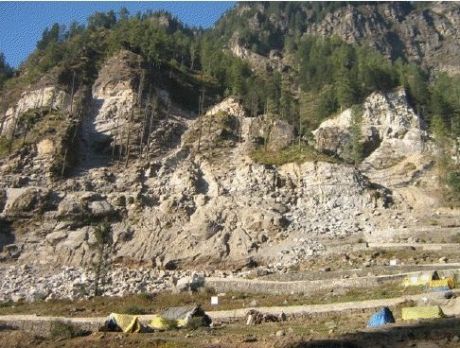
Deforestation and mining in the Himalayas is the cause of landslides and flooding.
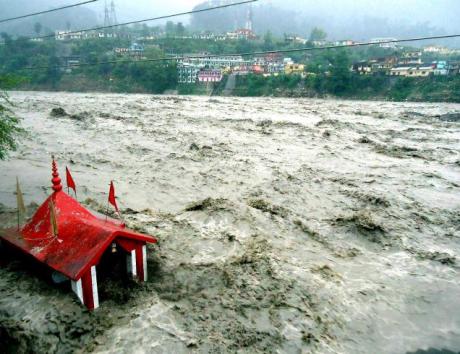
The Ganga in spate at Uttarkashi, June 2013

Pilgrim offering a lamp to Ganga at Prayag, Kumbha Mela 2013
Filed under: india | Tagged: biodiversity, capitalism, deforestation, devatas, ecology, environment, ethics, ganga, ganga river, himalayas, hindu, hinduism, hindus, iconography, india, indian politics, kedarnath, national disaster, psychological warfare, rampant destruction, religion, rituals, river ganges, sacredness of nature, science, shiva, spiritual perspective, superstition, superstitions of science, temples, tourism, uttarakhand, values |








 BHARATA BHARATI
This is a good reminder. Hindus have kept the forms, but forgoetten the spirit. We worship the Ganga, but pollute it. We worship the cow, but drink buffalo’s milk, and let the muslims slaughter the cows. We venerate Himalayas but do not know how to show it in practice.We do not realise how sacred indeed are the Himalayas. I will relate an incident. In 1970, I listened to a pravachan on Ramayana by a pundit in Delhi. He was relating how he had visited all the sacred places like Kashi, Prayag, Haridwar etc but felt distressed at the way the places had become commercial, filthy, over crowded. He went to Rishikesh and met Swami Sivananda and reported to him how bad the places were becoming and said they seemed to have lost their sacredness. Swami Sivananda just looked at him and chided: “Hai you, what do you say?” (In Tamil: ‘Dai, Ennada solray’) So saying, he kept his hand on the head of the Pundit and asked him to turn towards the Himalayas and see. And lo! the Pundit saw hundreds of Sadhus doing Tapas of various kinds in all sorts of places, including every nook and corner, cave, branches of trees, etc exactly as described in some of our old books. The Pundit then realised that the sacred places have not lost their sacredness, but we have lost our ability to perceive sacredness; not that there are no sadhus now doing Tapas but they are now invisible so as not to become objects of curiosity of tourists. Thus the entire Himalayan region is sacred and it should be kept free from all man-made ‘development’ projects.
LikeLike
South side front entrance to the Kedarnath Temple in 1882
There were no permanent buildings at Kedarnath until the 1960s. The temple pujaris and devotees built simple huts for shelter before that date. After the 1970s and into the 1980s, when the villagers of the area became flush with money, permanent buildings were put up by the priests of the Kedarnath Temple. They were the first to build houses with tin sheet roofs, others in the area followed them.
In reviewing this problem of the desecration of our sacred places, the economy of the hill people also has to be considered. They need an income and serving yatris is an accepted and legitimate way for them to make money.
But it is true that our right hand no longer knows what our left hand is doing. We offer lamps to Ganga Ma and pray for Her blessing, and at the same time contribute to the sewage that is emptied into Her waters. There is something very wrong here and it has to be corrected. If the Ganga dies—and She is dying from our abuse, no doubt about it—Hinduism as we know it today will die with Her.
LikeLike
It’s how the divine asks us to change — Yogi Ashwini — The New Indian Express — New Delhi — 30 June 2013
This was nearly 15 years ago, we were travelling to the higher reaches of Badrinath and on the way back we went into a restaurant just outside the temple. We asked for some cow milk and told the owner to be doubly sure that it was cow milk and not powdered milk; he assured us and went into the kitchen. We waited for 10 minutes and then I decided to take a look in the kitchen. Inside to my surprise, I saw him boiling water and adding powdered milk to it! On confronting, he cheekily replied, “Now where do I get cows here?” I told him that if you people won’t send your cows to the butchers then you would have them and your character would be devik and not asuric, for this is what you people have become. How can you fool people at the dham of Vishnu?
Another time on my visit to Kedarnath, I found families thronging the shrine in a picnic and holiday mood, filmi songs blaring and card parties galore. Inside the dharamshalas surrounding the shrine, people dressed as Shiva waving their trishul at me and simultaneously demanding money! It is too pathetic and sad for someone like me to describe in detail what all I saw and how I got out of there. These could not be the state of affairs of a Jyotirling and Vishnu Dham.
This was nearly 15 years ago, I dread to think what would be happening there now? Suddenly the news flashed on television, “THOUSANDS KILLED IN LANDSLIDES AND FLOODING IN KEDARNATH”, “THE TEMPLE STANDS”, “SADHUS CAUGHT LEAVING THE AREA WITH JEWELLERY AND MONEY HIDDEN IN THEIR CLOTHES AND JHOLAS”, “VILLAGERS SELLING WATER AND FOOD TO THOSE STRANDED AT 10 TIMES THE PRICE”, “PEOPLE DESPERATE TO LEAVE, DEAD BODIES STREWN ALL OVER”.
Are we talking about a coveted Chaar Dham? Are we referring to a Jyotirling? Are we talking about real sadhus? Are we talking about human beings? And last but not the least, are we talking about people who went there looking for moksha?
It’s important to note here that a rock rolled down and stopped just short of the temple while other rocks destroyed everything around. The temple stairway was washed away, the Nandi statue and the temple unharmed; nothing else survived. This rock was like a dam which prevented the water and other boulders from hitting the temple. Is it not so clear that the statue of Nandi and the entire temple are standing and the stairway has been washed away? Shiva is telling us not to disturb him by our foolish actions. Such places should be left for sadhakas and for those who want to do penance. They should be out of bounds for family picnics.
Is this too uncanny or just a coincidence? No, it’s neither uncanny nor a coincidence. Did this happen because a goddess temple was being shifted to make way for a hydel power project? The reasons I will give below:
1. India is the third largest exporter of beef, thousands of Nandis are separated from their mothers and killed to satisfy the greed of a few. The media or the politicians don’t pick up the topic as they say it will turn communal even though as per law it’s illegal to kill cows and calves. I don’t see anything communal in this. It is just a blatant violation of the Indian law by powerful people. The biggest traders of skin and different kinds of meats are Hindus. Cows are killed by bashing them on their heads. Lord Shiva had given a boon to Nandi, “Whatever is whispered into your ears will be heard by me.” One can imagine the pain and suffering of the animals and what all will be going to lord Shiva’s ears.
2. The majority of people going to Dhams don’t go there asking for moksha or for penance. They go there for a picnic, a family outing and in the process temples are visited and more wealth and health is asked for. Never have they bothered to feed a hungry human or animal on the road.
3. We have polluted the Ganga, and our water bodies are now poison. Trillion tonnes of effluence go into our sacred rivers. Extreme negative karma is created when this water poisons the animals, humans and plants which it touches.
4. Majority of sadhus are unsuccessful businessmen who have found religious blackmail a good way of making money. They have opened big ashrams and are thronging religious melas in the hope of coming into the Forbes list of billionaires. A lot of them are selling asanas and so called Ayurvedic medicines to cure all diseases, known and unknown.
5. Majority of religious places are busy collecting wealth and filling their coffers. The money which they get as donations for helping the poor is used for making gold thrones. The fact is completely ignored that the founders had spent their entire lives in helping others and doing penances, they propagated moksha, not bhoga.
In this age Muhammad Ghori and Mahmud of Ghazni or even the Afghan warlords would not come to loot these places and kill the inhabitants. Our armed forces are competent to handle all this, but then the divine has to tell us that what we are doing is wrong, we are ruining our culture and making a mockery of our religion. The divine has to find some way of telling us that we must change or else the creation will end and we will suffer in hell, for we are only responsible for all the harm we are causing to nature—by destroying it with our tree cutting, pesticides, killing cows, polluting rivers and water bodies, turning ashrams into business models, becoming completely selfish and nonsensitive to our neighbours, desecrating places of penances and sadhana by our wild partying.
LikeLike