














“There was a time when the Kedarnath Temple was visible from three km away. But over the years, with all the encroachment by shops, you have to go right up to the temple before it is visible,” say the temple’s chief pujari. Adi Shankara’s samadhi shrine is behind the temple.
Increasing tourism for recreational purposes and ruthless commercialism are to be blamed for the destruction caused in Kedarnath, believes Vageeshling Maharaj, chief purohit of Kedarnath dham.
“So many people, who have no feeling of piety or devotion, visit Kedarnath. They go to Kedarnath only to have fun and enjoy themselves, with a mindset which has nothing to do with faith and worship,” said Vageeshling Swami, chief purohit of the dham.
“Lord Shiva is a bairagi. He has nothing to do with materialism and desire. People come here in the wrong spirit. Just as Lord Shiva has discarded everything, so should the people who come here; they should give up all worldly thoughts to cleanse themselves,” said Swamiji, who is at present residing at the Vishwanath Temple in Guptkashi.
Swamiji was inside the temple on June 17 when a great wave of rocks, ice chunks and boulders came crashing down the lake, which is nearly one km behind the temple.
“We could see boulders breaking off and a mass of water descending at a furious pace. The wave reached the temple within seconds. Some of the boulders even hit the temple, which shook for a few moments. But it passed just as quickly,” he recounted.
“A 40-feet high wave engulfed the temple and flowed away. The cascade of water seemed as high as the spire of the temple,” Swamiji added.
He left the temple on June 19 when the army evacuated some members of the temple staff to Fhata.
“Fifteen of the temple staff are still missing. We were evacuated in batches; apart from the 15, all are safe,” Swamiji said.
Although the temple structure remains unharmed, the compound is now a mound of rubble. “The way the temple and the area was before June 17 — it will take 20 years for Kedarnath to look like that again. The cloudburst set us back by more than a century,” he said.
Sitting beside Vageeshling Swami, Shashidharling Swami, chief pujari of the Vishwanath temple in Guptkashi, said, “A space of 80 metre should be left free on each side of the temple. In front, they should leave a stretch of 150 metre of free space”.
“There was a time when the Kedarnath Temple was visible from three km away. But over the years, with all the encroachment by shops, you have to go right up to the temple before it is visible,” he added.
Describing the natural calamity as “divine punishment for human excesses”, Shashidharling Swami said, “Yes this is a message from above. The message is in the destruction that rained from the skies. The message is in the temple standing intact after all that.”
“The temple was not destroyed because the Lord did not want to shatter faith. A broken temple would have broken people’s faith, their very spirit. So the temple emerged unscathed but everything else around it was wiped clean,” he added.
“But God is merciful. If thousands perished, then lakhs survived. People should think about this calamity and look within,” Shashidarling Swami said as Vageeshling Swami nodded his head in approval. — Rediff.com, 24 June 2013

The route to Kedarnath from Gaurikund following the Mandikini River

Buildings about to fall into the Alaknanda River at Rudraprayag
It was a disaster waiting to happen—and it did happen!
The Ministry of Environment and Forests has decided to step in, though late in the day, asking the Uttarakhand government to stop any construction along the river bank.
Even as the jury is still out on whether the destruction in the state is man-made or caused by nature’s fury, there’s sufficient evidence to suggest that warnings were loud and clear much before the disaster struck.
The Union ministry, which could now seek demolition of illegal structures on riverbeds, had sounded the alarm bell last year on the adverse impact of unrestricted constructions in the region.
Warnings ignored
A study conducted on Uttarakhand hydro-projects by the Wildlife Institute of India under the MoEF in 2012 said that of the 1,121 km stretch of rivers that flow in the entire Alaknanda and Bhagirathi basins, at least 526.8 km, or 47 per cent of the basin, could be affected due to illegal construction along the river bank.
Also, a Comptroller and Auditor General (CAG) report three years ago had stressed that there was a hydro-electric project every 5-6 km, with more than 40 projects already operational and many readying to come up.
This, CAG had said, was a serious threat to nature and bio-diversity of the region.
Not only that, MoEF had earlier questioned the state government on the need for so many small power projects that are below 2 mega watt on the Ganges.
Illegal construction
Apart from the power projects and dams, illegal motels (small hotels) and residential complexes have mushroomed close to the river beds to tap rising number of tourists in the area.
An executive from a real estate firm, not wanting to be identified, admitted there were illegal buildings all around. Seeing it as a source of income, many residents have converted part of their houses into guest houses, with rents in the range of Rs 1,000-2,000 a day.
In addition, many local developers get into the business of hotels and guest houses in states such as Uttarakhand and Himachal Pradesh, violating many building rules, to be able to make quick bucks, another realtor pointed out.
However, Naredco (National Real Estate Development Council) Director-General R. R. Singh argued that the current disaster was due to landslides and that there was no problem with real estate development in the region.
“The buildings, which came up must have been approved by local authorities. Being a hilly terrain, all the construction was done on slopes, which will be washed away by landslides, irrespective of the quality of the material used,” said Singh.
While the official death toll due to the floods is around 150, more than 1,000 people are feared dead and many more stranded across Uttarakhand.
A top environment ministry official said that once the rescue operation is over, the ministry would seek explanation from the state government on un-restricted development along the banks of the rivers.
“We would ask for immediate removal of all existing structures on riverfront. The major issue there is not the dams, but the illegal constructions that were allowed,” said the official.
“We would ask them (Uttarakhand government) to review all those plans that are not nature-friendly. The entire affected area was part of eco-sensitive zone plan and it should not be compromised for development work,” the MoEF official added.
According to estimates, there are at least 600 small and large hydro-electric power projects within the state.
At the moment, apart from national highway projects and mega infrastructural projects, none of the major projects in the state is cleared by MoEF.
Environmentalists, meanwhile, have put up their demands.
“There should be cumulative impact assessment that the MoEF should do in Uttarakhand related dams and projects along the banks of rivers,” said Himanshu Thakkar, co-ordinator of South Asia Network on Dams, Rivers and People.
As for damage control, the National Disaster Management Authority has deployed 13 teams of the National Disaster Response Force with 7,000 members, including 4,000 army men. The State Disaster Mitigation and Management Centre team is also in action.
“There is a joint command for all these co-ordination works. The major problem for us is communications, because the only mode to conduct rescue work is through air or by foot,” said J K Sinha, member, National Disaster Management Authority. – Rediff.com, 21 June 2013
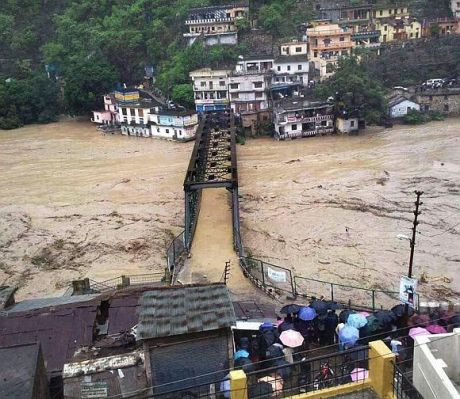
Bridge to Kedarnath submerged by Alaknanda at Rudraprayag
Filed under: india | Tagged: adi shankara, alaknanda river, char dham, climate, cloud burst, criminal negligence, culture, deva, devi, ecology, environment, floods, ganga river, garhwal district, hindu, hindu pilgrimage sites, hindu pilgrims, hinduism, india, indian army, indian politics, kedarnath, kedarnath temple, lifestyle, mandikini river, national disaster, pilgrim tragedy, psychological warfare, psychology, rain, religion, river ganges, ruthless commercialism, shiva, temples, uttarakhand, values |








 BHARATA BHARATI
EDITOR’S NOTE: This article has been copied from the FB account of Alpana Agarwalla Bhartia at https://www.facebook.com/alpana.bhartia
KALI’S ANGER
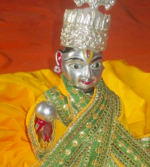
Kali Torso at Dhara Devi
This may sound like a story from a comic book, but it is not so – its reality that most people today like to ignore and push aside as superstition. The fury of the goddess is well known and any attempt to instigate her would lead to great destruction. Let us look at the events leading to the great devastation of Uttarakhand by flooding of Uttar Kashi.
The government has tried to build up dams to overcome the power shortage. This has been opposed by locals and some prominent politicians like Uma Bharti and B. C. Khanduri of the BJP since it would lead to the submergence of the shrine, and efforts to construct dams have been delayed indefinitely. Previously, in 1882, an attempt to shift the shrine was immediately followed by havoc in Kedar Valley. There is some strange connection between this guardian goddess and the Kedarnath jyotirliñga.
The Joint Temples
These are not just any other Shakti temples, they are among the 108 Shakti Pitha mentioned in the Devi Bhagavat. Dhari Devi is a temple on the banks of the Alaknanda River in the Garhwal region of Uttarakhand state, India. It houses the upper half of an idol of goddess Kali specifically called “Dhari Devī” that, according to local lore, changes in appearance during the day from a girl, to a woman, and then to an old lady. Perched atop a 20 metre high rock, the temple of Dhari Devi is situated on the banks of river Alaknanda. One has to travel a distance of 19 kms. from Srinagar (Pauri Garhwal) on Srinagar-Badrinath highway up to Kaliya Saur, then down trek another half a kilometer towards Alaknanda river. According to a local legend, the temple was once washed off by floods, while floating the idol struck against a rock, the villagers heard the cries of the idol. On reaching the site they heard a divine voice instructing them to install the idol as it was, on the spot it was found. Since then the fierce looking idol remains where it was, known as Dhari Devi, under the open sky, and thousands of devotees on the way to Badrinath pay their obeisance to it. The Temple of Dhari Devi in Srinagar hosts only the upper part of idol of Goddess Dhari, the remaining lower part is believed to be in Kalimath in Rudraprayag district. It is believed that the idol of Dhari Devi shall not be put under roof. For the same reason, the idols in Dhari Devi Temple are put under open sky. Taking photographs of Dhari Devi idols is strictly prohibited. The village near the temple is name after goddess Dhari and known as Dhari Village. A hanging bridge over Alaknanda river connects the Dhari Devi Temple to Dhari Village.
Now, the lower half of the idol of Kali is located in Kālimaṭh Temple. These joint temples are exactly at NE-SW direction symbolising Kali as sleeping with her feet in NE direction and head in the SE direction.
This causes the energy to flow in the NE direction, which in jyotiṣa, is the direction of Jupiter (Iśāna Śiva), the parameṣṭhi guru. The upper part of the devī with the head symbolises the calming of Kali by Śiva, the Guru. The lower part of Kali is not in the form of an idol and instead, is worshipped as the Śrī Yantra. In this manner we learn that the Śrī Yantra, as established by Ādi Śaṅkara at Kālimaṭh, is the yoni of Śaktī from which all creation proceeds.
The Kedarnath jyotirliñga is exactly north from Kālimaṭh symbolising the husband-wife or Śiva-Śaktī relationship. In this Kedarnath being to the north (Mercury direction for ahimsa) is constantly calming the devī who is in the south (Mars direction, anger, agitated and at war).
On June 15th, 2013, the idol of Dhara Devī was removed to be shifted to another location to facilitate the construction of the same dam, which locals were opposing ever since the conception of the project with the belief that the moving of the Dhara Devī would somehow agitate Kali. They were right in their belief as any movement would lead to a change in the angle of the Dhara Devī and Kālimaṭh, besides altering the distance. There are energies we human beings do not understand as yet and it is best to let these spiritual shrines where these energies are contain, be maintained.
With the shifting of Dhara Devī, the agitated Kali has been woken up, and she seeks the demon Raktabīja (seed of blood). As per mythology, Raktabīja took various bodies and she continued to destroy each one. Primarily this indicates unimaginable bloodshed and death. Exactly on the next day massive cloudburst and flash floods started in Uttarkhand and even today, when official (?) death figures are at 1000 (identified people/bodies), the unofficial figures is way beyond 5000 deaths and more are still following as the rains are returning.
Urgent
Restore the idol of Dhara Devī (Kali torso) to its original shrine and start the prayers that calm her down. Shri Yantra sādhanā has to be maintained at Kālimaṭh and Bael leaf must be offered to Kedarnath. If this is done, then Kali will calm down and the agitation of nature will stop. If this is not done, then the agitation of Kali shall spread throughout India and this will prove to be one of the worst years in the history of modern India.
LikeLike
Dear all. I visited Kedarnath, Badrinath from 23rd May to 28th May 2013 along with my wife, brother-in -law & sister from Delhi. Through out our road journey (except from Phata to Kedarnath by Helicopter) we have not seen any developmental activity, the presence of any police or state official for help. All the tourists were on their own i.e purely on the mercy of Almighty. Though we have reached safe before this tragedy but we have lost our peace of mind. The kind of relief started and the politics over it speaks about the level we have achieved in public life over the years. May god bless the people who r at the helm of these affairs so that in their hearts they realise the importance of SATYA, PREM & KARUNA for the people of all religions. Thanks.
LikeLike
Kedarnath priest takes Lord Shiva’s bhog murthy to its winter home – Yogish Kumar – Times of India – New Delhi – 26 June 2013
New Delhi: There was the famed continuity of Hindu tradition even amid calamity and chaos. The most revered symbol of Lord Shiva at Kedarnath, the “bhog murti”, or the idol of the deity that must be fed daily in what is called its akhand puja (unbroken worship), too fell victim to the devastating flood. But its custodian, the priest Vageshling from Davanagre, Karnataka, waded through sludge and corpses to retrieve it, to ensure the rituals surrounding it remained unbroken.
“According to the religious practice at Kedarnath, the sacred idol is brought inside the main temple every morning for the ‘bhog’ or feeding ceremony and moved to the pujari’s (priest’s) quarters in the evening,” said Vageshling, 33.
In a hoary tradition, this very idol shifts to Ukhimath in winter months when Kedarnath’s doors close after snowfall, and is kept at Omkareshwar temple. The idol returns to Kedarnath in May every year.
The morning after the apocalyptic flashflood swept everything, Vageshling knew the bhog murti had to be recovered. He was inside the temple with 300 others who had survived and lived through the dread of hearing the deafening roar of the flood waters hitting against the temple’s walls the entire night. He lived in pujari niwas but had taken shelter in temple like many others. But on Tuesday morning, Vageshling stepped out to look for the bhog murti.
“There were at least 20 bodies in and around the temple. But unfazed by the devastation, I waded through the sludge to reach the idol kept in pujari niwas adjoining the temple,” said Vageshling. Then there was the other thought: where to perform the akhand puja of the bhog murti.
Outside, debris and bodies lay scattered and he knew that it was inappropriate to perform puja. Leaving everything behind, Vageshling left the temple and headed straight for Garur Chhetti, 10 km away, where he performed the first prayer of the deity in an ashram.
He then took a rescue chopper and reached Phata village from where he walked to Gupt Kashi, about 14 km from Phata, which took him several hours. “The roads were broken and I had to take the forest route to reach there by the evening of June 19. I could perform puja by the rules,” he said.
On Saturday, he walked to Ukhimat, the winter abode of the deity. It’s now at the Omkareshwar temple and normal prayers have started. Asked when would Kedarnath temple reopen, he said, “No prayers can be performed until the entire place is cleansed. This would take time,” he said.
LikeLike
MUST SEE NDTV VIDEO OF KEDARNATH TEMPLE AND TOWN HERE
LikeLike
Go to link below for photos and commentary on Kedarnath:
http://kaulabhairav.wordpress.com/2013/06/23/kedarnath-rudra-tandav/
LikeLike
Rama ji very nice. But before beating ourselves up, also consider the financial aspect of this visit. the uncontrolled growth as done by politicians is not needed but with increase interest in Dharma will translate into more civilised tourism.
LikeLike
Har-ki-Pauri ghat at Haridwar where all of Hindu India comes to bathe
The desecration of Haridwar and Rishikesh was completed long ago. Both towns have by-laws against flesh foods being brought into their municipal areas and cooked. Yet some years ago Mulayam Singh Yadav, the CM of UP, bought his Muslim followers to Har-ki-Pauri ghat and fed them mutton biryani on its steps!
This action was ‘Mullah’ Mulayam showing his utter contempt for Dharma and for the Hindu pilgrim who regards Har-ki-Pauri as the most sacred spot on the Ganga at Haridwar.
Swarg Ashram at Rishikesh was from ancient times a place for sadhus and their ashrams. It was a magical place. Now it is a vast bazaar where anything can be bought for a price.
Perhaps some of the shops at Swarg Ashram have been washed away. But they will be replaced as soon as the water recedes unless some authority again intervenes.
LikeLike
It is not only Kedarnath, but every Hindu holy place of pilgrimage has been brought into the ‘tourist’ circuit, as a purely money -making device.The piety, the vratas, etc which one has to observe before and after a pilgrimage are totally neglected.
2. Certain kshetras are meant for specific purposes. For instance, pilgrimage to Rameswaram is traditionally undertaken for specific reasons:
– by childless couple, praying for child
– by people performing parihara for pitrudosha, as indicated in the horoscope
– by people performing last rites for the departed
– by people returning from Varanasi, as completion of their pilgrimage. (They are supposed to bring Ganga jal for Abhishekam to Lord Ramanatha.)
Now, all these traditions are given up and just anybody goes. Instead of choultries being built by philanthropic individuals and families for the free stay of pilgrims we have luxury lodges to attract tourists. The same situation prevails in every holy place.
3. It is not just Kedarnath. The entire Himalayan region is the abode of the Lord and should be treated with the utmost respect. People should go there only for prayer and meditation. It should be left untouched by any modern industrial activity. Sunderlal Bahuguna protested against the Tehri dam in the Himalayas. Who cared? We have lost all sense of the sacred. We are told even Ganga will stop flowing in a few years.
LikeLike
What is not discussed here is the vast deforestation that has taken place on the Shivalik Hills for decades with the connivance of greedy contractors and corrupt government officials.
The Shivaliks have become ugly hills because they have no trees left on them.
No trees on the hills is the immediate cause for the landslides.
When are Indians and especially Hindus who revere these hills going to wake up and pay attention to the great crime of deforestation that has taken place and continues to take place in the hills and the river basins of the Bhagirathi, Mandikini and Alaknanda?
Or shall we blame this environmental and cultural crime on Lord Macaulay too—(and by doing so absolve ourselves of all responsibility for the circumstance)?
LikeLike