






 “If he continues as the Minister of State for Human Resources, even if he achieves some limited success — that is if he does not come a cropper — there is every sign that he will short change the majority Hindu community. His colleague Salman Khurshid announced in June of this year that scholarships and loans are being granted to the students of the minority community, but there was no mention of the millions of poor Hindus who are also in need.” – Dr. Vijaya Rajiva
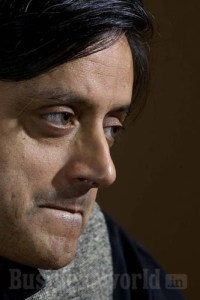 On a program in 2008 with the University of California’s series Encounters with History, Shashi Tharoor ends with a misquote. When asked by the anchor about his hectic life he muttered something about how being busy is not a good thing etc. and ended with the quote “ what is this life if full of care….”
The full quote, actually the first opening line is “What is this life if full of care, / We have no time to stand and stare….”
The line is from the poem by W.H. Davies (1871-1940). It is titled ‘Leisure‘.*
Tharoor however mentioned the name of William Wordsworth! That is the wrong author.
For a well read person this misquote or rather misattribution comes as a surprise. However, this seems to be typical of Tharoor’s general approach to life. There is a slapdash quality about it. This is something he is undoubtedly aware of and has made indirect references to it in his public speeches.
The question that the Hindu Samaj should ask is whether he is capable of or even interested in the Hindu ethos or Hindu interests. He is fond of quoting from his hero Jawaharlal Nehru, the same Jawaharlal who called Sardar Patel a communalist for taking urgent action against Hyderabad and who would have stuck a dagger in India’s heart if Patel had not acted decisively.
 Tharoor, like some other recent Indian writers, is awestruck by India’s civilisational history and rightly characterises it as built out of diversity. He misses the foundations of that diversity, Veda Agama, otherwise known as Hinduism. This is a topic that he does not fully understand and one sees the results in his thinking. In his writings India: From Midnight to the Millenium and the most recent book Pax Indica: India and the World in the 21st Century he attempts to draw a hard-line between different Hinduisms, his own — and his mentor Jawaharlal’s — understanding of Hinduism and what he and his milieu like to call Fundamentalism. A recent crop of writers have taken to use the word Hindutva and use the word ‘fundamentalism’ interchangeably to describe Hindu nationalism. Needless to say, these writers are deficient in their knowledge of Hinduism.
A Hindu who is well versed in his/her tradition might wonder why what is clearly a Hindu resurgence in India after the long night of the two Occupations — Islamic and Colonial — should so unsettle Tharoor (or his peers). The answer clearly comes from his educational background. He was educated in both the Jesuitical educational institutions and the Anglican ones, Calcutta and Delhi respectively. And he has been unable to shed the negative aspects of this baggage. Part of this inability is also owing to the fact that he left early for the West where his academic hard work plus his carefully cultivated accent launched him into unexpected positions of power and influence. He has told us in his speeches that he had been given a push by well-known diplomats and inducted into the UN. He is unable or unwilling to let go of this baggage and indeed sometimes wears it as a badge of honour.
 At the UN his career has been a chequered one, although his own self glorifying accounts do not reveal this. His closeness to Kofi Annan the Secretary General of the UN also gave him much leeway. He was the Congress Party’s man, so to speak, at the UN. This would be a normal practice if not for some missteps, at least one of them being a serious one. This alone should have served as a warning to our hero. Nevertheless he proceeded full steam and on to Dubai after resigning from the UN because he was not elected to the post of Secretary General. He was already primed for the Dubai misadventure by acquaintances who now were no longer only diplomats and politicians but also some dubious business people, some he most probably got acquainted with during his stint as UN Commissioner for Refugees. The rest is history. That saga from the Volker Report to the IPL and onto the allegations about electoral fraud (see Keralawatch.co) shows a characteristic trajectory, that of someone who tries to wing it each time and all the time. It speaks either to his naivety or something else. The present writer is of the opinion that until these matters are cleared up, mattering to India will remain an elusive project for Shashi Tharoor.
But back in 2008 when he spoke to the University of California interlocutor he seemed star struck by himself. The present appointment (in 2012) to a Cabinet position by the sinking ship of the Congress Party seems once again to place him in a position where he can continue his slapdash career. However, he will , once the debacle has occurred — the ship has sunk — get himself out of a difficult situation and find a niche in some other enterprise. Shifting gears will present no problems to him. He seems to be quite adroit at that.
 But how seriously should the Hindus of India take this individual?
To the extent that he tries to tarnish Hindu nationalism and downgrade Hindu interests he should be countered since both those projects are derived from politically motivated individuals on whose shoulders he is being carried. He has openly said that Hindus cannot claim to be a majority community. He has said this at a speech to the Minorities Commission. Clearly he was not talking about numbers. He was denying the fact that India has been a Hindu country since time immemorial. Our Vedic Rishis began the sacred Vedas and these continued in the Agama. The Veda Agama is the bedrock of Hinduism and it is this which makes India a Hindu country, not the numbers. Nor is it the secularism of his hero Jawaharlal Nehru, who perverted the classic definition of ‘secular‘ as non-interference by the state on religion by giving his blessings to the Hindu Religious and Charitable Endowments Act which is a blatant interference by the state against Hindus. Nehru’s anti Hindu stance is well-known.
This intervention by the state allows indiscriminate plunder of Hindu temples by the state. This practice does not exist against the religious institutions of the minorities.
 Tharoor’s second offence against the Hindu Samaj (in the present writer’s opinion) is his bland assertion that M.F. Husain‘s controversial paintings of Hindu goddesses are well within the Hindu tradition. The VHP (Vishwa Hindu Parishad) has written a comprehensive and excellent refutation of M.F. Husain. What could be added is that while ancient temple art, working with stone, showed goddesses partially clad, Hindu scriptures refer to the goddesses as fully robed. The references to the Goddess Saraswati (in Skanda Purana and other sacred writings ) being robed in white garments are numerous but even a single example will suffice.
The most famous and the best known is Sage Agastya‘s invocation of her as the one with a white robe draped around her: yaa shubra vastravrita.
There is hardly any Hindu familiar with his/her tradition who has not heard of this line. And every Hindu, even one who has been abroad for several years (as Tharoor was) but who grew up in India (as Tharoor did) has seen the famed paintings (or calendar copies that hang in every Hindu home) by Raja Ravi Varma that show all the goddesses fully clothed. Raja Ravi Varma was faithfully following the Hindu tradition. Salman Rushdie may be excused for asking where has one seen goddesses robed (see my article Salmon Rushdie’s non-Hindu attitudes: The Two Indian Interviews? Can Shashi Tharoor with a straight face claim that Husain was working within the Hindu tradition?
Nor are the explicitly sexual poses of the various goddesses to be found in Hindu temple architecture. Those depict ordinary mortals, not the sacred goddesses.
 And yet, once again, owing both to Tharoor’s ignorance of Hinduism and his eagerness to please the vote banks, he said quite blatantly that Husain was working within the Hindu cultural tradition (see his discussion on Youtube on free speech with Christopher Hitchens).
In a more general sense his glorification of the Muslim contributions to Bharatiya culture has served a certain purpose to bolster his offensive against the resurgent Hindu nationalism and to please the minorities. Tharoor is better suited to represent India at foreign forums where his sauve personality and his articulate speech are an advantage. Inside India he will continue to be victimised by his own personal ambitions and the machinations of the politicians that he keeps company with. Photo ops with Oommen Chandy, Chief Minister of Kerala, are a sign of things to come and at any rate do not tell the whole story.
If he continues as the Minister of State for Human Resources, even if he achieves some limited success — that is if he does not come a cropper — there is every sign that he will short change the majority Hindu community. His colleague Salman Khurshid announced in June of this year that scholarships and loans are being granted to the students of the minority community, but there was no mention of the millions of poor Hindus who are also in need.
The discrimination against the Hindu majority is growing by the day under the UPA government. There is no evidence that Congress camp followers like Shashi Tharoor will be an exception to this practice. – Haindava Keralam, 29 November 2012
» Dr. Vijaya Rajiva is a Political Philosopher who taught at a Canadian university.
Reference
* “Leisure” by William Henry Davies
What is this life if, full of care,
We have no time to stand and stare.
No time to stand beneath the boughs
And stare as long as sheep or cows.
No time to see, when woods we pass,
Where squirrels hide their nuts in grass.
No time to see, in broad daylight,
Streams full of stars, like skies at night.
No time to turn at Beauty’s glance,
And watch her feet, how they can dance.
No time to wait till her mouth can
Enrich that smile her eyes began.
A poor life this if, full of care,
We have no time to stand and stare.
Filed under: india | Tagged: civilization, culture, devatas, devi, free speech, freedom of expression, goddess, hindu, hindu intellectuals, hindu samaj, hinduism, hindutva, history, india, indian civilisation, indian national congress, indian politics, islam in india, jawaharlal nehru, lifestyle, nehruism, nehruvian secularism, politics, psychological warfare, religion, sardar patel, secularism, shashi tharoor, sonia gandhi, UPA-2, values, vedas, vedic hinduism, w.h. davies |




 BHARATA BHARATI
“Sita, Lord Rama’s wife was also Jain according to Jain scriptures”
Yes, it’s a pretty fable. As much so as how, according to other (also late) Jain scriptures, Rama AND his brothers AND Sita AND Hanuman are all Jains, AND the Rama, Lakshmana and Hanuman reinvented as Jains moreover have 1000s of wives each.
As you see, none of these late Jain retellings have anything to do with the very Vedic Rama and Sita. In the Vedic original Ramayanam, Sita is the Vedic daughter of the very Vedic king Janaka. As I recall, she was found during a Vedic rite.
Further information can be found in vedamsbooks.com/no57443/jain-rama-katha-or-padma-purana-padmacarita-composed-sanskrit-by-ravisenacarya-seventh-century-ad-vols-i-ii-shantilal-nagar.htm
Which also reveals that Jainism apparently only started its hobby of re-writing the Hindu original in the 1st century CE, naturally giving the Vedic epic original a Jain spin in the Jain retellings, in order to “redirect” the popularity among the natives of the country to Jainism instead. (If christianism had done the same, it would plainly be called inculturation.)
But why only lend a credulous ear to the late Jain rewrites of Hindu originals? When, according to Thai Buddhism, Rama (and his brethren) AND Sita etc were all Buddhists and not Vedic Hindus, though according to Sri Lankan Buddhism, Rama was the (Vedic Hindu) villain, while Ravana the poor put-upon and misunderstood Buddhist hero. Equally pretty fables, as all can see. And equally having no bearing to the Vedic original. Though earlier, Indian Buddhism had hissed audibly against the Ramayanam and Mahabharatam for the crime of being of the Vedic religion. However, as the popularity of the Hindu epics did not fade fast enough, Buddhism was forced to resort to such eventual inculturation. The same process occurred in Buddhism vis-a-vis Hindu Gods and rituals: first a total aversion to these very things, then a gradual process of inculturation and backprojecting with the hope of transforming the population to Buddhism by transforming their religion. The exact same forces were employed by Buddhism in China, Japan and elsewhere, where the local Hindu-like religions of the natievs were first utterly suppressed and, when after a time they proved to be stubbornly popular, Buddhism was forced to reinvent the Chinese and Japanese Gods and their rituals as “Buddhist” instead. Inculturation and subversion. Just like how suddenly “Kataragama” and other once-Hindu sites in Sri Lanka have gradually been turned into “equally Sinhalese Buddhist culture too” when it was originally exclusively Hindu religious sites and even disapproved of by Buddhism. But Buddhism found it could not eradicate it owing to its popularity and so has subsumed it under Buddhism in order to neutralise its Hindu-ness.
Of course, anyone wanting to give an “equal hearing” to the late Jain and Buddhist versions on Hindu originals such as the Ramayanam, should be prepared to give an “equal hearing” to christian versions on of Olympic originals: Christianity declared several pre-existing Olympic Gods as Christian saints, also in an attempt to absorb their popularity in the minds of the natives. (And I suppose if tomorrow the Ramayanam were to get a Christian rewrite, Hindus will be similarly expected to give an “equal hearing” to how Sita and Rama were originally christians as per very late Christian reinventions of the story… Since we’re not interested in when others’ versions were invented, and only in considering others’ versions as an equal to the Vedic original.)
Of course, it’s not just the original Vedic text known as Ramayanam that’s never even heard of Jainism (let alone Buddhism): the other Vedic text, the Mahabharatam, doesn’t appear to know of any Jainism either. It’s not just Krishna who has no Jain relatives in the oldest text wherein Krishna appears: the Mahabharatam. The Mahabharatam simply doesn’t know of any Jain.
It isn’t until (late inserts into) the much later Purana Srimad Bhagavatam, where we start seeing stories about Jinas connected to Krishna or the Jain Bharatam being forcibly merged with the Vedic Hindu clan of Bharatas of the dynasty to which the Vedic Hindu Chakravarti Bharata belonged. But about the same late period in history as the mentioned elements in Bhagavatam we also find a lot of demonstrably Jain and Buddhist inserts into key Hindu texts like puranas and even Buddhist inserts into at least one Yamalas.
“It is needless to add that Hinduism and Jainism at least are parellel”
Actually, it is “needless to add” that the Hindu epics of the Vedic age DO NOT know Jainism. At all. And, as a pre-emptive, naturally the Vedas don’t either: only Jains choose to read strained allusions to their religion into the Hindu Vedas. They’re forced to do so only because Jainism doesn’t have any texts of its own that reach as far back that can prove their claims to antiquity. (Consequently absurdities abound: even Vedic *Rishis* mentioned in the Vedas are now desperately being declared to be Jains merely because their names matched with Teerthankaras. I suppose tomorrow the very pre-Buddhist Vedic Rishi Gautama will be posthumously declared to have been a Buddha too, on account of his name and thereby be found to attest to an early antiquity for Buddhism also. By the same logic.)
I’m surprised that Raj Dharm didn’t refer to the extremely late Jinasena’s Adipurana as proof from (Jain scriptural) authority that Jainism invented and hence predated Brahmanas. Even though Jinasena, if I recall aright, is from the 9th or 10th century. But doubtless that won’t stop the enthusiasts from thumping the text as clinching evidence.
I suggest Hindus just ignore the various Jain and Buddhist (and other competitors’) variations on Hindu originals. Not being subject to their religions, Hindus are not compelled to lend it any credence either. While it may be offensive that other religions, despite their at-times extremely anti-Vedic stand, have encroached on sacred Vedic Hindu religious narratives like Ramayanam and deliberately subverted it to their own ends (inculturation wasn’t invented by christianism, after all), the
If Raj Dharma doesn’t want to hear such things, he really shouldn’t have started trying to evangelise Hindus using Jain subversions on Hindu originals. He’s free to believe in late Jain inventions (or rather, Jain inculturations on Hindus’ Vedic religion), but has no right to expect Hindus to fall for the same.
“Most Jains though believe that Jainism is more nonviolently advanced and sophisticated part of Hinduism at different times.”
Yes, the keyword being “believe”.
LikeLike
India is the only democracy(?) in the world, where citizens don’t have equal rights. Being a “secular” country it favours minorities ( minorities in India means Muslims and Christrians only.)
Nehru, a dictator and nepotism expert ( books on him by his private secretary, Mr. Matthews are not available ), described himself a Hindu by accident but Muslim by culture
LikeLike
@Kishan
I agree. But first we have to bring this woman to book for the crimes she has committed against India viz. the vast sums she is said to have stashed away in Swiss banks and elsewhere. If she is let go before that she and her ilk will happily travel to Europe and settle there and use their ill gotten gains. And there will be many in the Indian seats of power who will try to spirit her away.
But yes, first things first, she and her minions must be brought down.
LikeLike
This kind of distortion of Hindu ethos as practiced by the likes of Tharoor to please their Muslim vote bank will continue till the Christian lady at the top remains in power. She and her fellow-travelers must be banished forever from the seats of power that they presently occupy if Hindu ethos has to survive and progress in India.
LikeLike
LikeLike
These imposters, moles and their cronies which include ignorant gandhi, fake and illeterate gandhis and most foolish nehru and corrupt dynasty to likes of idiots who have no clue of meaning, relevance and root of Bhartiya gem words called Syadvad and anekantvad are today using a perverted western word called secularism to screw all Indians: mostly Muslims, Sikhs, Christians Jains and Hindus. The people like dynastic slave St. Stephenianian parroted Shashi are illeterate because I challenge and bid $1000 that they have never heard word Syadvad. Because to know about Syadvad is to love distinctive pure Bhartiya culture in this world. Syadvad can not be understand without cluster of sydvad which is anekantvad and nyayvad.
No wonder to use sweetness of sugar on diabetic patients of anti Bhartiya anti Syadvad cultures is leading patients to illness without curing them of anti Bhartiya culture.
Just to clarify my above reference to Syadvad, the short meaning and therefore relevance to Bhartiya culture, I quote from following Jainworld.com: “Jain philosophy is based on the nature of reality, which is considered through Non-absolutism or Many-fold Aspects (Anekantavada). According to this view, reality possesses infinite characteristics, which cannot be perceived or known at once by any ordinary man. Different people think about different aspects of the same reality and therefore their partial findings are contradictory to one another. Hence they indulge in debates claiming that each of them was completely true. The Jain philosophers thought over this conflict and tried to reveal the whole truth. They established the theory of Non-absolutistic standpoint (Anekantavada) with its two wings, Nayavada and Syadvada. Proper understanding of the co- existence of mutually opposing groups through these principles rescues one from conflicts. Mutual co-operation is the Law of Nature”.
It is needless to add that Hinduism and Jainism at least are parellel and sprang from the same source as Jain’s first Tithankar Rishbhdeva was also the elder brother of Satyuga Bharat Chakravarti first emperor of Bharat (India) in 1st cycle of planet earth and 23rd Tirthankar was contemporary and cousin of Lord Sri Krishna. Sita, Lord Rama’s wife was also Jain according to Jain scriptures. Most Jains though believe that Jainism is more nonviolently advanced and sophisticated part of Hinduism at different times.
LikeLike