















 “There is a need to reassert that Devas and Devatas are real and legitimate experiences of Hindu culture. There is no need to be apologetic about astute representations of reality, both internal and external. Mathematician genius Ramanujan experienced a Devata in his highly mathematical mind and attributed the formulae he arrived at and the insights he gained to the cognitive gifts he received from this Devi that was very real to him, and since the formulae can be verified is real, one has to be careful about describing his experience in the realm of his consciousness as ‘delusional.'” – Achintyachintaka
 The word “Vedas” is translated in English to mean “Knowledge.” The verb “Vid” to know or comprehend is the root in the “noun,” when transformed to “Vedas,” meaning that which is known or comprehended (or realized). Vedas are thus the expressions of “what is known” in poetic form. What is known and expressed is the content of consciousness. The cognition in Vedas is not anything different than the representation of internal and external reality. The knowledge in Vedas may be viewed as representation of inner reality, or outer reality, and of course, we cannot dismiss the subject expressing it (Rishi) who will necessarily reveal his/her “relationship or reaction” (subjectivity) to the perception and comprehension as well as his own emotional experience of the inner or outer reality as realized.
So if the Rishi is describing in a poetic format any revelation which he may call Sookta, he may appropriately name it as a revelation of his experience which may be narrowed down to a Devata, and it would be proper to name the Rishi as its composer, and the Chhanda in which the Sookta is composed (the meter, and the inflections, etc.).
All of the Vedas are to be viewed as the content of consciousness and the task is to understand which inner or outer reality they represent or describe.
These realities may assume the status of devas or Devatas, and if addressed in any Sookta, the Sookta may be assigned or dedicated to that Devata.
Some of these Devatas may have correspondence with outer objective phenomena, forces of nature that have deep impact on the lives of humans then, or then and now. They have to be graphically described for generational transmission of cultural memories.
These cultural memories cannot be transmitted from one generation to the next unless the compositions are elevated to “sacred” and the duty to transmit them in the authentic format is also recognized as a sacred duty. That is the wisdom behind the oral transmission of Vedas in their purity for many millennia, un-adulterated and non-distorted forms, from one generation to the other. More on the inherent sacredness and assigned sacredness later.
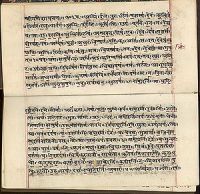 The people of the ‘religions of the book’ projected that “The Vedas,” so very revered by Hindus, must be similar to the Bible or Koran for the Hindus, and some Hindus went along with this to humour them in this perception. Vedas themselves have to my best knowledge never claimed to have founded a religion; nor are they described as the authoritative book of any “religion.”
The fact that they reveal their deeper understanding of nature and deeper spiritual knowledge does not it in itself make them the “Dharma shastra”. That does not mean that a dharma shastra may never be evolving or may not have evolved from the wisdom revealed in Vedas, in some measure or in some parts. The practical utility of the knowledge revealed, if known to the composer, will be described as “Viniyoga”.
Since the concepts of Devas and Devatas are older than the concept of god and goddesses, it is imperative that these newer concepts are not projected on to Devas and Devatas, but examined with a mind not tainted with the concepts of god or goddesses.
If a mind of a rishi comprehended these phenomena of consciousness or knowledge as worth preserving for perpetual cultural memory, it would be included in the Vedas. It must be presumed that there was a consensus for including that insightful knowledge in the form of Sookta or other forms in the Vedas for oral transmission.
Phenomena of consciousness or knowledge must be recognized as representation of inner and/or outer realities. So these important realities that will affect the human race were to be given the status of Devatas. Not all of them may be worshiped by everyone, and may not be worshipped by anyone at all.
However, if they attained the super-ordinate value in human consciousness they were to be recognized as “Devas”. That special place in human consciousness leads to their sacredness and elevation in positive transference to images to be loved and worshipped.
 To understand Devas and Devatas one must focus on human consciousness and its contents. One must abandon the concept of god and goddesses to understand and interpret the images representing these concepts, Devas and Devatas, even though they may be worshiped by their bhaktas or worshippers. Such worship is what makes them look like the gods and goddesses of some other cultures or the Judeo-Christian-Islamic God or Allah.
In simplistic terms, what looks like a duck, quacks like a duck, and walks like a duck, is a duck.
One could use such simplistic argument to dismiss this assertion as meaningless and still maintain that Devas and Devatas are indeed nothing but gods and goddesses. The latter are presumed to be outside the realm of consciousness in the West, and until the West came into contact with the East in the last couple of centuries, Western theology had no mention of “Consciousness”, but now it is not uncommon to hear words like “Christ Consciousness.” The West needs these borrowed concepts to sell their gods. In contrast, the word chit / chid to denote the sentient nature of Brahman is indigenous to Hindu philosophy in describing the nature of Brahman.
Viewing Devas and Devatas as phenomena of consciousness does not devalue them, but in fact raises questions about any spiritual science that bypasses consciousness.
While god is an elaborated projection of a child’s infantile memories of his/her father, Devas and Devatas are real phenomena and exist in the outer or inner worlds.
At a very high level of evolution of individual consciousness, the subjective and objective reality merges into one. That is the Brahman.
But when the duality sets in, as in the paradigm of Purusha and Prakriti, a paradigm elaborated in Sankhya, the Subject is Purusha and Object is Prakriti. So objective devatas are necessarily Saguna and are closer to Prakriti than to the Nirguna Brahman.
These must be understood as “sookshma” or subtle realities from which the manifest (measurable – root “mi” meaning measure and “Maya” meaning that which is measurable – the space-time-mass-energy complex with its measurable precursors if identified by modern physics) universe described as Prakriti emerges starting with “Moola Prakriti.” The saguna Brahman is the beginning and is the “beeja” or the source of “all this” (idam) and is symbolized by “OM”. We are so brainwashed into this business of “god” “demigod” “demons” terminology which comprises of foreign concepts superimposed upon Vedic concepts leading to mistranslations of authentic Vedic concepts, that it is difficult for most people to abandon that foreign paradigm of god and goddesses. No wonder many scholars had trouble making sense of anything that is simple because it is made so very complex over the ages, and also with the introduction of many translational flaws.
 The phenomena of consciousness are not inconsistent with what the majority of the human race experiences as objective. The “concepts” when comprehended are inner representations of objective reality. We don’t have to go back to argue whether they are same as Gods or Goddesses because we are getting away from that superimposed foreign paradigm here. The phenomena of consciousness are the “real” powers working in the human mind. Nothing from “outside”!!! There is nothing “childish” about it when these phenomena are linked with the rudimentary consciousness which is later elaborated with richer and richer contents that nevertheless always remain linked to earlier experiences.
This small article sets the groundwork and elaborates slightly more on this topic previously introduced elsewhere (http://www.sookta-sumana.blogspot.com/) because some felt it did not make sense. If people find anything confounding when processing these concepts and paradigms which seem somewhat novel, it is okay to stay confused for a while and start from scratch again, because any paradigm shift is initially confusing.
There is a need to reassert that Devas and Devatas are real and legitimate experiences of Hindu culture. There is no need to be apologetic about astute representations of reality, both internal and external. Mathematician genius Ramanujan experienced a Devata in his highly mathematical mind and attributed the formulae he arrived at and the insights he gained to the cognitive gifts he received from this Devi that was very real to him, and since the formulae can be verified is real, one has to be careful about describing his experience in the realm of his consciousness as “delusional.”
This topic needs further elaboration in a separate article as the human Unconscious (a compartment of consciousness most human beings are only vaguely aware of) is very rich and full of surprises.
There is no need to insist that words like Deva and Devata must have equivalents in other languages. For instance, the word “Prana” can never be literally translated into one word in English that could adequately or even partially denote all the different meanings this one word conveys in Sanskrit. – Sookta Sumana, 8 October 2012
Readers may see the previous articles in this series at
- http://www.vijayvaani.com/FrmPublicDisplayArticle.aspx?id=2479
- http://www.vijayvaani.com/FrmPublicDisplayArticle.aspx?id=2458
Filed under: india | Tagged: acharyas, agama, brahman, conciousness, culture, devas, devatas, god, goddess, gods | goddesses, hindu, hindu culture, hinduism, india, inner reality, knowledge, monism, neo-vedanta, outer reality, panentheism, pantheism, philosophy, polytheism, religion, rishi tradition, rishis, spirituality, vedanta, vedas, vedic agama |










 BHARATA BHARATI
@IS thankyou for your detailed and beautiful reply. The key sentence which I find useful is your statement that ofcourse we see them in our consciousness ALWAYS, by which you mean the ongoing processes of our human minds. And you add that they are OBJECTIVE simultaneously by which you mean that they are independent of our awareness of them. This would be my position also.
I have been thinking of A’s position. He too is not denying that Devas are objective. He is trying to understand what that consciousness is which relates to the Devas and in terms of developmental psychology (this in the latest article). That should not confuse any educated Hindu. The uneducated Hindu is not likely to read his articles anyway.
Whether as an epistemological question (consciousness ‘knowing’ about the Devas) or as a question of developmental psychology (the child’s unfolding consciousness) the Devatas are objectively outside of these processes. That too would be my position.
Ofcourse, your concern is also legitimate. The “educated” Hindu is truly not educated. Either he/she is a product of Macaulayism, both residual and direct, or he/she is a contemporary young person not rooted in our Hindu tradition. That might be where the person can get confused.
The aam admi simply worships the Devatas. End of story.
LikeLike
Dr. Rajiva, we cannot presume to know what Achintyachintaka “really” means except from his own word that he writes here. He is an academic and highly qualified person in his discipline. We must assume he means exactly what he says. We cannot assume anything else. We critique him on what he says here not on what he may “really” mean in his head or some place else.
You articles are fine because you do not presume to know something of the Devas and Devatas that you do not know.
Of course we perceive the Devas in our conciousness–we have an inner relationship with them always. But they are objective divine beings, fully independent of the human being and human mind (which today is a garbage heap anyway). They interact with human beings out of their own free will and compassion for the sorry human condition, spontaneously, or we can call them and make a place for them here through ritual wherewith they may or may not choose to visit us. See the lovely article Baijnath Mahadev: The only Hindu temple built by an English couple in India describing the interaction of Baijnath Mahadev with an English couple. There are many authentic recorded stories like this of Christian British administrators in India being guided or assisted by Hindu Devatas. Certainly these Devatas were not the product of the British administrator’s mind. They were independent beings who came to help or advise of their own volition.
Our quarrel with the professor of psychiatry is that he is saying over and over again, in so many words, that we Hindus have created the Gods and Goddesses, Devas and Devatas, out of OUR OWN mind conciousness. This is purely a Western psychological theoretical construct. It is 1) not true, and 2) totally subversive of Hindu Dharma. Our scriptures treat the Gods and Goddesses as completely objective independent divine beings who interact with us spontaneously, and this sadhu’s own experience confirms the scriptures to be true.
As for Gods amd Goddesses, whom Achintyachintaka wants to exile out of our Hindu discourse, they are no different whatsoever from Devas and Devatas (see the image of Artemis above; it could easily be an image of Saraswati). They are the same divine beings, manifestations of the Saguna Brahman, present in a different culture and therefore identified with the different culture (as Ram Swarup would say). They have been banned and exiled from these cultures by the asuric Christian missionaries starting with apostle Paul and have returned to their subtle abodes (there are proper Sanskrit terms for this process of de-manifestation which this writer does not know), but that is a different discussion from this one.
Achintyachintaka’s comment above shows that he has either mis-understood our critique or that he wishes to distort and pervert what we actually say in it. If the latter, then he is a very dangerous man with an anti-Hindu agenda that has been concealed up to now.
LikeLike
I second IS’ comment entirely.
I want to further add:
Until Achintyachintaka sees and truly interacts with the real Hindu Gods (i.e Devas/Devis/DevargaL) — a.o.t. to any imaginary ones in his head — he has no right to lecture Hindus on the Hindu Gods at all. Full Stop.
*Unfortunately*, since Achintyachintaka himself has insisted that his notion of the Gods are entirely a product his delusion — I mean, consciousness — he has himself precluded all possibility of ever lecturing Hindus about the real Gods (who are not delusions/consciousness).
Another rule: Achintyachintaka (and his kind) should all Stop Talking about other heathen religions. They don’t know what they’re talking about.
To Achintyachintaka, There are two people here who *know* you to be delusional.
Actually, IS is too kind to think of you as a liar, but I consider you to be one. I too would have called you merely delusional if you had left it at deluding yourself. Or even had you become silent after noticing the *nature* (reasoning) in the arguments against your initial nonsense. But you not only persist in your personal delusions but also in your insistence on continuing to foist this on others. This makes you a liar. A liar against the Real Gods.
You *don’t* know what you’re talking about. (Again: fact.)
I am sure there are many people willing to believe your falsehood, who see your nonsense as something for them to be be “proud” of (because they don’t *know* better and can thus be made to be believe anything). It is clear that makes you feel vindicated (ego, what?). It still doesn’t make you right. You remain wrong. You will *always* remain wrong in this. [That’s just a fact.] What’s the worst part of this, though, is your crime is not limited to subverting yourself but in subverting others too. I’m sure you are willing to live with it.
But your delusions are a danger equal to that of the memetic christian-class virus. You don’t see this. Others can (e.g. I saw your silly Hindu Gods are “a product spiritual consciousness” coming before you stated it in your article).
If you had any interest for the welfare of heathenism (the Hindu kind in this case, since your delusions are fortunately limited to damage Hindus in their scope), then you would persist from speaking on matters you are clearly ignorant of. But you won’t. Making the responsibility for the crime all yours, and the responsibility for cleaning up the mess the work of future generations.
LikeLike
@ IS in fairness to A. it was my articles on Hindu Polytheism that seems to have set the ball rolling. However, my viewpoint is somewhat different from his in that I see the Devas and Devatas, as objectively existing outside of human consciousness and were hailed by the Rishis as such.
A’s subjective approach (unintentional) could be resolved if he used a different terminology such as inner and outer cosmos (ARS) and this terminology would remove the subjectivism of the word ‘consciousness’.
Although I believe that the Devatas manifest spontaneously at their own time and wish, it is hard to understand how we can see or relate to them without either our senses or our consciousness. This is the puzzle I am unable to solve at the theoretical/philosophical level.
So then one has to simply say: this happens. Perhaps that is why too the Vedic Rishis sooktas are considered apauruasheya.
LikeLike
To clarify: “Even if only to show that traditional Hindus do not agree” I mean: “Even if only to show that [the views of the Gods of] traditional Hindus do not agree do not agree with Achintyachintaka’s views”
LikeLike
I can’t tell you how relieved I am you wrote your comment stating that Achintyachintaka is indeed a deluded person/liar.
And your comment *should* be the article. Please make it an article. Make it the primary article.
It is exactly the response that’s called for and which needed to be made to counter memetic diseases like the one Achintyachintaka and his fanclub just launched and foisted onto the Hindu masses. I fear even christianism less than the internal subversions regularly propagated by the deluded subverted.
“Why we don’t talk about it? Because there is a tradition not to reveal one’s spiritual life to the public and especially profane persons like professors of psychiatry. They will only ridicule or analyse the experience into oblivion, or like Dr. Achintyachintaka explain the relationship as a product of our own subjective conciousness.”
Yes. I know. It is indeed a sort of taboo, if not officially, then unofficially. But when times are such that delusional liars are getting a mass hearing, I think loyal Hindus who know better should be willing to expose the lies and tell the truth. Those who can distinguish the truth from the lies — those to whom truth is a friend — will favour your accounts, and those who prefer the lies deserve their own subversion.
I am sorry to have forced your hand to make you write about what is private. But it was either that you would speak of it, or that I would have to speak of Hindus I know. But they have not authorised me to speak of them (though I was contemplating doing even that much). It’s better to have come from you, as yours are first-hand accounts. While mine are 2nd-hand.
No one is expected to believe — and belief would be wrong — but the truth about the Gods deserves to be *stated* as a counterpoint to the lies being proliferated. Even if only to show that traditional Hindus do not agree, and to reveal how different traditional Hindus’ experience is to that of the nonsense of Achintyachintaka.
LikeLike
Achintyachintaka, you have not understood our comments at all or you are deliberately distorting their meaning. You had better go back and read them carefully.
We are not discussing Abrahamic one-godism in the comments. We are discussing your theory that the Devas and Devatas are different from Gods and Goddesses. Our view is that they are not different at all and that you don’t know what you are talking about vis-a-vis Gods and Goddesses in ancient Greece, Rome, Egypt, etc.
Second point: Your theory that Devas and Devatas are a product of the Hindu mind is 1) not true, and 2) completely subversive of Hindu Dharma. It is to be totally rejected.
Your theory is a purely Western psychological construct and has no relevance to the practising Hindu in India at all.
I repeat, go back and read all the comments very carefully as we are not saying as you suppose in your comment above.
LikeLike
Dear readers and commentators:
Achintyachintaka did not anticipate that there will be such a voluminous outpouring of thoughts, feelings, and a sincere effort to share superior spiritual knowledge of Gods and Goddesses in response to the three articles sent to Bharatabharati. The author had to find time in his busy schedule to read all (nearly all responses at one sitting) and certainly had no capacity to respond to all points of view and all points raised in the discussion, leave alone engage in a dialogue with each poster of views.
First, there was no malice towards Hindus and if perceived it is far from even the dreams of Achintyachintaka. There is no conscious or unconscious motivation to subvert Hindus into diminishing their love and worship of their sacred Devas and Devatas.
The articles are not “Interfaith Dialogue” nor “Comparative Religion” nor lectures or exhortation to Hindus as to how they “should” or worse “must” view and understand their Devas and Devatas, but on the contrary these are three articles in a series of articles on this topic published many months and some many years ago on several other blogs.
Some of them were recently republished on Vijayvaani and now on Bharatabharati. There is no political motivation to help the leftists or communists and “A” has no knowledge of political leanings of blogs in India.
It appears with all differences and criticism voiced against A’s views there is a consensus among the commentators about discomfort with the so called “One Godism”. It is One Godism that decimated the Greek, Western Asian, (including Turkey) Gods and Goddesses. They downgraded them and in turn wanted to and continued to want to downgrade the Hindu Gods and Goddesses with pejorative characterization of Hindus for being polytheistic or worshipping innumerable Gods and Goddesses. Hindus have been reactive but there is not one famous authentic work by anyone who knows devas and devatas to explain these and make the Aam Admi Hindus proud of their heritage. May be some of the commentators could write cogent, clear articles to explain the authentic Hindu view and understanding of devas and devatas for the ignorant Hindus who have not seen devas and devatas. Achintychintaka will read such work with great interest and curiosity to learn whether Chid (Consciousness) (with upper case “C”) of Brahman does or does not encompass all devas and devatas in that other frame of reference, and if it does, how that view differs from A’s view presented here. (Poornam Idam Poornam adam, and Ishavasya Idam Sarvam).
Coming to the last shared third article on Matru devo bhava which led to the expelling punishment or brandishment of Achintyachintaka from Bharatbharati, all devas and devas regardless of their independent existence have to attain existence in the human (individual) consciousness of the Bhakta or Devotee. The article examined the dictum Matru Devo Bhava and indicated how the bhakta becomes attuned to the Vastalya of Mother(generic mother) which is what drives the Devas and Devatas to take interest in their devotees. This is the mother-child, child-mother relationship paradigm that is the essence of Bhakti, well known to the Warakaris of Maharashtra (Vitthalbhaktas) who call everyone, meaning fellow bhaktas and their devata Vitthala “Maauli” a very endearing term for mother. The Bhava underneath that is childlike innocent outpouring of love like the one that would lead a 3 year old child who finds a dandelion flower to pluck it and bring it as a gift to his/her mother, and that is “archana” ritual of navavidha bhakti. (Please read 12th Chapter of Bhagvadgeeta)
Leaving aside all intellectualization, it is the love of devotee for his devas and devatas that is the driving force and does that not all occur in the sphere of consciousness? Why be so harsh on Consciousness (Chid) and individual consciousness (Chit) and all the chittavrittis that need to be activated to become attuned to devas and devatas?
Achintyachintaka may view the objections raised against his frame of reference as precisely arising from the contamination of Hindu ethos by the Western concept of God, Gods and Goddesses as residing outside of Consciousness ( and creating even Brahman and Universe from “there” as if He is a wizard of oz – “Father in Heaven”). Having said that, Achintyachintaka would be remiss if it is not clearly stated that the articles have been increasing the pride of many Hindus and have been appreciated by many Hindus and apologies will be due to the august readers of Bhratabharati if their sentiments were offended, which was exactly the opposite result than that which was intended. Therefore, Achintyachintaka will be happy to exit from Bharatabharati gracefully without offending its readers any more but will urge them to read the articles on
“Freedom to Think (“Dhee”): Essence of Hinduness” by finding this two part article on google search engine.
Finally in closing, author want to thank Shri Ishwar Sharan ji and all the readers for making sincere efforts to globally understand the three articles presented by Achintyachintaka and indulging him by making room available on the blog.
Achintyachintaka also would like to thank those who understood the spirit in which these articles were written and took time to write positive comments.
With many thanks to all, all who have now to take the torch to glorify the Hindu devas and devatas for all aam admi Hindus and simplify the concepts for all grown up and maturing Hindu minds,
Sincerely,
Achintyachintaka
And what harm will come to Hindus by reading Achintyachintaka’s views remains to be seen.
LikeLike
@IS liked your moving account of the gods appearing at will as when they choose etc. But perhaps you are being too draconian in not letting A continue writing his articles (after tomorrow). I do not believe the gods are threatened, and nor will they stop appearing to the devotee, nor will the Hindus both of Bharat and the diaspora stop their rituals. In fact, I suspect that A himself practises ritual quite diligently. I admire and respect ritual and see its beauty but am not always inclined to performing it. Does that make me less of a Hindu ? And like A I too am a diasporan (although that is not the reason I find his articles interesting).
Perhaps ARS also has a point. More should be written about the Hindu religious rites from the traditional point of view. He/she should do it, but not prevent someone else from writing about it !
But I am sure that I too can see the gods/goddesses as well as any traditionalist, and talking about consciousness etc. need not detract from that process. Is ARS absolutely certain that only he has interpreted our rich and diverse tradition correctly ?
And is there anything which prevents the gods/goddesses from visiting A during his reflections, as Devi did when Ramanuja came upon his mathematical discoveries ? As I understand Hinduism, jnana yoga is also an aspect of approaching divinity. And it can be a circuitous route also.
LikeLike
Yes, this poor sadhu cum editor has been engaging with the Devas since he was a small boy. Not once but a number of times there were encounters in Canada, later in Turkey, then India that radically changed his life and world view. As a child he did not call them Devas because he had no knowledge of Hinduism or Indian Pagan culture and did not identify them with any culture, but later they were recognised as Hindu deities.
These deities are everywhere and can manifest anywhere to anybody they choose. They may be the product of Universal Mind but they are not the product of human mind.
Why we don’t talk about it? Because there is a tradition not to reveal one’s spiritual life to the public and especially profane persons like professors of psychiatry. They will only ridicule or analyse the experience into oblivion, or like Dr. Achintyachintaka explain the relationship as a product of our own subjective conciousness.
The relationship between human and Deva is partly subjective as are all human relationships, but it is equally objective as are all human relationships. The relationship is not a product of the human subconscious mind as Dr. Achintyachintaka argues. His view is the western secular psychological view. It has no spiritual, religious or cultural value at all.
The Devas or Gods are fully independent divine persons who live in their lokas and visit whom they will when they will. They can be called either by an individual’s devotion or correctly performed ritual. They interact with humans when a place is made for them to manifest in society, either ritually in a designated place like a temple or yaga sala or puja room, or in a person they choose whose mind is “pure” and does not interfere with their will or work among human kind. Such persons who have deities with them, like the Kanchi Mahaswami or Baba Nityananda of Ganeshpuri, are recognised as saints or siddhas. Belief is not a criteria for divine beings to manifest (here the Abrahamists are completely wrong), but “right action” or what we call following dharma is a criteria.
All of this is in the scriptures. Dr. Achintyachintaka the Psychiatrist has got it wrong. Worse, his ego has got involved and he believes he is presenting Hindus with a new paradigm. Well, it is a paradigm Hindus do not need. This editor now understands why some Hindu intellectuals have been dead against the input of American NRI’s regarding Hindu religion. Dr. Achintyachintaka’s input is destructive not constructive. But he is not listening. His own intellectual creation obsesses him and makes him deaf to the input of others. He has not paid any attention at all to the comments made on this page.
We have promised to published his latest “explaination” of Devas and Devatas. It can be ignored by practising Hindus though it is more revealing of his western secular view than his earlier articles. Having fulfilled our promise in publishing it, we will no longer give him any space on this website.
LikeLike
IS, meaning no disrespect, surely you know more about Gods than Achintyachintaka? (You saw one.)
So why does the Hindu readership have to instead be subjected to Achintyachintaka’s groping in the dark? Unless he suddenly claims he has seen the Gods next, why should anyone care for his mere opinions on the matter? What value — beyond that of opinions — can they have? And are Hindus then to be subjected to the opinion of every other inexpert Hindu on the matter? Surely there must be as many theories and opinions as there are people? Most of which will never come close to revealing what is well-known about the Gods as explained in Hindu texts (and still witnessed first-hand by some Hindus).
It is *established* knowledge from our traditional texts and widely-known accounts that needs to be re-infused into Hindus of our age, so that they may learn the correct nature of the Gods from there — from the knowledge bequeathed to them by their own experts on the subject. It is *that* knowledge that will help Hindus approach their Gods with the right perception of who the Gods are. And that will then put them on the track that will help them to become able to confirm *for themselves* who their Gods are, thus confirming the traditional accounts for themselves. (Such accurate knowledge will also immunise Hindus from subversive views. That is, it will make them insubvertible.)
I think this is really the need of the day — that Hindus seeking to defend Hindus and their religion should be pushing the traditional views (of the Gods) onto interested Hindus readers, just as they are pushing for upholding the established tradition of rituals and the traditional acharyas.
LikeLike
1 The difference is not one of semantics. My whole point was to state that there is no relation to the sort of established inner worship as discussed in the Hindu texts I was alluding to, and whatever it was that Achintyachintaka was talking about.
(I.e. Achintyachintaka is not talking about the same sort of thing.)
Repeated with emphasis:
‘Yes, Hindu Gods are indeed worshipped internally also (such as in the daharaakaasha) by Hindus, as this is part of traditional practise. However, the TRADITIONAL DESCRIPTION of this practise OF INTERNAL WORSHIP (and the nature of the Hindu Gods as they appear here) BEARS NO RESEMBLANCE TO what ACHINTYACHINTAKA implied.’
and:
‘The GODS ARE as much EMBODIED IN THE INNER cosmos of the individual, as they are the outer cosmos of the manifest “universe”. The INTERNAL WORSHIP of the Hindu Gods is well-described in Hindu texts (and the FORMS OF THE GODS THAT APPEAR AT EACH STAGE during this Yoga are VERY SPECIFIC AND WELL-DESCRIBED).’
2. Also, the relevant Hindus texts merely confirm for those Hindus who observe these ritual practices that they are carrying them out correctly: that is, if you carry them out correctly, certain *very specific* forms of various known Gods appear at each stage. (This therefore also serves to indicate when you’re not doing the practise right/are not getting anywhere.)
Practising Hindus have repeatedly confirmed these texts. (Some of them were carrying out these practises independent/unknowing of the texts that have confirmed their experiences. Such cases are independent confirmation that these ritual practices, when done correctly, work.)
Also, those who have seen the Gods in their “mind’s eye” during this Yoga, tend to start getting direct visits by these Gods shortly after: i.e. the Gods appear at normal waking (non-meditative) times. More than merely appearing, they interact with the Hindus. I choose to say all this here *only* because such things are the very reason why it is important to defend the right view and understanding of the Gods.
LikeLike
@ARS agreed that the heathenism as you define it must be protected. I am personally inclined towards that heathenism (as you describe it). On the other hand, there is nothing wrong about providing a view of consciousness in this entire process. Or for that matter of the senses.
This is where I find A’s articles interesting. The deity presenting himself or herself may not really object to the presence of human consciousness (and senses) in viewing him/her and worshipping him.
This is why ritual is important. There is a similar with Aurobindo which I point out in my article ‘A Critical Examination of Shri Aurobindon’s Secret of the Veda’.
Why have ritual if it is symbolic?(Aurobindo) In this case why have ritual at all if the deity will appear anyway in front of us or inside of us ?
LikeLike
Achintyachintaka’s new article “Devas and Devatas not Gods and Goddesses: How then do they come into ‘Existence?'” is published at https://bharatabharati.wordpress.com/2012/10/17/devas-and-devatas-not-gods-and-goddesses-how-then-do-they-come-into-existence-achintyachintaka/
LikeLike
Right, it is Gods and Goddesses. The upper case does scare the Abrahamists. We know this from experience. “Pagan” should also be upper case always, just as we write Hindu.
English-speaking Hindus and Buddhists have been concerned about rendering Sanskrit terms into English from at least the 1940s when Buddhism caught a hold of the Western popular conciousness. Often the tried English so-called equivalents were rejected and the Sanskrit or Pali or, later, Tibetan terms kept. Looking for Sanskrit equivalents in psychology was also tried. It proved a disaster: “samadhi” is not “trance” as the dear “mental” doctors would have us believe! So this discussion is not new (and with due respect, the professors are late-comers to it), and there is an established acceptable terminology used today among Hindus using English (which includes a very large number of educated Indian Hindus). And Sanskrit terms are being added every day into English — which is the wonderful accepting character of the English language – and will very soon appear in the English dictionaries (as they will never appear in the French).
Where the problem of terminology arises — and I cannot overemphasize this though it may offend some Indian Hindus — is with the universalist Hindu gurus starting with Vivekananda and the Christian convert — for all intents and purposes — Yogananda. They are the ones who COALESCED terms and their meanings and said, or at least implied, Christian religious terms meant the same as Hindu religious terms, as this usage was part of their “it is all the same” agenda. They assumed the “sameness” partly out of sloppy thinking but also out of ideological need.
Western Hindus are aware to some extent of this perversion of terms and meanings (unless they consciously accept the universalist stance, as many do), if only because they have had to study Hindu religion from all sides and its roots, and cannot assume anything (unlike their Indian Hindu-born counterparts). But there remains a problem with the Indian Hindu because of the idolised place universalist religious teachers like Vivekananda and Gandhi hold in the modern Indian conciousness, and because important and powerful Hindu institutions in India like the RKM or monotheist Arya Samaj, or even the now monotheist — Muslim really — Sikhs, still promote the universalist or one-godist view as being the true representation of the Hindu view, as, of course, does the secular Indian government. Even the so-called Hindu political party the BJP has renegaded on their Hindu cultural identity and taken to secularism and universalism.
And there is the ever present bane of left-over Marxist thinking with its outdated internationalism which is being converted into a kind of distorted Hindu nationalism that we should be aware of — (Why Hindus took so readily to Marxist thinking is a mystery this writer has never been able to solve).
Therefore Dr. Rajiva is very right in promoting the authority of the traditional acharyas and maths — though there are many problems in these institutions too as the gurus grapple with modernity and the globalisation — should we say universalisation — of their own devotees. These acharyas are very much concerned with Sanskrit terms and meanings, and some are sufficiently knowledgeable in English to correct misunderstandings and wrong usage in English translation of Hindu concepts and religious terms. What they will not do is publicly critique Christianity and Islam — though they do it in private — as they are prestigious public figures and also bound by the current political compulsions of all public figures. This is very unfortunate because their public critique of the Abrahamist ideologies would have a profound effect on Indian society given their traditional authority and influence in high places.
LikeLike
“Thus A is not actually denigrading other pagan systems of worship”
He said this in his first article:
‘On the other hand, the natural tendency of the foreign invaders to project their own cultural understanding on the culture of the newly found indigenous cultures to find similarities can also be assumed to be a factor leading to projection of their own concept of “God” (including “Allah”), “Gods” and “Goddesses” (known to them from their encounter with the Greek culture of antiquity – now extinct or decimated by the Christian empire) onto Hindus whom they encountered and assumed to be “look alikes” in their forms of religious worship.’
He actually dismissed the real Gods of other heathen religions as his whole article was a denial that Hindus traditional understanding of the Hindu Gods could not in any way resemble the traditional understanding others have of their own Gods. The error is two-fold: Achintyachintaka does not know the religions and Gods of others and he does not even seem to know his own. Which is why he can’t see the obvious similarities. And, of all things, he would mention the Gods of ancient *Greece*, whose followers’ words are still preserved in fragments: enough for a Hindu to recognise fellow heathens in.
I’m glad IS objected.
The real Gods of others are not identical to Hindu Gods, nor do we have “equivalents” to theirs (only mythologists seek and speak of “equivalents” in this sense, which is a different bane of heathenisms and a different source of subversion). But the real Gods of — at the very least some — other people of this world are in many respects *similar* to what our Gods are. I base this on the little I have learnt about how traditional Hellenes viewed their Gods in Hellenismos and traditional Daoists have always viewed their Gods in Daoism, and the like. The more I know of these religions and the traditional way their Gods are viewed, the more I realise they may *never* be dismissed. And that they are moreover a great source of defence of traditional Hinduism.
LikeLike
“the polemical nature of A’s article. He is actually polemicising against the Abrahamic one godists”
I saw that he tried. But his is a very poor criticism. It does not really touch christianism and it subverts Hindus’ religion. Christianism is not afraid of pseudo-vedanta at all: it’s its own dear friend, as IS has repeatedly pointed out.
The best criticism — because true and piercing into the very heart of the monotheist monstrosity — is still from the 4th century Roman Emperor Julian:
“It is, I think, expedient to set forth to all mankind the reasons by which I was convinced that the fabrication of the Galilaeans is a fiction of men composed by wickedness.” Where “Galilaeans” is Julian’s important and famous choice of term for “christians”. And the “fabrication of the Galilaeans” therefore refers to jesus and hence christianism. Julian essentially declared that christianism is an evil lie.
And his famous challenge to christianism to provide evidence of historicity: “But if you can show me that one of these men [Jesus, Paul, Cornelius, Sergius Paulus, etc.] is mentioned by the well known writers of that time, – these events happened in the reign of Tiberius or Claudius -, then you may consider that I speak falsely about all matters.” (Loeb’s Translation)
LikeLike
@IS, agreed, and it takes time for the new word to gell and settle in our discourse. But since my own articles preceded A’s articles and there I spoke often of gods and goddesses, one poster said he was a bit confused by the free way I interchanged the words with devas and devatas. If A reads these comments he will understand that it is no longer necessary to clarify his usage of the words.
The significant difference (although it really may not be so) of ARS comment above is : the gods are embodied in the inner cosmos of the individual, not only in the outer. The difference may only be semantic because while the god can appear embodied in the outer universe, which is then apprehended both by senses and consciousness of the worshipper, then the same process cannot take place inside the individual. The ’embodied’ nature of the deity becomes problematic. A’s point is precisely that: no need for the deity to be ’embodied’ in the inner cosmos.
LikeLike
“interesting description of the outer and inner realm of the Devatas.”
To be precise, the phrase I was trying for is rather that the Gods manifest as the outer cosmos as well as in the inner cosmos (inside us).
It’s from our Hindu texts on the Gods, which are actually very detailed on the matter. And it’s quite standard Hindu religion: IS, you and other ritualists are sure to know several of them, but I veiled it in light language because I wouldn’t want the likes of Achintyachintaka pillaging such sacred texts to contort next. Better safe than sorry.
Hindus can (and really ought to) learn of the Gods and their nature from the traditional, correct views that are contained in our Hindu texts — since this knowledge is bequeathed to us by Expert Hindus — as well as learn about the Gods from first-hand accounts of traditional Hindus we know in our own time. Both sources confirm each other. Such knowledge also prevents Hindus getting subverted by others (as others tend to sound disconsonant with traditional accounts). It also makes it so much easier to defend the religion of the Hindu Gods from false claims like that of the Salman Rushdies.
LikeLike
VR: “I believe some devout worshippers actually see the form of the Devata during the homa”
Yes, I figured that out when you chose to repeat my references (at VV) to Kanchi Paramacharya’s writings in your articles about Hindus’ Vedic/Agamic religion. (The book is back Home, else I’d have typed out direct quotes.)
But there is more to be said about the Gods: they interact directly with many Hindus to this day. The Hindus they interact with at times even obtain things from them that help Hindu society in general. At other times the Gods merely choose to show themselves to delight their Hindus.
It is a real religion because the Gods are real (and the religion *works*). And it is a living religion only because *while* Hindus are unsubverted they can consequently still see their Gods. The religion remains alive only while the bond between the Hindus and their Gods is still strong. Therefore, the Hindus’ heathenism — their correct perceptions of the Gods — is what *must* be protected. It must be protected from all subversions and subversionists. And from the great enemy: the false ideologies of the non-existent, invisible mono-gawd of unspeakably evil character, who have promised death to all heathenism.
That reminds me, I forgot to add to my earlier littany of complaints that Achintyachintaka’s paragraph on Vedas — on why the Vedic sooktas were supposedly *made* sacred and how/why the Hindu Gods were made sacred and came to be worshipped — was utter nonsense.
But I still can’t fathom why or how someone who so *obviously* knows nothing about the Hindu Gods or the Vedas has gained the right to lecture Hindus about these very topics. (Meanwhile, the sole experts on the Hindu Gods remain as always the Hindus who still directly interact with them. Just as the sole experts on the Vedas remain those that carry the rites out correctly — especially those with divyachakShus among them, as they clearly know what they’re doing and what it means.)
LikeLike
Especially when title-cased 🙂
As in: Gods and Goddesses. This scares the believers in the non-existent mono-gawd no end. Because it goes against the first commandment, you see, to see the God(desse)s of others title-cased.
Also, all the real Gods (i.e. of the “heathen” religions) deserve to be title-cased. What’s more, they deserve to be named, with reverence — and, where they are our own, they deserve to be named/recalled with Piety (in the original, that is Hellenistic Roman sense).
Sadly, I’m going to have to go back to referring to the devargaL as Hindu *Gods* in English, even though some years back I was arguing to other Hindus that we should stick to using Devas/Deva/Devi even in English. And the only reason I’ve now decided against it is to make sure no English-speaking Indian Hindu misconstrues my usage of the terms in *English* as referring to Achintyachintaka-type “phenomena of consciousness” gobbledygook. Sorry, but it IS gobbledygook. I’m so glad IS said it plainly: it’s all nonsense that merely sounds clever: “But because it is couched in psuedo-vedantic and psychological terms, Hindu intellectuals do not readily recognise it for the learned nonsense it really represents.” I second the analysis.
I am forced to resort to using Gods again, only to avoid the new subversive connotations given to Devas/Devis in English language-use by some other Hindu. The irony. Fortunately, I can still use the Hindu terms in my own (Hindu, Indian) language in the correct, original and *only* correct sense: the traditional (and un-Achintyachintaka) sense.
LikeLike
As we use the terms ‘idol’ and ‘pagan’, there is no reason not to use ‘gods’ (in plural only) and ‘goddess’ in English discourse. There is no association with the Abrahamic asura in these terms. Even Sanskrit users do not often use the term ‘devata’. Anyway, as I have pointed out earlier, English-speaking Hindus have been using terms like ‘bhagawan’ and ‘ishwara’ and ‘devi’ for the last five decades at least.
LikeLike
@ARS, interesting description of the outer and inner realm of the Devatas. I believe some devout worshippers actually see the form of the Devata during the homa.
That said, I think we are all missing out on the polemical nature of A’s article. He is actually polemicising against the Abrahamic one godists when he presents the processes of consciousness during worship.
This is what I also tried to emphasise as the overcoming of subject object dualism which is typical of western thought.
I found A’s description quite interesting, although perhaps he could simplify the explanation a little bit. A is also suggesting that we should abandon the words ‘god’ and ‘goddesses’. These are translations from the English. Thus A is not actually denigrading other pagan systems of worship
LikeLike
I agree that Achintyachintaka should keep reference to Gods and Goddesses out of his articles. He doesn’t know what he is talking about. And it is very unjust to associate them with the imaginary Abrahamic one-god Yahweh-Jehovah-Allah.
LikeLike
VR: “He simply seems to be saying that when viewed as external realities they are indeed external (as in worship of murtis etc.) but they can also be worshipped internally in which case they becomes aspects of the individual’s consciousness.”
Yes, Hindu Gods are indeed worshipped internally also (such as in the daharakaasha) by Hindus, as this is part of traditional practise. The Gods are as much embodied in the inner cosmos of the individual, as they are the outer cosmos of the manifest “universe”. The internal worship of the Hindu Gods is well-described in Hindu texts (and the forms of the Gods that appear at each stage during this Yoga are very specific and well-described).
However, the traditional description of this practise of internal worship (and the nature of the Hindu Gods as they appear here) bears no resemblance to what Achintyachintaka implied.
Ironically, it is in these very aspects that Hindus share great similarity with other heathen religions.
Also, anyone not familiar with other religions similar to our own — such as the Hellenismos of the Greeks and Romans and the Daoism of the Chinese — should leave all mention of other heathen religions out. There are no excuses for mangling other heathen religions.
LikeLike
Sri Achintyachintaka-ji, Gods and Goddesses in English in no sense refer to the imaginary Abrahamic one-god Jehovah-Allah or his cohorts.
It is really not clear why you include them here and in the article above — only to exclude them from being manifestations of the Infinite Brahman (a contradiction in terms if ever there was one!).
Gods and Goddesses in English only refer to the deities of ancient Greece, Rome, Egypt, West Asia, etc. We know little of these deities because they have been exiled or subsumed (“digested”) by the Christians and Muslims. But we do know they were not imaginary deities but conceived and worshipped much like our Hindu deities. They were dressed and decorated and fed and sung to by specialised classes of priests. They were not at all like the blind white statues now found in museums. But most important, they were never in conflict with Hindus at any time in the ancient past.
According to some historians there were Hindu scholars and sadhus in Alexandria at least from Alexander’s time. And there was Hindu pilgrim traffic to Mecca from Prabhas Patan in Gujarat, to see the Moon God Hubal, long before the advent of Islam (which is why Muslims always targeted Somnath; they knew about Somnath and believed the Meccan Goddesses had taken refuge with him after being ousted by Mohammad).
So Hindu India has never been isolated and its superior spiritual teachings have always been recognised. And the Gods and Goddesses of West Asia have always been our friends! It is a grave mistake and injustice to lump them in with the Abrahamic asura Yahweh who would be the only god if he had his way — which he hasn’t had even till today!
LikeLike
Achintyachintakas has sought to clarify his position and refers to the article VEDIC AGAMA AND DEVAS & DEVATAS (DEVIS VERY MUCH INCLUDED) on Sookta Sumana.
This article as presented on Vijayavaani is also available at Devas and Devatas: Not Gods and Goddesses on Bharata Bharati. See the second part of the article called “Vedic Agama and Devas & Devatas”.
For immediate reference the article is reposted here as it is:
MORE ON “ONE GODISM” AND DEVAS & DEVATAS FOR SURVIVAL OF HINDUS AND OTHER INDEPENDENTLY THINKING POPULATIONS OF THE WOLRD THAT DO NOT NEED TO BE FOOLED ANY MORE.
VEDIC AGAMA AND DEVAS & DEVATAS (DEVIS VERY MUCH INCLUDED)
by
Achintyachintaka
The recent articles on Vedic Agama, Village Agama, Hindu Polytheism, and “One Godism” seem to have confused a few of the readers below.
So, it would be imperative to search for the basic assumptions on which there is an agreement.
Brahman of Vedanta and Purusha of Sankhya are described as the offshoots of many discoveries of Vedas. Both are described as basic “realities” from which all realities emerge and are accepted widely as “Sat-Chit-Ananda,” when combined into one word, “IT” is addressed as “SADCHIDANANDA.”
Sat stands for existence meaning “It Exists”. That adjective then asserts that “IT” exists and is real. It is not an imaginary entity.
(Please note that “IT” (Tat) is not a “male” God as in the Abrahamic God.)
Chit (Chid) means Consciousness. It is an assertion that Brahman is pure Consciousness and has no attributes of material world, like dimensions, (energy, mass, space, time, and other dimensions) Such consciousness, if accepted as the nature of reality outside the brains, makes IT a sentient energy when Brahman acquires the attributes of energy. (See “Hinduness for World Peace and Harmony” on the blog http://www.sookta-sumana.blogspot.com and “Demystifying Shri Ganesha” on this blog by placing the titles on google search engine). That is the primordial (sentient) energy with no mass, but only “vibrations,” “wave form,” or OM, when IT becomes the sentient energy. Mass is a magnificently concentrated energy which emerges much later in Vedic Cosmogony.
Ananda can be translated as Bliss. Those who experience this entity of Brahman describe experiencing the ultimate bliss.
All other devas and devatas are accepted as manifestations of this Brahmnan.
Since Brahman is consciousness as described above, all devas and devatas (including devis) are phenomena of consciousness.
Therefore, all “Devas” and “Devatas” (including Grama Devatas) must also be “Sat” and not imaginary entities. They exist spontaneously just like Brahman and all devas and devatas, and of course, Brahman itself is “Swyambhu” meaning spontaneously existing.
All devas and devatas are experienced as “bliss” when the devotee recognizes them at experiential level in an experience that is described as “Sakshatkaara.” (“Sakshatkaar” may be remotely translated in the spiritual parlance as “actualization” at the level of consciousness, as if consciousness itself perceives itself or an aspect of itself with full intensity in appreciating its true nature, sakshat meaning immediate perception of actual reality and akara meaning form and shape)
Human beings have to reach a stage of evolution of their consciousness to realize the presence of devas, devatas (davis), and recognize them as realities. Such recognition (seeing) must not be confused with imagining their presence. If imagined and if they do not really exist they are “ASAT” and no Hindu would want to worship anything that is “ASAT.”
If any God or “Gods and Goddesses” that are purely figments of imagination, they have no place in Hindu polytheism. “One Godism” based on a concept of “Imagined One God outside of Nature” “creating and controlling Nature” has no place in Vedic Agama Hinduism. That concept must be dismissed as pure imagination although some Hindu scholars have compromised by accepting such concept of One Godism as part of Hinduism or equivalent to Vedic concept of God. There is no GOD of that type in Vedas.
Vedas preexist by many millennia the concept of “God” conceived by other cultures, meaning other than the Vedic Cultures. Such concept of God was pronounced as dead by Nietzsche. Stephen Hawking declared such “God” was not necessary for this Universe to be “created.” Hindu view of cosmos and cosmogony must not be obfuscated by the Western and Middle Eastern concept of Abrahamic God that “created this world” because Vedas preexisted emergence of such primitive concept and are more realistic in comprehending the nature of Universe or Universes. Vedas by definition are knowledge of reality, with poetic elaborations.
The Vedic sages were not just discrete but realistic and quite wise in not anthropomorphizing Brahman, and for that matter also Purusha, its equivalent, described in Sankhya Darshana.
All that exists, exists in Brahman, which is Consciousness. Devas and Devatas are, therefore, by their nature phenomena of Consciousness.
Since there is no duality in Brahman there is no place for worship, for all consciousness flows, like rivers flowing into ocean and merging with it, into Brahman. Likewise Purusha is present in all that exists including the individual consciousness.
This UNDIFFERENTIATED REALITY appears to become differentiated as soon as mass, energy, space (and “time,” the function or dimension of space) become manifest. Such differentiated manifestation is eternally and cyclically occurring and the senses perceive these as palpable reality, which is called “Maya,” as it is measurable (Maya from the Sanskrit root “mi” to measure). This is also called Prakriti in Sankhya.
A 180 degrees turn has to occur now in the frame of reference here to, in a manner of speaking, change the gears to view that the senses are themselves conduits for perception of palpable reality and reside in the realm of palpable reality which is springing from the undifferentiated REALITY. Each of the (five) senses have limited range of perception (tanmaatra) of their spectrum of reality for each species. Therefore, in order to perceive the reality beyond their reach or scope, there is a need for extension of senses (like electron microscope, or Hubble telescope, etc., for example.) Nevertheless, with all such extensions human brain may not even completely perceive a fraction of reality that “exists.” Human brain may mathematically predict the presence of some aspects of reality that is beyond human perception (e.g. bosons) which may later be verified as to their existence when more acute extensions of senses become available.
Vedas are knowledge about what exists and not what can be imagined and are not limited to only what can be perceived by the senses. Anything that is purely imagined and therefore does not exist is “ASAT.”
When it comes to what exists there is an assertion in the Vedas that there was no time or place when there was any “ASAT” except in the imagination of human beings.
BRAHMAN IS ALL THAT EXISTS, EVER EXISTED, AND WHICH WILL ETERNALLY EXIST. (Please do not confuse this statement with the time limited existence of this Universe or rather the Universes that can emerge and dissolve over billions and billions of years.) The thesis of no possibility of a state of “ASAT” ever present in the Universes anywhere means something that exists does not come up or spring from “NOTHING.” That is the thesis of “Nasadeeya Sookta” in the Vedas.
So far word “God” is not necessary at all to understand what is stated above. “God” was not necessary for the existence of Brahman. Branhman always existed without any God creating IT. That is where the confusion in semantics occurs when scholars equated Brahman with God. Vedas never did use the word God but the word “Isha” was used as an equivalent of Brahman in “Ishavasyopanishada” in Vedanta. Some scholars have mistranslated the word “Isha” as “God or Godhead.” Sooner Hindus understand that they have nothing to do with “God” and “Gods” and “Goddesses” described in Western literature and Western and Middle Eastern Religions better off all of the Hindus will be.
Hindus never needed “God” from the time of Vedas. The word “Deva” was unfortunately mistranslated by some as “God” and it is time to cast it out. Let Hindus stay with Brahman, Purusha, Prakriti, Prana, and their Devas and Devatas and “Devis”, of course. Let them not buy any God any more as they have been badly damaged by the Western and Middle Eastern concept of God that is still being widely sold to Hindus to their peril. Let the God salesmen leave Hindus alone, Hindus have no use for “him”. Study the nature of what is “God” that is being sold and why “One Godism” is a political ploy to build empires for the two dominating religions of the world, to further dominate over the entire population of the world and control and use all the natural resources for those who sell these “Gods” as God and Allah as “One God”, Abrahamic God. Hindus need to stop being gullible and be proud they have the Vedic Agama as their system of spiritual advancement. They do not need any imported “God.”
THERE IS A CONCERTED EFFORT TO SMUGGLE IN ONCE IMMATURELY JEALOUS FOREIGN ABRAHAMIC GOD WHO DECLARED HE WAS “THE ONLY TRUE GOD AND ALL OTHER GODS ARE FALSE” INTO INDIA AS HINDU GOD; HE NOW WANTS TO SAY HE IS THE SAME AS THE GODS OF PAGANS LIKE THOSE OF HINDUS, TAOISTS, CHINESE INCLUDING “KRISHNA”; HE IS AN ASTUTE POLITICIAN INDEED MOTIVATED BY HIS IMPERIALISTIC INSTINCTS NOW WANTING TO CLAIM ALL PAGANS ARE WORSHIPPING HIM and no one else!!! IF SO, WHY IS THERE A NEED TO PROSELYTIZE? THIS GOD TALKING WITH A FORKED TONGUE WILL NOT BE ABLE ANSWER ALL THESE SIMPLE QUESTIONS, BUT GULLIBLE HINDUS FEEL PRIVILEGED THAT ABRAHAMIC GOD FINALLY RECOGNIZED KRISHNA AS HIMSELF AFTER TORTURING THOUSANDS OF HINDUS AS IN THE GOAN INQUISITION (http://en.wikipedia.org/wiki/Goan_Inquisition) TO GIVE UP KRISHNA AND ACCEPT “HIM” MEANING THE “GOD” OF CHRISTIANS REPRESENTED BY JESUS. HINDUS REMAIN GULLIBLE, SEE FOR YOURSELF AT : onegodism.com/index.htm
The invaders of India have done enough damage and it is time that after the 65th Independence Day Hindus realize that they still do not really have independence because the One Godism powers owned India and contaminated it for many centuries and are still at work to own India and weaken the 80% majority Hindus by infiltrating their society physically like termites and corrupting them at intellectual level (“inculturation”) which is worse because then Hindus will again go back to “Ishwar Allah Tero Nam” type of stupidity,” “all religions and all gods are equal/one” kind of stupidity, without using their intellect. Hindus have been so badly abused by these “One Godism” “believers” for several centuries and yet misinterpret it to their own peril. Secularism must not lead to such “STUPIDITY.”
LikeLike
The problem is not whether the information in the article is true or not, the problem (from my perspective) is the fact of the article itself as it can and will mislead the Hindu devotee into believing he or she IS the deity itself and therefore downgrade the worship of the Devas and Devatas as inferior or not necessary or never necessary.
Had a Western scholar written this piece – a Vedantin like Dr. David Frawley for example – he immediately would have come under suspicion of having an ulterior motive and trying to undermine the Hindu religion and its Devas and Devatas.
Psychology should be viewed as a modern secular Western religion. Hinduism is not to be explained by or measured against the scale of Western religion, either Christianity, Islam, OR Psychology.
In fact Hinduism is not to be explained at all. It is to be practised. Explaining Hinduism becomes a substitute for practice. It misleads the devotee into believing that he knows something that in fact he does not know.
We do not know how the ancient Greeks and Egyptians, Romans and Arabs viewed their Gods and Goddesses because the Christians, and later Muslims, have successfully destroyed, or subsumed and perverted, that knowledge. Achintyachintaka appears to have accepted the perverted view that the Christians have imposed on these deities. Therefore he has rightly distinguished the Devas and Devatas from the European and West Asian Gods and Goddesses. But this distinction may not be as clear cut as he wishes. There is an established etymological link between the Hindu and Greek deities which scholars like Dr. Koenraad Elst and Ram Swarup have discussed in great detail. In fact Ram Swarup firmly believed in the close relationship of all the ancient deities including Hindu, and was involved with those European Pagans who were trying to re-establish the worship of the Norse deities.
If there is an etymological link through language, then there is a conceptual link also. So the division between the Devatas and the Gods is not as distinct and final as Achintyachintaka would like us to believe.
LikeLike
Having read some of the comments I find that A’s article has been misconstrued. He is not denying that the Devas and Devatas are objective realities. He simply seems to be saying that when viewed as external realities they are indeed external (as in worship of murtis etc.) but they can also be worshipped internally in which case they becomes aspects of the individual’s consciousness.
This is therefore a very different approach from how the West viewed consciousness as something set apart from the external world and hence what is called subject -object dualism arose in their thinking. Whereas A is saying that when the dualism is transcended either in bhakti or in the consciousness of the worshipper we get brahmasmi.
Where I would differ form the author is that there are no degrees of reality. In other words the Devatas are of the very nature of Brahman while in their manifestations of Brahman, and therefore are of the same level of reality.
The author has done sterling work in disentangling Devas and Devatas from the Western gods and goddesses, and this he/she does by redefining consciousness as that multi dimensional reality that is neither subject only or object only, but is both simultaneously.
A fine article.
LikeLike
Given the response this article is getting, it is only fair to tell visitors that the author is an Indian Hindu psychiatrist working in the US.
If this article was political, he would immediately be recognised as a Macaulayite. But because it is couched in psuedo-vedantic and psychological terms, Hindu intellectuals do not readily recognise it for the learned nonsense it really represents.
The great Vedanta acharya Adi Shankara walked and talked with the Devas and Devatas, and he would surely condemn this kind of representation of the divine beings whose worship he practised himself and taught others to do with faith and sincerity.
LikeLike
Apologies for the endless spam. But it’s this sort of thing really bothers me: Hindus lecturing other Hindus on who and “what” the Hindu Gods are.
1. Everyone would have seen this coming from Achintyachintaka based on his first article. I did too, which is why I’d already said in that other overly long comment on this blog from the 23 Sept:
‘I confess I have no sympathy for people who have de-Hinduised and who betray their Gods — considering them to be symbols, OR PRETENDING THAT THE GODS ARE “PROJECTIONS/PRODUCTS OF HINDUS’ SPIRITUAL CONSCIOUSNESS AND LEVEL” [I.E. THAT WE INVENTED THE GODS’ FORMS OR EVEN THEIR MANIFESTATIONS OR INDIVIDUALITIES, rather than these being the Gods’ own forms which is what they are], let alone speak of the apotheosis of any of ours Gods and the like (something which only people who never saw the Gods could contend). As a result, I see no point in the instruction of such people: their loss of correct perception of Gods is deliberate, as they did it to themselves. No one outside of themselves could have brought them to that pass. Essentially: they got subverted because they *were* subvertible, which is a flaw within themselves.’
2. The reason I anticipated Achintyachintaka is because I’ve seen such arguments — made more convincingly, but no more accurately — by others before him. Also in English (only), of course.
The trajectory of the “points” that Achintyachintaka has chosen to make in his sequences of articles merely fits an oft-seen pattern.
Further, that he would go this particular route became a distinct possibility when he insisted on absolute uniqueness for Hinduism by dismissing the Gods of other religions that are similar to Hindus’ religion — and he did so readily despite (obviously) knowing absolutely nothing about those Gods either (forget first-hand, not even from their traditional sources).
He never seemed certain as to whether the Hindu Gods were real or not. He said they were and — as could be anticipated — only did so to declare they were basically part of the individual’s spiritual consciousness.
Yet, reducing the Hindu Gods to products of our “spiritual consciousness” is ultimately the same as reducing them to symbolisms: both being notions arising from humans (i.e from the oberver dreaming them up), and not independent reality (independent of the oberver). Yet the Gods *are* independent reality. They existed before humans evolved from monkeys, and they will continue to exist long after humans have extincted themselves and some other species on the planet evolves “intelligence” (or not, as the case may be).
Hindus need to defend the Hindu Gods from just this sort of subversions. This is what happens when Vedanta — which as I understand was only ever meant for Sannyasins, who are a very particular type of Hindu — is not merely foisted on the Hindu masses universally, but moreover subverted into neo-Vedanta first (thus killing Vedanta itself).
3. It’s why I said the Gods do not compute to modern Hindus.
Once more repeating from my earlier comment from 23 Sept: “the de-Hinduising Indian would-be intellectuals of the anglicised variety who tend to still want to be Hindu (at some level), but who have essentially been brainwashing themselves out of Hindu religion […] The thing they just can’t understand or swallow is who the devargaL of the Hindu religion are, and the place of the Gods in the religion. The Hindu Gods tend to regularly be reduced to side-shows and afterthoughts and also-rans by vocal Hindu apologists for Hinduism (I don’t want people to apologise for the reality of Gods). Yet the Hindu Gods are the aims and ends in themselves, and have always been in traditional Hindu religion.”
LikeLike
4. “This article very articulately expresses the Vedantic psychological point of view.”
IS, there’s no need to conceed on any point:
Achintyachintaka’s description of the Gods is not Vedanta (or Yoga etc). It is pseudo-Vedanta — that is, it is untrue. And it’s indeed a major poison: a major source of subversion.
First of all, just as Advaitins do not reduce Vedic yagnyas to symbolism — traditional Advaitic Hindus also insist most strenuously on the ongoing active performance of the rituals — Advaita does not appear to teach that the Gods are inventions of spiritual consciousness. Advaita speaks only of the absolute reality of Hindu religion. The traditional, established (and only authoritative) advaitins acknowledge the Hindu Gods are each a full embodiment of this absolute reality. Shankara may have insisted that the final goal for *sannyasins* be the absolute (unmanifest) reality — though his mathas continue to acknowledge this reality is known to be manifest in the manifest Gods — but his established mathas do not deny the reality of the manifest Gods by excusing these as spiritual projections of our consciousness, as they recognise these as being the [own] reality of the manifest Brahman. As an example worth repeating, I well recall reading the Kanchi Paramacharya self-evidently and unmistakably implying the independent reality of the Vedic Gods when he declared what other old traditional Hindus have also always said (from their first-hand experience): that the Vedic Gods can be seen being present during correctly-performed vedic rites by those who have divyachakShus. This is why some of those who perform Vedic rites still see the Vedic Gods during the rites. That is, the Gods are independently verifiable. (The rites invoke the Gods, the rites do not “create” them. They already exist. Independent of us.)
Indeed, many a Hindu from various ancient Hindu communities – including a great many who do not know the Vedas practically – has seen the Vedic (i.e. Hindu) Gods, because the Vedic Gods choose to interact with them, because the Gods are close to such Hindus. It is the right perception of the Gods — and the loyalty (or “devotion”, or Piety in Roman parlance) that’s inevitably induced by a correct understanding of who the Hindu Gods are — that leads the Hindus to know their Gods. Those “Hindus” who deny or misconstrue the Gods’ reality and true nature merely close themselves off to the Gods. Such denial or misperception does not make the Gods themselves cease to exist as independent realities from such Hindus’ “consiousness”.
– As for declaring that the manifest Gods are supposedly all “only prakriti”, there’s two ways in which this is incorrect: I think, Krishna — as other Hindu Gods — declares that Prakriti is a portion of him. That means that Krishna and the other Hindu Gods are “more” than Prakriti. As for Prakriti itself, it is itself equated with the (Vedantic) Brahman in the very Hindu (Vedantic) texts speaking of Prakriti and on vyakta-avyakta matters. Seen from this angle of the argument too, the manifest Hindu Gods are Brahman and therefore, once more, the end in themselves.
– E.g. Indra’s stuti to Lakshmi declares that Mahalakshmi is “parabrahma swaroopini”. She (like each Hindu God) is herself the full manifestation of the absolute reality known to Hindu religion. Indeed, her very own form can be declared real on that account: it being the own form of the parabrahman, it is said to be identical to the parabrahman nature. It is not some form willed into existence by the imaginations/consciousness of anyone. It is independent of our existence or non-existence.
– Moreover, Advaita is not the only legitimate, established point of view on the Vedanta. Long before the 3 famous acharyas of the 3 famous maTha lineages — Shankara, Ramanuja and Madhva acharyas — these same 3 points of view on the Vedanta existed. All 3 POVs are apparently documented as going back far into the antiquity of the Vedanta. The 3 acharyas were all following their ancestral Hindu traditions.
And while even Advaita does not equate the Hindu Gods with merely “figments of consciousness” (or “manifestations owing to our consciousness/level”, or however this familiar old excuse for demoting and reducing the Gods’ reality is couched), the other 2 Vedantic POVs most certainly insist on the reality of the Gods. All 3 Vedantic POVs can and have been used to describe all our Gods — not just Vishnu, and not just among Shaiva and Shakta Hindus either, but about all the Hindu Gods.
Achintyachintaka also high-handedly reduces Hindus who worship the Gods to “bhakti marga” (and appears to look down on them as some sort of “literalists” who are unable to reach or comprehend the “deeper” things he imagines he understands, whereas he hasn’t even got so far as acknowledging the reality of the Gods) instead of realising that bhakti in its most plain sense — i.e. the Hellenistic Romans’ “Piety” — was very much a part of the Vedic Rishis (because they had seen the Gods, and piety is the first thing the Hindu Gods inspire and can’t help doing so) and remains a part of all traditional Hindu religion. It is seen in texts on Hindu Gods that predate Adi Shankara and which texts precisely also covered advaitam (and dvaitam and other aspects).
Neo-Vedanta has not just twisted Vedanta but also eclipsed the piety of the Vedas and Vedic society as seen in the Vedic religious epics. “Ironically” (predictably) it is the Hindu laity — frequently dismissed by smug and high-handed people as not knowing Hindu religion “properly” to “realise” what is at its “really” at its depths — who are very much Vedic Hindus and are moreover consciously so: because they continue the correct perceptions of the Gods. That is, they are heathens. And Vedic religion is *very* much a typical heathenism.
Also, in defence of the Hindu “laity”: they are very capable of deep “philosophical” reasoning. The difference is that they are capable of one more thing that others are not: understanding that their Gods are a reality, along with the position of the Gods in Hinduism. Their piety to the Gods is not owing to absurd blind faith, but because they know the Gods are truly the ends in themselves, as they have always been in Hinduism. A further correction to Achintyachintaka’s surmising: the Hindu Gods are indeed the (Divine) *Parents* [in a more literal sense than human parents] of the Hindus. Indeed, this is comparable to the Daoist Gods being the Divine Parents of the Daoists. And similar to Julian considering Helios, Cybele (Jupiter etc.) his Divine Parents.
LikeLike
5. Odd why in his 2nd article Achintyachintaka said Hindus supposedly identify with christians/muslims worshipping their non-existent gawd entity, whereas in his first article he was adamant that there was supposedly no relation between Hindus’ Gods and those of the Greek/Roman religion, etc. Yet, where traditional Hindus become acquainted with other ideologies and religions they know that Hindus would not in any way identify with christianism/islam. Whereas they realise that the nature of what the Gods are in Daoism or in Greco/Roman religion (etc) are in many ways similar to what the real nature of the Hindu Gods are (in Hinduism).
Indeed, a far more recognisable (because closer to the Hindu situation) explanation of how the Gods are related — according to the Vedantic view — to the absolute reality, is (predictably) made by by Platonists, since Platonists are a lot like Vedantists, in my opinion. They’re comparable.
And, coincidentally (or, rather: naturally), the Platonists apparently very much insisted that the way to attain their absolute reality is through the [established ritualistic] worship of their real Gods. Note though that just as not all traditional Hindus are abstract Vedanticists, not all Hellenes were Platonists. Yet while the general tendency is to blame the internal proclivities in the fall of Hellenismos on Platonism having abstracted away tangible Gods, even hard-core Platonists defended the reality and worship of the Olympic Gods. This is directly opposite to how every English-language “defence” of the Hindu Gods by Hindus is usually by neo-Vedantists who want to excuse away the very real Hindu Gods (whose existence/reality is entirely independent of our will/consiousness/etc).
6. Achintyachintaka does not sound like any of the Hindus who have seen the Hindu Gods, who all sound alike (e.g. Kalidasa down to Shyama Shastri to the famous Sri BR, also a Lalitopasaka). So what I’d like to know is what Achintyachintaka’s authority is. (He clearly has not seen the Gods, so that’s not where he draws his authority from.) I’m afraid he’ll turn out to be a swami of some recent Hindu movement.
Modern “yoga” and “advaita” practitioners choose to regularly conclude the Hindu Gods must be the product of human spiritual consciousness, *because* they have never seen the Gods. Some of them merely try to choose to meditate on the forms of the Gods at times, and thus, when they call up images in their mind during their “meditation” (or something), they realise that *they* had brought forth those images in the mind. But then they wrongly conclude that in general the Gods must be similarly invoked in the mind by other Hindus. This is a wrong conclusion, and is based on their own limited experience. The only thing that’s true is that what they experienced was indeed their imagination/active spiritual consciousness. However, in contrast, traditional Hindus do directly interact with the Gods outside of meditation/mental visualisations/etc and this has nothing to do with these Hindus initiating such interactions: the Gods appear of their own volition usually (or by invocation if they are familiar), outside of “meditation/yoga/chitta shuddhi” occasions (and usually these things happen long before the Hindu ever thought of practising such things). Also the Gods have appeared in cases where multiple people — with divyachakShus — have seen them at the same time. It has *nothing* to do with imagination in the genuine cases, which are the only traditional [i.e. Hindu] cases.
Where people declare the Gods to be the product of spiritual consciousness, it is because what such people are doing produces nothing more than stuff from their imaginations/fictions. They don’t know (and are unlikely to ever know, because they have dismissed the possibility), that the Gods are real, manifest — and independently so of the consciousness of others — and that were the Gods appear to others, it is because they *choose* to appear and interact with the humans.
For traditional cases of genuine encounters with the Gods — and all such cases are confirmed by (and themselves confirm) the ongoing instances of such interactions, which are quite identical — we can look at Hindu experts on the Hindu Gods, ancient and current.
LikeLike
I am inclined to agree with IS’s analysis. And it might be more pertinent at this stage to emphasise ritual as it is simply practised by all Hindus. The Devatas are objectively real. In an earlier article A had used the phrase indicating centres of energy to describe them. That description had a more tangible quality.
The transition to brahmasmi is not necessary. IS, of course, given his vocation sees it as the end result of sadhana. I believe that even that may not be necessary for the everyday Hindu. Bhakti towards the Devatas, acceptance of their tangible reality and the performance of ritual (as our Vedic rishis prescribed them) are the best way to go.
LikeLike
This article very articulately expresses the Vedantic psychological point of view. Nevertheless, for all its qualifying clauses, it is destructive of Hindu religion and culture. Is the author aware of this? Is it his intention to destroy the Hindu’s belief in the Vedic Agamic tradition that has been handed down to him by his forefathers?
What purpose does it serve to inform an ordinary Hindu believer who has learned his religion at his mother’s knee, that his Devas and Devatas are products of his own Hindu consciousness?
In fact it serves no positive purpose either spiritually or culturally.
No traditional guru will teach Vedanta to a layman who has not worshipped the Devas and Devatas with success and has not fulfilled his responsibilities to the ancestors and gurus.
A clever Jesuit analyst can take this article to his next interfaith meeting with an ill-prepared, egocentric Hindu godman and say see, we have a “real, historical god” and you have only the imaginative creations of your own very clever ancient Hindu brain.
The information in this article can only become knowledge when the Hindu has done years of sincere worship of the real objective Devas and Devatas. He must have performed a yogic sadhana under the guidance of a qualified Hindu guru. The Vedantic truth is “realised” not learned from books however revered and holy. The information in this article may be deemed knowledge of positive spiritual value if it encourages the Hindu devotee to worship the Devas and Devatas sincerely.
Otherwise the information contained in this article is poison for the Hindu devotee. It will open wider the door to unbelief and alienation, to a clever, inflated sense of self and individualism, to the secularism, Marxism, and gross materialism that already plagues educated Hindu society.
That is not Achintyachintakas’s intention for sure. But that is what will happen if an uninitiated reader takes this article literally and identifies his impure ego-mind with its contents. Indeed it has been happening for the last hundred years since Vivekananda let the Neo-Vedantic virus out of the bottle.
LikeLike