















 “Today’s fashion is Hinduism’s ancient wisdom. Cassandras who tirelessly warn us of the disastrous impact of global warming on earth, water, fuel/energy, air and sky, are discovering today what the rishis eloquently spoke about millennia ago. The Vedas tell us to worship Prithvi, Jal, Agni, Vayu and Akaash — the five elements that combined to give us our world and remain integral to our lives. The first word of the first hymn of the Rig Veda is ‘Agni’ — it also tells us ‘Agni is one though ignited in various forms, the one Sun rises in all the worlds, the one dawn lights up all this; the One alone has become all this.'” – Kanchan Gupta
 There was much excitement this week over the reported discovery of a ‘Higgs Boson’ like particle, popularly known as the ‘God Particle’, by scientists at the European Centre for Nuclear Research who smashed atoms to unravel what constitutes their building blocks. Atoms and sub-atomic particles that form the standard model of mass and matter have long held few secrets; what creates the ‘sticky field’ for them to coalesce into mass and matter has remained a mystery.
If there is any substance to the claim of scientists having spotted the missing link and identified it as the particle which till now existed in theory as ‘Higgs Boson’, then one of the eternal riddles of the world would cease to be an enigma. With this discovery, once it’s established as infallible, we would know how Earth came into being, and how living beings that have populated this planet took form and shape. Once there was nothingness, then there was Earth and, lo and behold, life was born. Higgs Boson did it.
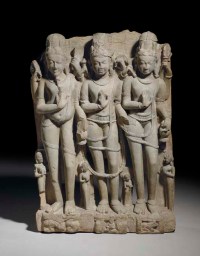 For the faithful, the creation of our planet and life on Earth, past and present, is the work of god — a divine intervention that wrought order out of chaos. If faith were to be supplanted by science, then chaos was followed by creation due to the extraordinary powers of the Higgs Boson, or the ‘God Particle’. Only fools would rush in to debate the merits of faith over science, or vice versa; the wise would look at the larger picture which validates the primal belief that there exists a certain ‘power’ to which human beings, and all that is not created by them, owe their existence.
To that extent, those who have wasted no time to declare “god is dead” stand looking utterly foolish if not downright stupid. If they thought it was the smart thing to say, they are obviously clueless about what smart intelligence means. This is not to question the right to be a theist, agnostic or atheist; to believe in the existence of god, or to doubt it, or even to reject the very idea of god. That’s a matter of personal conviction and choice, and, contrary to what pretentious Marxists claim, ideological predilections have nothing to do with it.
 That freedom also exists for those who see god as a superman and attribute to ‘him’ all that is good, virtuous and righteous. Monotheism, especially of the Book, whether it is the Torah, the Bible or the Quran, excludes the possibility of god being a superwoman, from which is born a pernicious inequality that we now refer to as gender discrimination. If ‘he’ alone is omniscient, omnipotent, omnipresent and omni-benevolent, then where does ‘she’ fit in?
Much as those who spurn the very idea of god, or are repelled by the concept of faith, as well as believers who subscribe to the fundamentals of Judaism, Christianity and Islam as contained in their respective Books, would mock at polytheists, there’s something endearingly elevating about polytheism. Popular Hinduism embraces both gods and goddesses; divinity is neither all male nor all female, but a generous mix of both. No less inspirational is the spontaneity with which nature and its innumerable children are treated as manifestations of god. What was once denigrated as the evil practices of heathens — that is, Hindus — who worship trees and rivers, reptiles and serpents, birds and animals, is now considered chic environmentalism.
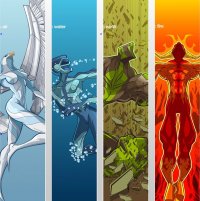 Today’s fashion is Hinduism’s ancient wisdom. Cassandras who tirelessly warn us of the disastrous impact of global warming on earth, water, fuel/energy, air and sky, are discovering today what the rishis eloquently spoke about millennia ago. The Vedas tell us to worship Prithvi, Jal, Agni, Vayu and Akaash — the five elements that combined to give us our world and remain integral to our lives. The first word of the first hymn of the Rig Veda is ‘Agni’ — it also tells us “Agni is one though ignited in various forms, the one Sun rises in all the worlds, the one dawn lights up all this; the One alone has become all this.” If you are truly looking for the ‘God Particle’, here it is. No Higgs Boson can serve as a substitute, no matter how tantalising the scientific proposition.
At one level, the idea of god is something that pervades the public space and public debate. At another level, the concept of god is deeply personal, shaped by an individual’s faith. As someone who lives by the precepts of Brahmoism, for me there is one supreme god — “a god endowed with a distinct personality, moral attributes and intelligence befitting the governor of the universe”. I worship and adore the Eternal Unsearchable and Immutable Being who is the author and preserver of the universe — the ‘One’ alone that becomes many, yet remains indivisible. Snigger if you must, but for me Higgs Boson is but a passing minor distraction. – Mid-Day, 7 July 2012
» Kanchan Gupta is a journalist, political analyst and activist.
Filed under: india | Tagged: atheism, brahmoism, CERN, cosmology, elements, faith, god, god particle, goddess, higgs boson, hindu, hinduism, india, kanchan gupta, monism, monotheism, philosophy, polytheism, religion, rig veda, rishis, science, vedas |










 BHARATA BHARATI
Vivekachudamani explains the two fold path very well. The path of affirmation which is Bhakti and the path of negation which is gnana. Translating gnana as thought, looks like all is lost in translation. John Dobson as he clearly says in his book “Advaita Vedanta and modern science” that words like gnana, vivartavadin is Sanskrit have no equivalents in any language as these philosophical concepts are unique to India and only Sanskrit has the ability to handle these philosophical concepts. The orientalists have made a mish mash of translating such Sanskrit only concepts into English. Take for example idol . It is not idol , it is a deity or vigraha which is the right word. Many orientalists have used the word idol liberally.
The path of bhakti includes Vedic Mantras, Namasankirtan, Puja at personal level and Karmakhand. Gnana is not for householders because it requires bairagya to shun the external world. it does not mean that a gnani cannot perform bhakti yoga. A Gnanis bhakti yoga is that of ascetic. The gnani has to be desireless, but in in the ever expanding external material world as, the Bhagvad Gita puts it, only the wise will call gnani a sage. How many are wise in this world? Wisdom is not a trait acquired by degrees. It is very difficult to find wise humans in the present age.
S N Bose, who did not have a PhD when he wrote the theory about this particle was a true gnani. He worked in many areas, was a polyglot. If the Noble committee did not recognise him till 1974 when S N Bose passed away, then one can call the Nobel committee as wisdomless humans for their discriminatory capacity to recognise a gnani had touched nadir.
Indians, more so Sanatanis should forget Nobel and work like our sages and be Noble. As Sankara says in sloka 37 of Vivekachudamani
“There are good souls, calm and magnanimous, who do good to others as does the spring, who having crossed this dreadful ocean of birth and death, help others to cross the same without any selfish motive whatsoever”
Sloka 37
Shanta mahanto nivasanti santo
vasantavllokahitam charantah
Tirna swayam bhima bhavarnavam
janan ahetunanyanapi tarayantah
One hopes the English equivalent of sloka 37 of Vivekachudamani has not lost much in translation.
LikeLike
2. Rajaram cannot really support his feeling on the issue with reference to Adi Shankara. Authoritative members of Shankara’s own lineage very much insist the Vedas including the Vedanta is tied to the Paramaatma present in all the Devas and all the world, as seen in point 3 below.
Next, Vedanta is also the chief area of expertise of the Acharyas of the other established points of view: Ramanuja and Madhva. They insist that Vedanta is very much about the Paramapurusha, in their case this is particularly Vishnu. And in Shakta literature well before Shankara, Vedanta exists in and is embodied by their Shiva and Shakti, and in fact in all the Hindu Gods.
This is evident in how, before Adi Shankara ever came to be, there existed authoritative Hindu texts upon Hindu texts (Agamic and Tantric) that reiterated in strong terms that Vedanta, just like the Tantra, Agamas and Nigamas, is directly related to the Hindu Devas. (There is a valid reason for why all standard Tantra and Agama texts of Hinduism are still regarded as apaurusheya by Hindu experts.) Adi Shankara’s views are needs subordinate to these very texts. Moreover he is popularly understood to have worked with them and to have embellished their corpus in a like strain.
Ultimately, there is no way to separate the Vedanta from the Hindu Gods, just as there is no way to separate Philosophy from the Olympic Gods. Although Buddhism did try, with some upanishads at least. Whereas it is Adi Shankara who is among those credited with removing Buddhist ‘philosopical’ intrusions on the Vedanta (which Shankara and others Hindus regarded as subversion of the Upanishads and Vedic religion) and returning Vedanta firmly to its Vedic-only roots.
3. Also, assuming Rajaram’s translated quotation on Shastra is accurate to Shankara, in the given context “shastra” is not likely to refer to the Vedas, including therefore the upanishads belonging to the Vedas, but would perhaps refer to some other Hindu scriptures not regarded as apaurusheya, particularly because Shankara’s successors such as Kanchi’s Chandrashekharendra Saraswati Swami reiterate their standard viewpoint that the Vedas, which therefore includes the Upanishats that are part of them, are specifically not the Word but the very “Lifebreath of ‘God'”. (Where “God” is Hindus’ standard way of mistranslating into foreign languages the word Paramatma/Parabrahmam, which is present in all the Hindu Devas who are all more appropriately translated as “Gods” in English. In reality, Hindus’ paramatma is more akin to the “One” of the Platonists who, as I recall, insisted that their One is only known and can only be worshipped through the Olympic Gods).
Note that the book by the aforementioned Kanchi Acharya is specifically about the Vedas, as well as the Upanishads’ natural and inseparable relationship to them. He particularly criticises all those Indians fond of interpreting the Vedanta without first being experts in the Vedas (carrying out the Vedas is also an imperative with Adi Shankara, which is stated by the Kanchi Acharya).
It’s hard to have two views on what the Kanchi Shankaracharya “actually meant” in his chapter-long discussion on how the “Vedas are not the word but the lifebreath” (of the Hindu paramaatma). The Kanchi Shankaracharya moreover referred to Hindu scriptures to drive home the point held among his kind. It is not only the previous Kanchi Shankaracharya. The current Kanchi Acharyas, as well as those who’ve been heading Shringeri, still do regular pooja, including in private, to their Hindu Gods and regard them as central. These acharyas are not merely the official and authorised representatives of Adi Shankara and advaita vedanta, they are its true representatives.
Rajaram may go and dispute with them. Did he not reveal in a comment on this very blog that he holds presentations on Vedanta to christians, of foreign climes what’s more, presumably trying to impart the knowledge of “vedanta” to them? It must therefore be unfortunate for his interests, that the separation of Vedanta from Hindu theism cannot be achieved.
LikeLike
While “god particle” was never a serious term for the subject among scientists, I like IS’ dubbing it “Goddess particle” as this is clearly a reference to the Magna Mater of the Romans and its equivalent elsewhere.
However, I can’t like the article: hard science may inch but slowly towards greater clarity of our universe, but physics and maths do not become “bunk” merely because a Brahmoist wills it so. And to think, Brahmoists regard the “polytheistic idolatrous” Hindus of India as needing the “enlightenment” of worshipping some invented invisible mono-god. I’ve yet to encounter any “polytheistic idolators” close their eyes to hard science.
Rajaram’s statement that “I feel Vedanta also should be formulated as metaphysics without reference to God or anything divine” is indeed nothing more than his feeling. It’s invalid besides.
1. I understand Vedanta is defined as the collection of upanishads and the bhagavadgita and the brahma sutras.
I haven’t looked at the brahmasutras, but the upanishads are part of the vedas, including such upanishats as the Taittireeyopanishat which are regarded among the “oldest” upanishads (this is if we’re not allowed to speak of the vedas as apaurusheya). The Taittireeya and other similar ancient upanishats are all quite “theistic” being still praise and rituals concerning the Devas, as the rest of the Vedas are. More generally, all the Upanishats that belong to the Vedas may not be separated from the religion of the Vedas.
Next, the Bhagavad Gita is most certainly about the Hindu Devas, in particular the Paramatma/paramapurusha in them, and its relationship with the individual atmas.
LikeLike
Sankara also said ” Neti, Neti” . Not this , Not this !!!
LikeLike
There is no such thing as a ‘God particle’. The Higgs mechanism of particle physics postulates a peculiar creature called the Higgs Boson which is the source of matter though a boson with spin zero. This postulate may have been confirmed by the recent CERN result, but we should be patient until the results are in. (I was there last October and told them that their search reminded me a bit of the movie The Wizard of Oz.
It is too early to draw hard and fast conclusions. My preference is to keep science separate from religion. I feel Vedanta also should be formulated as metaphysics without reference to God or anything divine. In fact Shankara himself says “Shastra is not any word of God but the accumulation of knowledge through ‘gnana’ (thought) and ‘karma’ (action or empirical evidence).”
LikeLike
As the Higgs Boson creates mass, it must be a Goddess particle not a God particle.
LikeLike