











 “But the worst offenders in the country are the Dharma Gurus who do not even raise the issue of meat-eating as a fundamental concern of dharma. If every temple, matham and adheenam raises a demand for laws to ban the movement of cows, buffaloes, camels, across state borders – which law exists irrationally for agricultural produce meant for human consumption – a beginning would have been made to bring compassion back into our national life and our daily lives as citizens of the world’s greatest living civilisation.” – Sandhya Jain
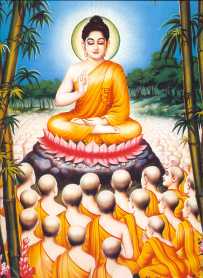 Making homage at all the sacred sites associated with the Buddha, the Chinese pilgrim Xuanzang (Hiuen Tsiang) encountered the moving story of Hamsa Stupa, situated on a mountain in the vicinity of Rajgriha, where King Bimbisara and his people welcomed the Buddha after he had attained enlightenment. The monks of this monastery used to eat the three kinds of pure meat, in conformity with the “gradual teaching” of the Hinayana School.
Sakya Muni allowed monks to accept meat given as alms by householders. Meat, in Buddhist tradition, was considered pure (i) when it is not seen that it is being killed for oneself; (2) when it is not heard that it has been killed for oneself; (3) when it is not suspected that it may have been killed for oneself. Very early in the Buddhist tradition, however, this acquiescence was stretched to include meat as a dietary preference, and this issue is now beginning to agitate many devotees within the tradition.
One day, Xuanzang recounts, ‘pure meat’ could not be purchased, and the monk in charge did not know what to do. Seeing a flock of wild geese flying in the sky, he joked: “Today the monks are short of food, and the Mahasattva should know that this is the proper time to make a sacrifice.”
As he said this, the goose leading the flock returned and dropped dead to the ground. Seeing this, the monk felt frightened and ashamed. He informed the others, who shed tears of regret saying, “This is a bodhisattva, and who are we to dare to eat his flesh? The Tathagata has taught the ‘gradual teaching’ for us to advance gradually, but we grasped what he has taught at the beginning as his final teaching. It is owing to our stupidity without trying to correct our error that caused this disaster. From now onwards we should act according to the Mahayana teachings and never eat the three kinds of pure meat again.”
They built the Hamsa Stupa to bury and commemorate the dead goose and its spirit of self-sacrifice [Book III, p 119].
♦ ♦ ♦ ♦ ♦
 I-tsing visited India in the seventh century and is among the last of the major pilgrims who left accounts of their travels in the land of the Buddha. He was keen to learn the proper rituals and practices for the correct practice of the Dhamma, and to propagate the same in his native land.
A scrupulous and meticulous observer, I-tsing found that respect for the humblest forms of life pervaded the teachings of Sakya Muni. Moving through the monasteries, he noted that every morning, water must be carefully examined before drinking, wherever it is found, in jars, in a well, in a pond, or in a river, to ensure that it is free of ants. Insects as small as a hair-point are to be protected.
Water from a river or pond must not be drunk without filtering. Indians, he noted, use fine white cloth for straining water; in China fine silk may be used, after having slightly boiled it with rice-cream as small insects easily pass though the meshes of raw silk. I-tsing was tormented that in certain months the insects are so minute that they can pass even through ten folds of raw silk. But he insists that those who are concerned to protect life should try to set the insects free by some means or other.
Injury to living creatures is the greatest of the ten sins prohibited by the Buddha. Hence a filter is one of the six possessions essential for priests, who should not go on a journey of three or five Chinese miles without a filter. If a priest is aware that the residents in the temple where he is staying do not strain their water, he must not partake of food there.
I-tsing however concurs that no guilt is incurred in consuming the three kinds of pure meat permitted by the Buddha.
♦ ♦ ♦ ♦ ♦
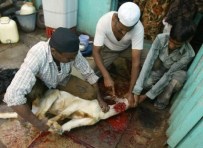
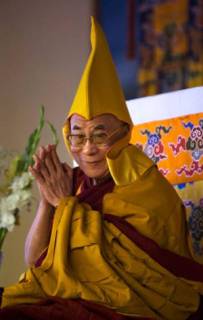 This laxity is now being questioned by environmentalists, modern Buddhists, and compassionate citizens the world over who are distressed at the manner in which meat eating is being promoted as a commercial enterprise at par with agriculture; animals are being raised in farms for the exclusive purpose of slaughter; and daily slaughtered in millions to provide raw material for the leather industry and other sectors using animal body parts.
When the 14th Dalai Lama Tenzin Gyatso fled to India over five decades ago, a large community of monks and lay Buddhists settled in different parts of the country. Visitors to these places soon noticed that in order to meet the culinary demands of this community, a large colony of butchers came from outside and settled permanently in these areas.
As these butchers are almost exclusively providing meat for the consumption of the Buddhist monks and lay disciples, this violates a fundamental Buddhist tenet that the meat should not be suspected to have been killed for oneself. As the sole consumers of meat in their exclusive enclaves, the monks are fully aware that a special caste of butchers is killing meat for them, and they cannot pretend otherwise.
While meat-eating by lay persons is a private matter, consumption of meat by monks is at variance with the spirit of Indian tradition. Among Sikhs, who rose in the medieval period, even lay persons who have partaken of the ceremony of ‘amrit chakna’ abstain for life from meat, onions and garlic. It is true that the original spirit of the vinaya was that monks should treat vegetarian or non-vegetarian alms equally, but when meat is purchased from shops, a culinary choice is being exercised. It violates the notion of compassion, daya.
These debates clearly exercised the Buddhists themselves. The Lanka Avatara Sutra of the Mahayana school prohibits any kind of meat-eating by monks, including fish. Many Buddhists feel that in tropical countries where there is no shortage of vegetarian food, meat-eating by monks is undesirable. It may be understandable in the northern part of Tibet where there are hardly any vegetables or grains available, but Buddhists living in India are not deprived of ethical foodstuffs. Moreover, they are a rich and prosperous community on account of the huge donations made by rich foreign devotees.
 Much of the current controversy centres round the 14th Dalai Lama, the world’s most distinguished Buddhist leader, for personally consuming meat while advocating non-violence and compassion. It is claimed that a doctor advised him to eat small amounts of meat after he had some problems with his gall bladder and suffered from hepatitis. But this has been strongly rebutted by devotees who feel that the Buddhist communities should lead the world by example to avert the man-made environmental crisis and end needless suffering caused to animals. One devotee, Matt Mailander, wrote to the Dalai Lama urging him to read certain books and visit certain website and see the overwhelming evidence that the healthiest people and societies are those that eat whole plant foods; hence there is no health reason to eat any meat. A move towards vegetarianism would also help in the fight against global warming that scientists and environmental activists maintain is intimately linked to diet.
Former Beatle Paul McCartney also wrote to the Dalai Lama urging him not to eat meat. Buddhists, he pointed out, believe in reincarnation and in compassion for all living beings. One of the five precepts of the faith is “do not kill,” which means that one must not deliberately kill any living creature, either by committing the act oneself or by instructing others to do so, or by approving of or participating in such an act. Buddhism does allow for personal choice and exceptions as the precepts are not set in stone, but many Buddhists view the precept as a call to vegetarianism as meat-eating violates the teaching that one must not cause suffering to any sentient being.
♦ ♦ ♦ ♦ ♦
 The 17th Karmapa Urgyen Trinley Dorje (recognised by the Dalai Lama) spoke on the issue of ‘Teaching on Not Eating Meat’ at the Great Kagyu Monlam at Bodhgaya on 3 January 2007. Addressing the issue if meat is allowed for monks, he said some people argue that it is not allowed because if there are people who eat meat, then there will be people who will kill those animals; and if no one eats meat then there would be no one will cook the meat. Hence, eating meat is very much related to killing and thus the negative deed of killing is very much caused by eating meat.
The Karmapa said that whether that is true or not is another issue. If some people wear pearls, then they are procured by killing the shellfish. Those who wear silk also cause the insects to die, as do those who use clothes made of animal skin. Then, even eating grains causes lots of insects living on top of the earth and below the soil to be disturbed and die.
Recounting a story from China, he said a butcher there would daily kill a pig, and would console himself that he did not kill because he wanted to, but because other people want to eat the pig. The butcher used to rise each morning to the sound of a monastery bell, but one morning he overslept and when he went to kill a pig, he found that the animal he proposed to kill that day had delivered 10 piglets. The butcher went to the temple and asked the head monk why the bell had not rung that morning. The head monk replied that he had had a dream the previous night in which ten beings urged him to “save them.” When the monk asked them how he could do so, they replied that the only thing he needed to do was not to ring the bell and they would be saved. Deeply moved, the butcher renounced the killing of animals from that day.
Coming to whether the Buddha allowed monks to eat meat or not, the Karmapa said that the Vinaya mentions that there are certain ways of being able to eat meat; certain kinds of meat cannot be eaten; and those kinds of meat that cannot usually be eaten, can be eaten in some circumstances; so there are many nuances involved. The Mahayana emphasizes not eating meat.
 Referring to the Vinaya specifying three kinds of pure meat, the Karmapa said that if one has a deep craving for the taste of meat, one may not know [care?] if the meat is specially dedicated for one or not. Sometimes people are so attached to meat that they even ask, “Please give me some meat.” The Karmapa confessed that when he was young, he was very fond of meat and would ask for it, which in turn influenced others also to eat meat.
That is why the Buddha said that the Bodhisattvas should not eat any meat. Because of our strong attachment to meat, beginner Bodhisattvas would do well not to eat meat. For when one goes to a restaurant and says, “Give me some chicken,” the monk does not know if they already have some chicken prepared or if they will have to kill the chicken. That is why it is said that a Bodhisattva should not eat meat.
Karmapa clarified that he was not speaking about the great Bodhisattvas like Chenrezig (Avalokiteshvara) or Chana Dorje (Vajrapani) or the great Bodhisattvas in higher bhumis, but ordinary Bodhisattvas like the monks [means bhikkhus – ed] who wish to work for the benefit of sentient beings. The Bodhisattvayana (Vehicle of the Bodhisattvas) exhorts that even if meat is pure in the three ways allowed in the Vinaya, the Bodhisattvas or beginner Bodhisattvas should not eat as having too much attachment to the taste can cause one to unknowingly commit mistakes. It has therefore been prohibited to eat meat in the Bodhisattva’s Way of Life. Meat eating, he concluded, has also not been regarded as good from the Shravakayana (disciples’) point of view.
In Tibet, he admitted, the bhikus usually eat meat that’s dedicated for them. Thus, if a lama goes to a village, the villagers immediately kill a sheep or yak, the lama chants some mantras and thinks it is okay. But that, the Karmapa avers, is not good, because the Buddha said that one should not eat any meat that has been specially dedicated for one or specially killed for one’s personal consumption.
In the Kagyupa School the great masters of the past were explicit that eating meat is “going against the dharma.” In some places it is said that if someone has a great method by which he can liberate the being whose meat he eats, only then might that person eat it, according to the Vajrayana. Other than that, you cannot eat meat.
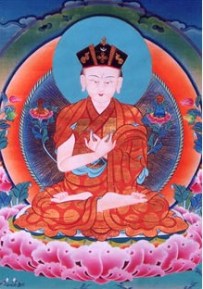 The 8th Karmapa Mikyo Dorje stated that offering meat or alcohol during the Mahakala puja was strictly prohibited. Maybe one can offer some fruits. Mikyo Dorje also said that monks have to give up eight things like meat, alcohol, weapons, as described in Do Palmo Che.
Before he died, Jamgon Kongtrul repeatedly said that he always prayed to be reborn as someone who would not eat meat anymore. The Karmapa mentioned the sutras in which eating meat has been clearly prohibited. He said even those places when eating meat was just allowed, it was not that one was encouraged to eat meat. It was just that those people who have too many difficulties not eating meat were merely allowed to do so. In Tibet, among the Kagyu, Nyingma, Sakya, Gelung, and Jonang, the Karmapa said, meat-eating is strongly prohibited; he did not know much about Bonpo.
So from a general or specific point of view, it is very important not to eat meat. Karmapa said that His Holiness the Dalai Lama had from 2006 completely prohibited wearing the skins of wild animals.
Karmapa urged that Buddhist monks or nuns or lay persons should not do business in meat, through buying animals and killing them and selling the meat. In one Tibet monastery, he said, all was destroyed but the slaughterhouse remains. There should not be a slaughterhouse wherever there is a Kamtsang monastery.
Nor should monks and nuns cook meat in a big way. Recently a western magazine carried a picture of about ten monks cutting meat. It looked as if they were making and cooking so much meat. Sometimes one may have to do a little bit, but to cook a lot of meat for big gatherings, especially wearing the robes, should not be done. Usually we say that there is no being who has not been our father or mother…. And regarding visits to the slaughterhouse wearing the robes to buy meat, one should lessen going to slaughterhouse.
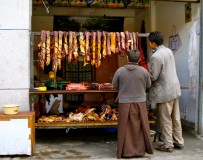 Karmapa suggests that if monks really need to buy meat they should ask someone else to buy it, for monks going to the slaughterhouse and buying meat looks very bad. Also, monks should lessen the eating of meat. Since we generally eat three times a day, one can eat meat only once a day or so. Or one can say, “I will eat meat only once a month,” or something like that. Some Tibetans don’t eat meat on special days like the full moon day or new moon day.
Some people give up meat altogether, but some people cannot, so they should at least reduce it. In society, he claimed, if everybody ate meat then it was very difficult to give up meat, but if the whole environment was not eating meat it’s easy to give up. He urged monks to reduce eating meat as a prelude to renouncing it altogether.
Karmapa stressed that monasteries belonging to the Kamtsang Kagyu should not cook meat in the monastery kitchen. Deviation meant that they did not belong to Karma Kagyu. He added that this was once very difficult in Tibet, but now because of the kindness of the Chinese it’s not so difficult; there are vegetables and things to eat. He urged the congregation to reduce or renounce meat as a sacrifice for the long life of His Holiness the Dalai Lama, for Apo Gaga, for himself, and in the name of their own Root Guru and all great beings.
♦ ♦ ♦ ♦ ♦
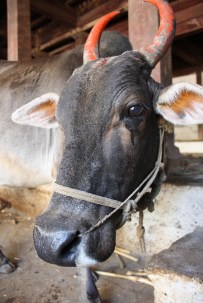 Worldwide, vegetarians, environmentalists, animal rights activists, and ordinary human beings are becoming increasingly concerned over the growing abuse and suffering of animals that are being factory-farmed – a trend that is disturbingly catching on in India as well, shockingly, with governmental support and encouragement.
Animals are not moving plants, created to fill our stomachs and tickle our palates. They are sentient beings and have the same Buddha nature as humans. There is an urgent need for us to bring a speedy end to the culture of raising animals for slaughter, and to restore natural systems of agriculture and save the planet. Since untold millennia, the Hindu tradition of India has maintained the moral supremacy of the vegetarian ethic – to relinquish this ideal would be to pervert our natal culture. It may be borne in mind that ordinary Hindus who eat meat have traditionally done so in a modest way, without the false sense that they are empowered to kill and consume the creation itself.
Ironically, we now have governments at the State and Central level that are pleased to treat meat as an industry – an unspeakable abomination of the civilisational values of the Sanatana Dharma – and bestow it with the incentives given to industrial manufactures and exports.
For instance, Kerala is India’s highest consumer of meat with a daily requirement of over 5,000 tonnes. The state animal husbandry director R. Vijayakumar says 80 percent of the residents are non-vegetarians, but the domestic production of meat (beef, mutton and chicken) is merely 264.31 tonnes and the deficit is made up by nearby states. This caused an outgo of Rs. 1752 crores in fiscal 2009-10. Hence Kerala state is promoting farm rearing of chicken, pig, goats and even rabbit as a domestic revenue-earner!
Every day, citizens who travel on the highways of southern India report the movement of truckloads of cows (male and female) and buffalo being transported to Kerala. At a rough estimate, more than thousand animals would thus be sent for slaughter daily to one state alone.
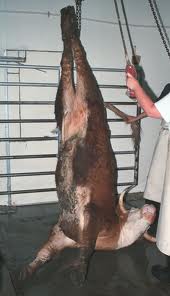 There is cruelty all the way. The vehicles are loaded to full capacity, with these large animals tied up tightly so that they cannot move, and remain standing continuously for three or four days without water, without food – the only consideration being to rush them to Kerala as fast as possible.
A profound cultural change, Asuric in intent, is being promoted in the country at large. People are being taught to view animals as living pieces of meat, which legitimately belong to the slaughter-house. Indians, read Hindus, are also being told that there is no special sanctity attached to the cow – that beef is only another form of meat, with a lucrative potential that should not be sacrificed to civilisational values.
India now has a thriving billion dollar Meat Industry. This year, India aims to overtake America as the world’s third largest beef exporter, behind Brazil and Australia! Naturally the police and politicians turn a blind eye as animals are shunted to doom in Kerala or Bengal or even to Bangladesh.
But the worst offenders in the writer’s view are the Dharma Gurus who do not even raise the issue as a fundamental concern of dharma. If every temple, matham and adheenam raises a demand for laws to ban the movement of cows, buffaloes, camels, across state borders – which law exists irrationally for agricultural produce meant for human consumption – a beginning would have been made to bring compassion back into our national life and our daily lives as citizens of the world’s greatest living civilisation.
The greatness of Sanatana Dharma derives from its bio-centric as opposed to theo-centric ethos – the understanding that Life itself is sacred. Through the millennia, Jainas have scrupulously adhered to the bio-centric ethic; now others must rise to the defence of the dharmic tradition. – Vijayvaani, New Delhi, 6 May 2012
References
- http://vegetarianstar.com/2010/07/29/dalai-lama-says-eating-meat-not-always-against-monks-principles/
- http://www.rinpoche.com/teachings/nomeat.htm?page_id=52
See also
Filed under: india | Tagged: bhikkhus, buddhism, buddhist tradition, carnivourous monks, civilization, compassion, culture, dalai lama, dietary preference, ecology, economy, ethics, hindu, hinduism, india, islam, jainism, karmapa lama, kerala, pure meat teaching, religion, vegitarianism |








Thank you for this.
Many (including this writer) believe Lord Rama ate deer meat while in the forest. Am happy to stand corrected.
Vegetarianism is the very foundation of spiritual life. It must be promoted.
LikeLike
http://www.stephen-knapp.com/vegetarianism_recommended_in_Vedic_scripture.htm
Well interpreted.
THE QUESTION OF WHETHER LORD RAMA ATE MEAT IN THE RAMAYANA
Sometimes the idea comes up that the Ramayana indicates that Lord Rama ate meat, especially while He was in exile in the woods. However, there is no verse in Valmiki’s Ramayana that establishes that Lord Rama, Lakshmana or Sita ate meat while in or even out of exile. In fact, it seems to show that He very much disliked the notion of eating meat. The evidence for this is as follows:
The verse that comes in question in this regard in the Valmiki Ramayana, Sundarakanda, Skanda 36, Sloka 41, says: “Na mamsam Raghava bhunkte, na chaiva madhu sevate, Vanyam suvihitam nityam bhaktamsnati panchamam.”
The literal translation of this verse is: “Sri Rama does not take meat or honey. He partakes everyday of wild fruits and boiled (wild) rice fully sanctioned (for an ascetic) in the evening.”
Faulty English translations have put it as something like this: Hanuman to Sita, “When you were away, Sri Rama did not even take deer meat.” This incorrectly implies that Rama normally may have ate meat but did not do so while Sita was away from Him.
Now in this verse, the Sanskrit word bhunkte is a verb that means strong desire for eating. It comes from the Sanskrit bhaksha, which means voracious eating. When you say Na bhunkte, as we see in the line that says “Na mamsam Raghava bhunkte”, it gives a complete negative connotation, meaning that Lord Rama abhorred meat-eating. On the other hand, if the words were “Na mamsam Raghavo khadate”, it could then mean that Raghava may have engaged in meat eating before, but had stopped it at this point. However, this is not what is said, but is where some English translations present a similar confusion, or are simply unclear about this issue. Nonetheless, by analyzing the correct view of the proper translation, it indicates clearly that the Valmiki Ramayana shows how Lord Rama not only did not eat meat, but greatly disliked it.
LikeLike
Indeed, the Xians did try to take over Tirukkural but it was the very fact that it advocated ahimsa and a vegetarian diet caused even their best thinkers to reject it. The Xian god does not like his spinach it seems!
LikeLike
Eat what Bishop Caldwell hath told you when he coined the word “Dravidians” as a race. Bishop Caldwell, the prime mover of Shanar (Nadar) converts must be DK, DMKs & others God father Caldwell’s followers, the so called Dravidians must have purged all vegetarian quotes in Tirukural (remember how there was a great conspiracy to call Tirukural a Christian text) and spout Kural.
LikeLike
What is unfortunate is that it is the Tamils themselves who are the greatest offenders against the vegetarian ethic.
The Dravidian politicians all spout Tirukural but none of them practice Tirukural!
LikeLike
From Stephen Knapps web site.
IS since you are TN Tirukural looks very relevant.
The following verses are from the Tirukural:
How can he practice true compassion who eats the flesh of an animal to fatten his own flesh?
Riches cannot be found in the hands of the thriftless, nor can compassion be found in the hearts of those who eat meat.
He who feasts on a creature’s flesh is like he who wields a weapon. Goodness is never one with the minds of these two.
If you ask, “What is kindness and what is unkindness?” It is not-killing and killing. Thus, eating flesh is never virtuous.
Life is perpetuated by not eating meat. The jaws of Hell close on those who do.
If the world did not purchase and consume meat, no one would slaughter and offer meat for sale.
When a man realises that meat is the butchered flesh of another creature, he will abstain from eating it.
Insightful souls who have abandoned the passion to hurt others will not feed on flesh that life has abandoned.
Greater than a thousand ghee offerings consumed in sacrificial fires is to not sacrifice and consume any living creature.
All life will press palms together in prayerful adoration of those who refuse to slaughter or savour meat.
LikeLike
IS, Stephen Knapp has a good web site on vegetarianism and Sanatan Dharma. This one must be in your web site fully.
http://www.stephen-knapp.com/vegetarianism_recommended_in_Vedic_scripture.htm
LikeLike
IS , Yes I agree with you on sadhus, monks and sadhaks refraining from eating flesh foods.
LikeLike
Animal sacrifice took place in ancient times and it takes place today. Both Bengal and Tamil Nadu have temples in which animal sacrifice takes place. Sacrifice is based on the concept that you offer the best you have to the God (usually a Goddess for blood sacrifices). In an agricultural society farm animals are therefore sacrificed as they are the farmer’s best offering.
It is extremely difficult to change people’s attitudes about these religious practices. Many sadhus have worked at stopping animal sacrifice for years. In many cases they have succeeded. But the practice is ingrained in agricultural society and continues in many places.
As I have said, what went on in ancient times cannot be evaluated correctly today because we don’t know the context. It appears that Sri Rama was a hunter and that he was not vegetarian. That does not make him less divine or worthy of worship.
Scriptures can’t be discarded because they record events that may not be approved today. Social ethics and morality changes all the time in societies. That is why dharma shastras are not permanent guides but are written for the times they reflect. Definitely we need a new dharma shastra for today in India. Indians have lost their cultural and moral foundation and do not know how to deal with everything modernity offers them. Though we have a concept of Lakshman Rekha, we don’t know where to draw the line in modern life.
The whole point is that meat-eating is not an accepted practice today for religious or spiritually oriented persons. Beef-eating is entirely against the Hindu ethos. In fact it is against the law. It is a different matter that our corrupt and secularised authorities are not willing to enforce the law.
All of this wrong conduct will change soon enough as neither the world economy nor the world’s ecology can support KFC and McDonald economics.
LikeLike
According to Jha, the animal sacrifice and meat eating was not just in the lawbooks, but actually supported by the Vedas and Upanishads, and practiced during the time of great personages like Shri Rama and Shri Krishna in the Ramayana and Mahabharata. Indeed, if it was ritually eaten, then where did those rituals come from if not Hindu scripture? If this is the case, then one wonders why any of it is worthy of reverence.
LikeLike
There is no justification whatsoever for monks or sadhus or sadhaks or other spiritual seekers to eat flesh foods today.
How is it possible for a renouncer or seeker to be associated even as a third party with the violence and cruelty that is inherent in animal slaughter?
What went on in ancient times belongs to ancient times. Without insight we cannot understand what those people did or why they did it.
LikeLike
It was Lord Krishna who preaches the sattvic, rajasic and tamasic gunas related to food in the Gita. The best commentary on this is written by Adi Sankara on Bhagavad Gita.
Srimad Bhagavatham stresses the nature of food related to the three gunas.
Rishis were arrogant those who recd boons, but those rishis who were Nishkama were moral and upright. In Sivapuranam a boon is described as a gift with consequences unknown, whereas Nishkama is all thru tapas, hard penance and non attachment with no boon asked..
Some rishis changed midway thru their living age.
Will write on this later.
LikeLike
Beef was eaten ritually in ancient times. That does not justify its eating today.
Dharma shastras like the Manu Smriti are relevant to their time and place. They are not a practical guide for Hindus today. In fact we need a new dharma shastra for today. Who is the worthy rishi who will write it?
Ambedkar was himself something of a riddle and more (read Arun Shourie’s “Worshipping False Gods”). He is hardly an authority on Hinduism.
The cow, besides its symbolic and ritual significance, lies at the very core of the Indian economy. Some argue it lies at the very core of world economy. The selling of its flesh by a few will be disastrous for the many.
Believing Hindus do not eat beef. We have of course a large number of deracinated nominal Hindus who are highly educated but no longer know who they are. They are just like the pie dogs in the road. They will eat from any garbage bin and also talk a lot of very learned highfalutin nonsense. They are McDonald’s best customers!
Renouncers like Buddhist bhikkhus should not eat flesh foods for a variety of reasons. But the “pure meat” theory in Buddhism is just self-deception. Again, an ancient rule which may have been relevant at Buddha’s time, is being used today to justify a bad practice and fulfil a craving.
Neo-Vedantins like the RKM will eat anything. Only their Mylapore Math is vegetarian. But they are not Hindus. They are Ramakrishanites or some such silly Bengali invention!
The Osmania beef-eating festival was a political act designed to offend the Hindu students. It goes against the whole Hindu ethos of respecting differences in order to keep the peace.
In religion anything can be rationalised with a bit of philosophising or quoting of scripture out of context. It is all self-deception, not sadhana and true seeking of the Self.
LikeLike
According to D.N. Jha’s “Myth of the Holy Cow” the sacrifice of animals, including cows, was in fact once very common among Hindus, and supported by the Vedas and other Hindu scriptures like the Ramayana and Mahabharata and law books like the Manusmriti. In fact, according to Dr. Ambedkar’s writings, like his “Riddles in Hinduism” during the Asvamedha yagna, the queen would copulate with the body of the sacrificed horse. I was very shocked to hear these things but as yet I have not found any way to refute these seemingly slanderous claims. Any thoughts would be appreciated.
LikeLike
Bhikkhus who justify their meat-eating with an ancient Buddhist teaching are engaging in sophistry. They are not doing sadhana; they are doing self-deception.
There is no justification whatsoever for monks or sadhaks to eat flesh foods in this day and age.
The Dalai Lama — contemptuously known among international leaders as “the monk in Gucci shoes” — is to be censored for misleading his flock with poor excuses! There is no illness that requires meat-eating as a cure!
The 16th Karmapa Lama Rangjung Rigpe Dorje was a great meat-eater. When we together attended a feast for him in the 1970s, put on by a Bollywood actor at Juhu, he made great fun of this writer for eating curd and rice when there were tons of mutton biryani to be had. Tibetan monks love meat and gorge themselves on it whenever they can.
Hindus who eat beef have lost their cultural identity. They are like pie dogs in the street who eat anything they can find in the garbage heap. They have no pedigree!
LikeLike
I find meat eating by spiritual people totally pathetic and can not be condoned. hence my respect for brahmins and jains. Brahmins and jains are the most dedicated to ahimsa. I have seen very westernzed brahmins here, who would drink alcohol and do all kinds of things, but THEY WOULD NEVER EAT MEAT.. and the same goes to jains.
LikeLike