










A rakhi is the world’s oldest friendship band, not only for brothers and sisters, but for friends, teachers, colleagues, grandparents, aunts, uncles, cousins and not restricted by caste or creed, either. – Renuka Narayanan
Saturday, August 9, is the festival of Raksha Bandhan, and, as ever, I find its deeper implications fascinating. The origin story goes that Indra, king of the celestials, had to fight big, bad Vritra, a powerful negative force who wanted to take over and rule the world. Indra, as the leader of the celestials, was duty-bound to fight him to protect the universe. He fought very hard, to the point of fighting just for survival, but kept being bested.
Rishi Dadhichi, an ardent devotee of Lord Shiva, had a body suffused with extraordinary spiritual power that could manifest as physical strength. The gods asked him to surrender his body so that Indra could fashion a weapon from his bones. Dadhichi gladly did so and sat down to meditate on Lord Shiva, who, the belief goes, is the ‘prana’ or breath that keeps us alive, the only barrier between life and death. Rishi Dadhichi sent himself into samadhi, a state of deep concentration and inner withdrawal, through which he willed his breath to leave his body.
Indra thus obtained his Vajra or thunderbolt from Rishi Dadhichi’s bones. But that alone was not enough. Indra’s inner spirit had to be made strong again after the psychological damage caused by repeatedly losing to Vritra. Indra’s wife, Shachi Devi, then tied a thread that she had prayed over on his fighting wrist. In the next battle, when he felt that he was going under, the sight of that thread gave him back his fighting spirit, and he made an enormous effort, drawing on every last bit of his strength and will to win. He managed to vanquish Vritra once and for all. He succeeded in saving the world, his, and ours, from a cruel, dangerous would-be tyrant. Shachi Devi became known thereafter as ‘Indrashakti Shachi’. This, I discovered later, was the official name given to one of the queens of Thailand in the 20th century.
There is even an NGO in Delhi called the Dadhichi Deh Daan Samiti (Dadhichi Body Donation Society). Its website says, “Dadhichi Deh Dan Samiti is a registered Public Charitable Society. Its fields of work include organ donations, body donations, blood donation, stem-cell donation registry and other causes for persons with disability. The Samiti spreads awareness, motivates, registers pledges for body/organs donations and coordinates the donation between a donor and the medical institution after the death of a donor. A donated body is used for several purposes. Anatomical examination: Teaching students and healthcare professionals about the structure and functions of the human body. Research: Scientific studies that improve the understanding of the human body. Education and training: Training and practice for healthcare professionals, especially for those learning surgical techniques.”
Amazing, is it not, how ancient legends from civilisational heritage still animate the modern Indic world, from personal names to good causes?
I also enjoy the thoughtful modern ads made for Raksha Bandhan. YouTube has several compilations, if you look for ‘Rakhi Ads’ or ‘Raksha Bandhan Ads’. It’s too cynical and easy to see them merely as marketing opportunities for chocolates and gifts. They are often very well-made and touching, even thought-provoking, in the deeper messages they try to convey. One such message is that Raksha Bandhan is a time-honoured calendar opportunity to heal rifts and misunderstandings between siblings, and reach out to heal and reconnect with no loss of face, dissolving the usual ego barriers. Raksha Bandhan enables that unconditionally.
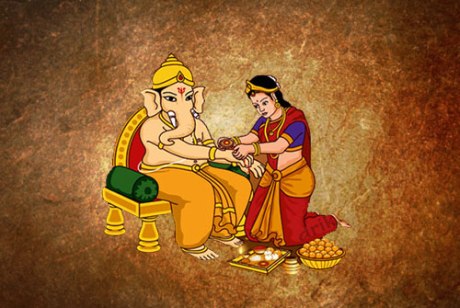
Another message, the primary one, is that it enhances family bonds, not only those of blood family but also chosen family. We are fully empowered to see it as an affirmation and celebration of important and meaningful relations in our lives. A rakhi thus becomes the world’s oldest friendship band, not only for brothers and sisters who share DNA, but for friends, teachers, colleagues, grandparents, aunts, uncles, cousins and not restricted by caste or creed, either. This universal friendship band includes the people whom we chose, and who chose us, because they want us in their lives, with respect, inclusion and affection.
The lunar calendar date of Raksha Bandhan falls in the month of Shravan (Avani in the South) when Danishta (Avittam in the South) is on the ascendant. Danishta is the 23rd of the 27 nakshatras or lunar asterisms in Indian astronomy. In Western astronomy, it is identified with the star Beta Delphini. Our tradition represents it with a drum or musical instrument and declares that it is ruled by the eight Vasus, a celestial group that bestows wealth and abundance.
As usual in anything Indian, there are layers to this. A person can be rich materially but be sadly poor in having friends. So, the Vasus preside over relationship wealth, too, not just over money and career opportunities. Thereby, Raksha Bandhan thoughtfully provides us with the repeated chance, year after year, to embrace and affirm our meaningful relationships. More than a religious ritual, this festival is thus a social and emotional opportunity given to each person to say, “Hey, I care. I celebrate having you as a friend”, to the people who matter. The practice of waving a lamp, applying tilak, and sharing sweets is more cultural than actually ‘religious’. Because “dhoop, deep, mala, tilak” are cultural markers of auspiciousness for us. They are native to this land, and everyone can have them if they also choose to share these pretty customs, as theirs too. Rakhis are thus an emblem of caring and emotional security—and, charmingly, today, girls wear them as well. – The New Indian Express, 4 August 2025
› Renuka Narayanan is an author and senior journalist in Chennai.

Filed under: india, world | Tagged: hindu rituals, indian culture, rakhi, raksha bandhan | Comments Off on Raksha Bandhan: A celebration of all bonds that matter – Renuka Narayanan






 BHARATA BHARATI