














 “The sthapathis of the Kedarnath Temple ensured the temple and its placement was in harmony with its environ. The collapse of the new structures around it reflects the illiteracy of greed. Early pilgrims respected ecology and traversed much of the Char Dham by foot. Today’s yatra-neophytes believe in penance powered by four-wheel drive. This seven-seater MUV influx worsened the poor infrastructure. The lure of lucre fuelled construction, and lives were precariously lodged on river banks in the state located predominantly in a landslide zone. Who is to blame, the penitents? Political correctness be damned, should there be no limit on the numbers trampling in and out? And if the state did want to prosper on the pilgrim purse, is it not obliged to plan?” — Shankkar Aiyar
 In India, everything that can go wrong usually does go wrong. Tragedy is never purely the outcome of fate, of uncontrolled events. Government action—rather, its lack—is frequently the cause of aggravation of consequences. The tragedy at Uttarakhand is about the fury of nature. It’s the causative; the consequences though are aggravated by sloth, complicity, criminal negligence. That a nation that can send a spacecraft to the moon couldn’t reach relief to Kedarnath for four days, that a week after the tragedy Indians don’t yet know how many perished proves the state of disaster risk management.
The tragedy of Char Dham was waiting to happen. The cloudburst and subsequent impact was simply the proximate cause. Uttarakhand has witnessed man-made disasters and natural calamities in four of the past seven years. It’s an active seismic zone, prone to earthquakes. It’s prone to landslides, given its riverine geography, avalanches and hailstorms. The state is nestled in India’s ecologically fragile zone and is the hub of temple tourism. Neither the geography nor the cultural context can be changed. But the risks can be better managed. Yet, every ‘Don’t’ in the book was ‘Done’.
 The visuals streaming out of Kedarnath vindicates the wisdom of earlier generations. The sthapathis of the Kedarnath Temple ensured the temple and its placement was in harmony with its environ. The collapse of the new structures around it reflects the illiteracy of greed. Early pilgrims respected ecology and traversed much of the Char Dham by foot. Today’s yatra-neophytes believe in penance powered by four-wheel drive. This seven-seater MUV influx worsened the poor infrastructure. The lure of lucre fuelled construction, and lives were precariously lodged on river banks in the state located predominantly in a landslide zone. Who is to blame, the penitents? Political correctness be damned, should there be no limit on the numbers trampling in and out? And if the state did want to prosper on the pilgrim purse, is it not obliged to plan?
The tragedy in Uttarakhand is symptomatic of a larger malaise. India is one of the 10 worst disaster-prone countries of the world. Of its 35 states and Union Territories, 27 are disaster-prone. Over 58 per cent of the landmass is vulnerable to earthquakes, over 40 million hectares—or 12 per cent of land—is prone to floods and river erosion. Of the 7,516-km-long coast line, 5,700 km is prone to cyclones and tsunamis, 68 per cent of the cultivable area is vulnerable to drought, and hilly areas are at risk from landslides and avalanches. The combination of natural and human-induced factors—adverse climatic conditions to environmental degradation fuelled by non-scientific development practices accompanied by a burgeoning population—make the risks worse.
Bhuj India woke up to disaster management post the earthquake (even though the seeds of the idea were embedded in the 1968 Civil Defence Act). In 2004, it formulated the idea of a National Disaster Management Authority (NDMA) and empowered it with requisite legislation in 2005. The NDMA, which is chaired by the Prime Minister, was reviewed by the CAG between May 2012 and September 2012. Its findings submitted in March 2013 explain the chaos witnessed over the week.
- The National Executive Committee of the NDMA which is supposed to meet every three months had not met between May 2008 and December 2012, and there was no advisory committee since 2010. This impacts evaluation of disaster preparedness.
- The National Plan for Disaster Management had not been formulated till September 2012, six years after NDMA Act 2005, and there was no provision to make guidelines binding on states in preparation of state plans.
- Only eight states have prepared emergency action plans for 192 dams as against 4,728 dams in 29 states, and inflow forecasts critical to mitigate risks from floods are available for only 28 reservoirs.
- None of the major projects taken up by NDMA were completed.
- The National Database for Emergency Management, which was to be completed by August 2011, was yet to be operational in September 2012.
- Shelters on river banks are a serious risk but a 2004 draft plan for amending rules on construction in vulnerable areas—particularly for quake, flood and landslide-prone areas—approved in 2007 is yet to be formalised.
And there is more. The reason why the rescue teams were using satellite phones of the Indo-Tibetan Border Police and Army is because six years after the receipt of the equipment, the satellite communication network is not functional. The cloudburst could not be forecast or sighted because the Doppler Weather Radars bought for surveillance of severe and weather system is paid for but yet to be operational. The National Disaster Communication Network and the National Disaster Management Informatics System are still in the planning stage, seven years after conceptualisation. The army and ITBP had to be called in because NDRF is hampered by shortage of manpower. Worse, only seven states had a State Disaster Response Force.
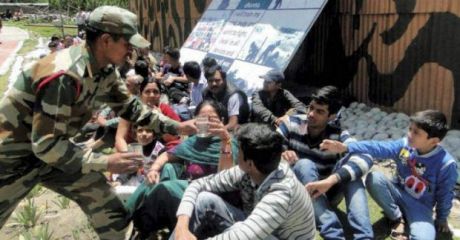
And so, as after every disaster, this unstated question: what would India do without the men in uniform—the heroes of every season. – The New Indian Express, 23 June 2013
» Shankkar Aiyar is the author of Accidental India: A History of the Nation’s Passage through Crisis and Change. Contact him at shankkar.aiyar@gmail.com


Filed under: india | Tagged: alaknanda river, bureaucracy, char dham, civic administration, cloud burst, criminal negligence, culture, devatas, ecology, environment, festivals, floods, ganga, ganga river, garhwal district, hindu, hindu pilgrimage sites, hindu pilgrims, hinduism, india, indian army, indian politics, kedarnath, kedarnath temple, mandikini river, national disaster, pilgrim tragedy, politics, psychological warfare, rain, religion, river ganges, sadhus, tourism, uttarakhand | 26 Comments »








 BHARATA BHARATI