











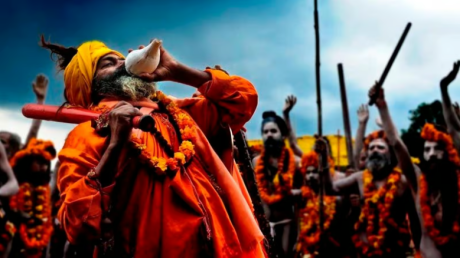
The Maha Kumbh Mela 2025 has been proclaimed as the ‘Maha Yagya of Unity’ by Prime Minister Narendra Modi. The bathing fesitival will be held in Prayagraj from January 13 to February 26 and is expected to see 40-45 crore devotees. – News 18
The Maha Kumbh Mela, that comes after 12 Kumbh Melas, has been proclaimed as the Maha Yagya of Unity by Prime Minister Narendra Modi. The Maha Kumbh Mela, which will be held in Prayagraj (Allahabad) from January 13 to February 26, is expected to see 40-45 crore devotees.
The Maha Kumbh Mela is not just a festival, but a spirited cultural event, which has historical roots that date back to thousands of years. The festival is a testimony of ancient Hindu mythology, astronomy and India’s rich religious heritage.
Let us understand the origins, history and significance of one of the largest Hindu festivals.
The Mythological Origins of the Maha Kumbh Mela
It is believed that eighth-century Hindu philosopher Adi Shankaracharya promoted regular gatherings of spiritual leaders and ascetics, and instituted the math system and the 13 akharas (warrior-saint orders).
The Kumbh Mela is celebrated four times in a period of 12 years, that is, once every three years, and is held in four places in rotation, which are Prayagraj, Haridwar, Ujjain and Nashik. While the Ardh Kumbh is celebrated in six years in Haridwar and Prayagraj.
The history of Maha Kumbh is linked to the Hindu myth of the Samudra Manthan (churning of the ocean). When Lord Vishnu, in the guise of Mohini, carried the pot of amrit (nectar) during the Samudra Manthan, a fight between the Devas and Danavas led to four drops falling at Prayagraj, Haridwar, Nashik and Ujjain—creating four tirthas (holy sites).
Devotees believe that a dip in the rivers flowing through these tirthas—Ujjain – Narmada, Nashik – Godavari, Haridwar – Ganga and Sangam at Prayagraj – Ganga, Yamuna and Saraswati—will lead to salvation.
How was it Celebrated in the Past?
The earliest references to the Kumbh Mela are found in Hindu Puranas and ancient texts, which described it as a time when Gods would descend to Earth to bless the devotees.
In the Gupta period (around 4th-6th century CE), Kumbh Mela began to attract large crowds as kings and rulers supported the event, built temples and bathing ghats along the sacred rivers. This period marks the beginning of the event’s transition from a local festival to a pan-Indian spiritual celebration.
From the 12th century onwards, the Kumbh Mela became an event with royal patronage. Kings and rulers from various parts of India participated in the festival, offering riches and performing rituals that added grandeur to the event. The Mughal emperors, especially during the reign of Emperor Akbar, showed respect for the Kumbh Mela, granting land and resources for the festival.
During the British Rule, the festival saw citizens from all walks of life, apart from the sadhus, attending the event to increase the momentum for the freedom movement. According to the Centre for Cultural Resources and Training (CCRT), even Mahatma Gandhi took part in the Maha Kumbh Mela in 1918 and interacted with other attendees.
Gradually, the British began controlling the Maha Kumbh Mela’s functioning, with the imposition of pilgrim tax, rapid expansion of railway infrastructure, institutionalisation of the Shahi Snan, preparation of housing, sanitation, and food facilities for the pilgrims and policing, thus limiting clashes between the akharas.
How Akharas and Shahi Snan Became Significant
Since the 8th century, sadhus (monks) from various akharas (orders) would gather at Prayagraj to perform the Shahi Snan or the holy dip on auspicious days. These akharas would be led by Naga sadhus, who are naked and covered in ashes and wear only weapons like tridents, swords, lances, coaches and drums. The Naga sadhus carry out traditional processions from various akharas to the river for bathing.
There are 13 recognised akharas, which participate in the Shahi Snan: the Shaivite akharas— Nirvani, Atal, Niranjani, Anand, Juna, Awahan and Agni; the Vairagi akharas—Nirmohi, Digambar Ani and Nirvani Ani, the two Udasin akharas (Naya and Bada) and the Nirmala akhara.
In 2019, a group of 15-20 transgender saints as part of the Kinara akhara—a 14th century sect—from Rajasthan, Uttar Pradesh, Madhya Pradesh, West Bengal, Assam, Tamil Nadu, Odisha, Maharashtra and other took part in the Shahi Snan, as reported by The Hindu.
From the 9th century to the 18th century, it was the akharas, which organised the month-long Kumbh festivities and decided the Shahi Snan order, which became a point of contention. But now the Shahi Snan order has been institutionalized, though the akharas still have an upper hand.
The chief monks or mahamandaleshwars of the akharas seated on chariots, palanquins or elephants lead the Shahi Snan in the early hours of Makar Sankranti, Paush Purnima, Mauni Amavasya, Basant Panchami, Maghi Purnima and Mahashivratri.
Kumbh Mela After Independence
The first Kumbh Mela after Independence was organised in January 1954 by the Indian authorities. In 1966, more than 7 lakh devotees took the holy dip on Magha Purnima—the fifth important bathing day, reported The Hindu.
While Emergency was imposed from 1975 across the country, the year 1977 marked the completion of 12 Kumbh Melas and the flow of Ganga in two streams had created two sangams (confluences).
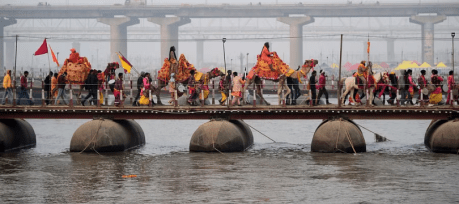
In 1989, the Kumbh area was expanded to 3,000 acres, with more pontoon bridges built by the Army over the Ganga. The crowd swelled to 1.5 crore for the holy dip in Prayagraj, and Kumbh Mela was recorded in the Guinness World Book of Records as the world’s largest gathering of people.
The Kumbha Mela began being broadcast by government’s media channel Doordarshan from 2001. India’s remote sensing satellite (IRS-ID) captured the landscape of the Kumbh area, including the confluence of the two rivers Ganga and Yamuna, as per The Hindu.
In 2013, a record 3 crore pilgrims reached the Sangam on the biggest bathing day, Mauni Amavasya, as the government arranged 22 ghats spread across 14 sectors and spanning 18,000 feet of the Ganga’s river banks.
In 2019, several new features were introduced in the Ardh Kumbh at Prayagraj including the inclusion of the Kinnar Akhara in the Shahi Snan. Moreover, the 10,000 sanitation workers who kept Kumbh premises clean were felicitated by Prime Minister Narendra Modi at a public event.
How is the Location of Kumbh Mela Decided?
The timing of the Kumbh Mela is based on the astrological alignment of planets. The position of Jupiter, the Sun and the Moon is taken into consideration and the zodiac sign in which it lies is also checked.
As Jupiter takes about 12 years to orbit around the Sun, the Kumbh Mela is celebrated four times over the course of 12 years.
The four locations—Haridwar, Prayagraj, Ujjain and Nashik—are believed to be sacred places and there is a belief that bathing in the holy rivers will cleanse all the sins.
Tragedies During Kumbh Mela
1954: On January 23, a tragedy unfolded in Kumbh Nagar leaving 300 pilgrims stranded and 600 houses being burnt. On the main bathing day on February 3, a stampeded occurred in Kumbh Nagar, killing at least 300 and injuring over a 1,000.
2013: On February 11, at least 10 people were killed and 39 injured after a footbridge collapsed due to the heavy rush of pilgrims at Allahabad railway station. After a few hours, another tragedy took place, killing 26 people in a stampede. A minor fire also occurred at the Kumbh site killing one and injuring five after a two-wheeler caught fire, which then spread to the huts, gutting them. – News18, 9 January 2025
See also
Filed under: india | Tagged: bathing festival, hindu dharma, hindu festivals, kumbh mela, naga sadhus | 1 Comment »






 BHARATA BHARATI