













The shifting religious demography driven by rapid Muslim population growth — both globally and in India — has significant social, cultural, and political implications – Arun Anand
The rapid growth in Muslim population due to their high fertility rate as compared to all other religious groups is changing religious demography across the world and India is no exception to this. Illegal migration of Muslims expedites this process further.
Global Trend
According to a Pew Research Center Study that measured How the Global Religious Landscape Changed From 2010 to 2020, Muslims were the fastest-growing religious group over the decade. The number of Muslims increased by 347 million—more than all other religions combined. The share of the world’s population that is Muslim rose by 1.8 points, to 25.6 per cent.
Meanwhile, Hindus grew at about the same rate as the world’s overall population. The number of Hindus rose by 126 million, reaching 1.2 billion. As a proportion of the global population, Hindus held steady at 14.9 per cent.
According to the study, “Christians remained the world’s biggest religious group. But Christians (of all denominations, counted as one group) did not keep pace with global population growth from 2010 to 2020.The number of Christians rose by 122 million, reaching 2.3 billion. Yet, as a share of the world’s population, Christians fell 1.8 percentage points, to 28.8 per cent.”
In a notable 2019 study, Pierre Rostan and Alexandra Rostan projected that within the next two centuries, 13 European nations could see Muslims forming the majority of their populations. These countries include Cyprus, Sweden, France, Greece, Belgium, Bulgaria, Italy, Luxembourg, the United Kingdom, Slovenia, Switzerland, Ireland, and Lithuania.
However, considering the continuing surge in Muslim immigration to Europe and their relatively higher fertility rates, this demographic shift could occur much sooner than anticipated.
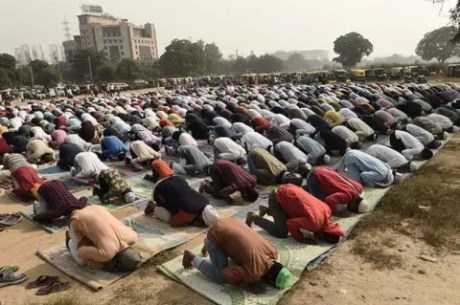
“The higher the proportion of Muslims in a country, the faster the social transformation,” the study observed—citing visible changes such as the construction of mosques, public calls to prayer, open-air worship, the widespread availability of halal food in supermarkets, and adjustments in work schedules to accommodate Ramadan observances.
Religious Demography in India
According to a working paper, Share of Religious Minorities: A Cross-Country Analysis (1950-2015), prepared by Prime Minister’s Economic Advisory Council in May 2024, the share of the majority Hindu population in India decreased by 7.82 per cent between 1950 and 2015 (from 84.68 per cent to 78.06 per cent). The share of Muslim population in 1950 was 9.84 per cent and increased to 14.09 per cent in 2015—a 43.15 per cent increase in their share.
The share of Christian population rose from 2.24 per cent to 2.36 per cent—an increase of 5.38 per cent between 1950 and 2015.The share of Sikh population increased from 1.24 per cent in 1950 to 1.85 per cent in 2015—a 6.58 per cent rise in their share. Even the share of the Buddhist population witnessed a noticeable increase from 0.05 per cent in 1950 to 0.81 per cent.
On the other hand, the share of Jains in the population of India decreased from 0.45 per cent in 1950 to 0.36 per cent in 2015. The share of the Parsi population in India witnessed a stark 85 per cent decline, reducing from 0.03 per cent share in 1950 to 0.004 per cent in 2015.
If we look at the Indian subcontinent, the share of the majority religious denomination has decreased in 4 countries while its share has increased in 5 countries. All the Muslim majority countries witnessed an increase in the share of the majority religious denomination except Maldives where the share of the majority group (Shafi’i Sunnis) declined by 1.47 per cent. Among the five non-Muslim majority countries, Myanmar, India and Nepal saw a decline in the share of the majority religious denomination while Sri Lanka and Bhutan saw their share increase.
Alarming Situation
According to Census 2011, “The 2011 census data shows that the Muslim population grew by around 24.6 per cent between 2001 and 2011, compared to around 16.8 per cent for Hindus over the same period. This has raised concerns about a possible population imbalance, with some analysts suggesting that the growth rate of the Muslim population has the potential to overtake that of the Hindu population in the coming years.”
The Census had underlined two states/UTs which had a massive majority of Muslims—Lakshadweep (96.58 per cent), Jammu and Kashmir (68.31 per cent). It also underlined the fact that some states now have a “significant” Muslim population that included Assam (34.22 per cent), West Bengal (27.01 per cent), Kerala (26.56 per cent), Uttar Pradesh (19.26 per cent) and Bihar (16.87 per cent). In addition, states like Jharkhand (14.53 per cent) and Uttarakhand (13.95 per cent), Karnataka (12.92 per cent), Delhi (12.86 per cent) and Maharashtra (11.54 per cent) also have substantial Muslim populations.
In a reply to a parliamentary question on 7 July, 2014, the central government identified 88 districts in the country where the overall share of Muslims in the population is more than 20 per cent.
Given the high rate of fertility amongst Muslims and presence of illegal Muslim migrants from across the border, it can be safely extrapolated that their share in the population in these states as well as in all other states would have gone up significantly.
Lebanon: A Case Study
Post second-world war, Lebanon was the only Christian majority country in Muslim dominated West Asia and Muslims were a minority till the 1970s. During this era, Lebanon was compared to Switzerland and Beirut was considered to be no less attractive and cosmopolitan than Paris. After Muslims became a majority, Lebanon was wrecked by violence and sectarian clashes. Gradually it became a sanctuary for terrorist groups like Hezbollah.
The shifting religious demography driven by rapid Muslim population growth — both globally and in India—has significant social, cultural, and political implications. The trends emerging from global studies and India’s own demographic data indicate that these changes are not isolated or temporary but part of a sustained transformation that could reshape national identities and social dynamics. – News18, 14 October 2025
› Arun Anand is an author, journalist, columnist and broadcaster.

Filed under: india, world | Tagged: indian muslims, muslim population, religion statistics, religious demography, world religions | Comments Off on Muslim population growth is changing religious demography in India – Arun Anand









 BHARATA BHARATI