












The New Religious Intolerance: Overcoming the Politics of Fear in an Anxious Age by Martha Nussbaum, Harvard University Press, 304 pages, £19.95
 “The fact is, non-Muslims have no problems with religious activity like fasts and prayers; it is Muslim violence while invoking its sacred scripture that is at the root of the problem. But Nussbaum avoids the question while highlighting trivial issues like hijab and dress. The book jacket with its fetching photo of a young Muslim girl in a head scarf typifies the sum and substance of the book. We need look no further to grasp Nussbaum’s message.” – Dr. N.S. Rajaram
 On September 11, 2001 the Western world woke up to the side of Islam that it had chosen to ignore for decades. Following this, known ever since as 9/11, the image of Islam in the West, never particularly good took a severe beating. In the spate of writing that followed, several academics who until then had labored in obscurity came out to explain Islam. Among these are entrepreneurs like John Esposito of Georgetown University, funded by the Saudis, followed by the likes of Diana Eck and Michael Witzel of Harvard hoping to cash in by marketing their academic voices to polish the image of Islam. Martha Nussbaum is not among these. Her interest is in using her knowledge and expertise to analyze the various phenomena around Islam, especially intolerance.
Nussbaum has worked closely with Amartya Sen with whom she has authored the book The Quality of Life. Where Sen is an economist who of late has ventured into philosophy and history (and politics), Nussbaum is a legal scholar and philosopher trained in Classical Greek thought. She is highly regarded in these fields, holding a distinguished chair at the University of Chicago. She is not a historian, however, and looks at contemporary issues like fear of Islam from the perspective of a classical Greek scholar and legal expert. In addition, she appears to rely heavily on her colleague Amartya Sen for information about Islam and history. Also, being a scholar of Greek literature she is somewhat prone to sophistry.
 Nussbaum’s legal training and classical Greek learning are of little use in analyzing the challenge that Islam presents today. Islamists regard any legal system other than the Shariah (Islamic law) as illegitimate, fit to be uprooted. Against this all the legal erudition that Nussbaum can muster is a sermon in the wilderness, little more than sophistry that conceals more than it reveals. Relying on Sen’s version of Islam and history, she sees Muslims living in democratic countries as targets of unjustified suspicion. At the same time Nussbaum is a conscientious scholar even if she jumps to conclusions based on superficial knowledge, presenting sophistry as analysis. Unlike Amartya Sen, however, she seems to study the works and read the writings of the people she criticizes.
Given this pedigree it should come as no surprise that Nussbaum happens to be viscerally anti-Hindu. In 2004 she even produced a track questioning if democracy would ever succeed in Hindu majority India. (The Clash Within: Democracy, Religious Violence, and India’s Future, Belknap Press/Harvard University) As she sees it, Hinduism is inherently violent and intolerant while Islam is misunderstood and a victim of stereotyping and ‘new’ intolerance. Hence it is the responsibility of democracies—especially America and Europe—to adjust their attitudes and change their systems to address their concerns. She feels though America is doing a better job of it than Europe. Obviously she has not paid much attention to the British scene.
 Astonishingly, she goes to the extent of justifying the incompatibility of the Shariah with the First Amendment of the U.S. Constitution—a strange position for an American legal scholar to hold to say the least. She finds the First Amendment particularly hard on Muslim minorities for the reason they cannot decide cases based on their religious law! (How about the law books of others, say Hammurabi, Manu, etc?) There is no recognition of the fundamental fact that Islam does not separate religion and state: the prayer book of Islam is also its law book. From the outset, Prophet Mohammed, the high priest of Islam was also its head of state and the commander of its armies. Islam abhors secularism.
Her view of religious freedom also strikes one as strange—more sophistry than analysis. There is no mention of Jihad which is the central doctrine of Islam. The fact is, non-Muslims have no problems with religious activity like fasts and prayers; it is Muslim violence while invoking its sacred scripture that is at the root of the problem. But Nussbaum avoids the question while highlighting trivial issues like hijab and dress. The book jacket with its fetching photo of a young Muslim girl in a head scarf typifies the sum and substance of the book. We need look no further to grasp Nussbaum’s message.
But what about the real world? Bin Laden (and other Jihadists) used Islamic texts—the Quran and the Hadis—to exhort Muslims to attack non-Muslim sites from New York to Bali. The Al Qaeda chief Ayman al Zawahari emphasized how Muslim legal scholars “have throughout Islamic history unanimously agreed that the jihad is an individual duty if the enemy destroys the Muslim countries.” The legal scholar Nussbaum is 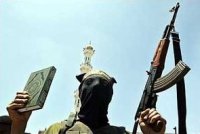 totally ignorant of it or considers it irrelevant to her thesis. And she nowhere mentions Jihad let alone its consequences including Dhimmitude. Her idea of Islam, like Sen’s is a sanitized and peaceful Islam without Jihad.
While it is no one’s argument that innocent Muslims should be made to suffer for the acts of terrorists, one cannot ignore the fact that Jihadists cite their scripture as justification for their acts. What Nussbaum and her ilk are doing is to deny this reality and treat it simply as a philosophic and at best legal issue.
The problem with this even at the legal level is that according to Islam only the Shariat (Islamic law) is legal: all other legal and political entities like U.S. Constitution, the Indian Constitution and the courts are illegitimate and should be overthrown to be replaced by institutions based on the Shariat. This is to be accomplished by a permanent war called Jihad.
Neither Amartya Sen with his superficial reading nor Martha Nussbaum with her legal hairsplitting and sophistry can help us comprehend what Islam has meant and continues to mean in the real world. To see this we need to go to one of Islam’s own historians  and philosophers—in fact the greatest of them, to Ibn Khaldun (1332 – 1406). He was never in doubt about the true mission of Islam. He saw Jihad as an aggressive war of expansion. As he wrote, “The other religious groups did not have a universal mission, and the holy war was not a religious duty for them, save only for purposes of defense…. Islam is under obligation to gain power over other nations.” And this is to be accomplished through Jihad.
Where does Ibn Khaldun stand relative to acclaimed modern academics like Sen and Nussbaum? Not many Indians have heard of him, but scholars outside India have recognized his greatness. British historian Arnold Toynbee called Ibn Khaldun’s Muqaddimah “… a philosophy of history which is undoubtedly the greatest work of its kind that has ever yet been created by any mind in any time or place.” Nor was Toynbee alone. Robert Flint, a distinguished British philosopher wrote of Ibn Khaldun: “As a theorist on history he had no equal in any age…. Plato, Aristotle and Augustine were not his peers, and all others were unworthy of being even mentioned along with him.” And this emphatically includes Martha  Nussbaum and Amartya Sen.
To understand what Islam means in our time one is better off going to a timeless master like Ibn Khaldun than spend time on the false history and pseudo-erudition peddled by the likes of Sen and Nussbaum. In summary, The New Religious Intolerance contains nothing worthwhile while totally ignoring the Old Religious Intolerance of Islam that has dominated history. It is a pointless tome of theological sophistry burdened with a lot of name dropping from ancient Greek sources and modern law books, both irrelevant to the subject at hand.
Filed under: india | Tagged: amartya sen, geopolitics, india, intolerance, islam, islamic iconoclasm, jihad, legitimizing power, martha nussbaum, mohammed, muslim apologetics, muslim terrorism, partition of india, philosophy, psychological warfare, religion, religious intolerance, sophistry | 3 Comments »







 BHARATA BHARATI