
















“There was a time when the Kedarnath Temple was visible from three km away. But over the years, with all the encroachment by shops, you have to go right up to the temple before it is visible,” say the temple’s chief pujari. Adi Shankara’s samadhi shrine is behind the temple.
Increasing tourism for recreational purposes and ruthless commercialism are to be blamed for the destruction caused in Kedarnath, believes Vageeshling Maharaj, chief purohit of Kedarnath dham.
“So many people, who have no feeling of piety or devotion, visit Kedarnath. They go to Kedarnath only to have fun and enjoy themselves, with a mindset which has nothing to do with faith and worship,” said Vageeshling Swami, chief purohit of the dham.
“Lord Shiva is a bairagi. He has nothing to do with materialism and desire. People come here in the wrong spirit. Just as Lord Shiva has discarded everything, so should the people who come here; they should give up all worldly thoughts to cleanse themselves,” said Swamiji, who is at present residing at the Vishwanath Temple in Guptkashi.
Swamiji was inside the temple on June 17 when a great wave of rocks, ice chunks and boulders came crashing down the lake, which is nearly one km behind the temple.
“We could see boulders breaking off and a mass of water descending at a furious pace. The wave reached the temple within seconds. Some of the boulders even hit the temple, which shook for a few moments. But it passed just as quickly,” he recounted.
“A 40-feet high wave engulfed the temple and flowed away. The cascade of water seemed as high as the spire of the temple,” Swamiji added.
He left the temple on June 19 when the army evacuated some members of the temple staff to Fhata.
“Fifteen of the temple staff are still missing. We were evacuated in batches; apart from the 15, all are safe,” Swamiji said.
Although the temple structure remains unharmed, the compound is now a mound of rubble. “The way the temple and the area was before June 17 — it will take 20 years for Kedarnath to look like that again. The cloudburst set us back by more than a century,” he said.
Sitting beside Vageeshling Swami, Shashidharling Swami, chief pujari of the Vishwanath temple in Guptkashi, said, “A space of 80 metre should be left free on each side of the temple. In front, they should leave a stretch of 150 metre of free space”.
“There was a time when the Kedarnath Temple was visible from three km away. But over the years, with all the encroachment by shops, you have to go right up to the temple before it is visible,” he added.
Describing the natural calamity as “divine punishment for human excesses”, Shashidharling Swami said, “Yes this is a message from above. The message is in the destruction that rained from the skies. The message is in the temple standing intact after all that.”
“The temple was not destroyed because the Lord did not want to shatter faith. A broken temple would have broken people’s faith, their very spirit. So the temple emerged unscathed but everything else around it was wiped clean,” he added.
“But God is merciful. If thousands perished, then lakhs survived. People should think about this calamity and look within,” Shashidarling Swami said as Vageeshling Swami nodded his head in approval. — Rediff.com, 24 June 2013

The route to Kedarnath from Gaurikund following the Mandikini River

Buildings about to fall into the Alaknanda River at Rudraprayag
It was a disaster waiting to happen—and it did happen!
The Ministry of Environment and Forests has decided to step in, though late in the day, asking the Uttarakhand government to stop any construction along the river bank.
Even as the jury is still out on whether the destruction in the state is man-made or caused by nature’s fury, there’s sufficient evidence to suggest that warnings were loud and clear much before the disaster struck.
The Union ministry, which could now seek demolition of illegal structures on riverbeds, had sounded the alarm bell last year on the adverse impact of unrestricted constructions in the region.
Warnings ignored
A study conducted on Uttarakhand hydro-projects by the Wildlife Institute of India under the MoEF in 2012 said that of the 1,121 km stretch of rivers that flow in the entire Alaknanda and Bhagirathi basins, at least 526.8 km, or 47 per cent of the basin, could be affected due to illegal construction along the river bank.
Also, a Comptroller and Auditor General (CAG) report three years ago had stressed that there was a hydro-electric project every 5-6 km, with more than 40 projects already operational and many readying to come up.
This, CAG had said, was a serious threat to nature and bio-diversity of the region.
Not only that, MoEF had earlier questioned the state government on the need for so many small power projects that are below 2 mega watt on the Ganges.
Illegal construction
Apart from the power projects and dams, illegal motels (small hotels) and residential complexes have mushroomed close to the river beds to tap rising number of tourists in the area.
An executive from a real estate firm, not wanting to be identified, admitted there were illegal buildings all around. Seeing it as a source of income, many residents have converted part of their houses into guest houses, with rents in the range of Rs 1,000-2,000 a day.
In addition, many local developers get into the business of hotels and guest houses in states such as Uttarakhand and Himachal Pradesh, violating many building rules, to be able to make quick bucks, another realtor pointed out.
However, Naredco (National Real Estate Development Council) Director-General R. R. Singh argued that the current disaster was due to landslides and that there was no problem with real estate development in the region.
“The buildings, which came up must have been approved by local authorities. Being a hilly terrain, all the construction was done on slopes, which will be washed away by landslides, irrespective of the quality of the material used,” said Singh.
While the official death toll due to the floods is around 150, more than 1,000 people are feared dead and many more stranded across Uttarakhand.
A top environment ministry official said that once the rescue operation is over, the ministry would seek explanation from the state government on un-restricted development along the banks of the rivers.
“We would ask for immediate removal of all existing structures on riverfront. The major issue there is not the dams, but the illegal constructions that were allowed,” said the official.
“We would ask them (Uttarakhand government) to review all those plans that are not nature-friendly. The entire affected area was part of eco-sensitive zone plan and it should not be compromised for development work,” the MoEF official added.
According to estimates, there are at least 600 small and large hydro-electric power projects within the state.
At the moment, apart from national highway projects and mega infrastructural projects, none of the major projects in the state is cleared by MoEF.
Environmentalists, meanwhile, have put up their demands.
“There should be cumulative impact assessment that the MoEF should do in Uttarakhand related dams and projects along the banks of rivers,” said Himanshu Thakkar, co-ordinator of South Asia Network on Dams, Rivers and People.
As for damage control, the National Disaster Management Authority has deployed 13 teams of the National Disaster Response Force with 7,000 members, including 4,000 army men. The State Disaster Mitigation and Management Centre team is also in action.
“There is a joint command for all these co-ordination works. The major problem for us is communications, because the only mode to conduct rescue work is through air or by foot,” said J K Sinha, member, National Disaster Management Authority. – Rediff.com, 21 June 2013
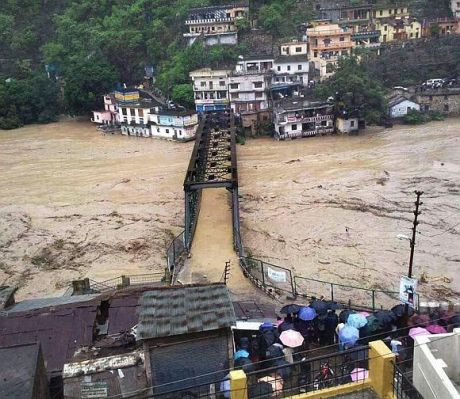
Bridge to Kedarnath submerged by Alaknanda at Rudraprayag
Filed under: india | Tagged: adi shankara, alaknanda river, char dham, climate, cloud burst, criminal negligence, culture, deva, devi, ecology, environment, floods, ganga river, garhwal district, hindu, hindu pilgrimage sites, hindu pilgrims, hinduism, india, indian army, indian politics, kedarnath, kedarnath temple, lifestyle, mandikini river, national disaster, pilgrim tragedy, psychological warfare, psychology, rain, religion, river ganges, ruthless commercialism, shiva, temples, uttarakhand, values | 9 Comments »










 BHARATA BHARATI