









 “The pro-independence Tibetan leaders need to understand that their utterances and activities are antithetical to the political philosophy and methodology of the Dalai Lama. He is for genuine autonomy, not independence. … It should be clear to Beijing that the Dalai Lama has no intention to perpetuate his own rule in Tibet. In 2011, the Dalai Lama devolved all his political authority to the Lobsang Sangay, Tibetan Prime Minister-in-Exile who happens to be a follower of the Dalai Lama’s path of non-violence.” – Jagdish N. Singh
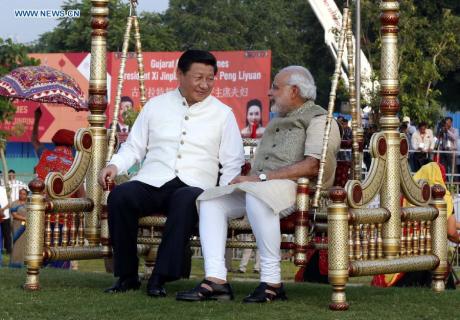
 Prime Minister Narendra Modi began his historic meeting with Chinese President Xi Jinping on Wednesday afternoon in Ahmedabad, Gujarat. As per schedule, Mr Modi took Mr Xi on a tour of Mahatma Gandhi’s Sabarmati ashram.
While Mr Xi was visiting the site from where the Mahatma started his famous salt satyagraha against the British government, far away, in Dharamsala, Tibetan organisations were hoping that Prime Minister Modi will not just show-case “the beauty of Indian democracy … and how it works,” to the Chinese Premier, but will also take up the issue of Tibet during the three-day tour.
One hopes that Mr Modi will, indeed, use this opportunity to bring his guest closer to Tibetan spiritual leader Dalai Lama, someone Mr Modi admires a lot, and actually play the role of a grand statesman, a promise on which he began his tenure, by trying to solve the long-pending Tibet issue.
Beijing remains critical of the Dalai Lama despite the fact that in 1979, Chinese supremo Deng Xiaoping declared, in conversation with the Dalai’s elder brother, Gyalo Thondup, that Beijing would discuss any proposition but Tibetan independence “any time, any place”. Following this the Dalai Lama came forward with various concrete ideas — the Five-Point Peace Plan for Tibet in 1987, and Strasbourg Proposals a year later. His proposals envisaged that diplomacy, defence, communication and finance could remain under the jurisdiction of the central government in Beijing, while culture, education, environment and religion could come under the provincial Tibetan government in Lhasa.
In tune with this framework, the Dalai Lama’s envoys presented a Memorandum on Genuine Autonomy to Beijing in early July 2008. This memorandum proposed that all Tibetan areas be brought under a single autonomous administration.
The envoys have made it clear in their subsequent dialogues with Beijing’s officials that Dalai Lama respects the sovereignty and territorial integrity of the People’s Republic of China, the Chinese Constitution, the Chinese government’s three principles — leadership of the Communist Party, socialist system and autonomy for all minority nationalities — and the hierarchy and authority of Chinese Central government.
 Dharamsala has clarified that in its vision of autonomy, there is no discrimination against Han Chinese people and their language. It also said that it does not seek the withdrawal of the Chinese Army from Tibet and has no intention to return to the past social, economic and political order (i.e. the system that prevailed in Tibet before the Communist take-over).
However, there has been no movement towards a settlement of the Tibetan question. The administrative control remains almost completely in the hands of the Central government in Beijing. The authorities in China have of late been saying that the several rounds of talks held since the re-establishment of contact between Beijing and Dharamsala in 2002 have gone astray, principally because, they allege, the Dalai Lama has a separatist agenda to spread his authority over entire Tibet, which includes Sichuan, Qinghai, Gansu and Yunnan.
 In 1956, while establishing the Preparatory Committee for the “Tibet Autonomous Region”, Chinese vice-Premier Chen Yi had said that if Lhasa could be made the capital of the Tibet Autonomous Region, which would include Tibetan areas within other provinces, it would contribute to the development of Tibet and friendship with China. Party secretary Hu Yaobang had supported the idea of bringing all Tibetan areas under a single administration.
But now Beijing says that the Dalai Lama has ulterior motives. In an interaction with a media delegation last month, Wu Ying Jie, executive deputy secretary of the Communist Party of China’s committee on the Tibet Autonomous Region, said that Dharamsala’s demands were simply unacceptable because the Dalai Lama’s designs were not for “genuine autonomy” but greater autonomy.
Sources in New Delhi and Beijing say one of the reasons behind Beijing’s suspicion about the Dalai Lama is that certain elements on the side of the Tibetan cause have apparently throughout indulged in activities aimed at achieving complete independence for Tibet.
There is substance in this argument, as can be seen in the demand for complete independence being made by Tibetan protesters in New Delhi right now. The protesters allege that the Chinese government under Mr Xi’s leadership has done little to address their legitimate grievances and that the situation in Tibet has been “exacerbated by a deepening crackdown … on any forms of peaceful expressions for freedom”.
The pro-independence Tibetan leaders need to understand that their utterances and activities are antithetical to the political philosophy and methodology of the Dalai Lama. He is for genuine autonomy, not independence. They need to listen to the Dalai Lama if they really do believe that the Dalai’s strategy is the best course for Tibet, a sentiment they never tire of repeating.
Dalai Lama is of the view that in today’s context independence is irrelevant since, as he said in an interview on the 54th Tibetan Democracy Day, it is no longer “Chairman Mao’s era, an era of ideology”. Today economy is “more important than just ideology” and China has, in some ways, become “a capitalist country.” There’s not much choice but to “accept some liberalisation in the political field”, he said.
 He is of the view that it is in the Tibetans’ interest to live with China if genuine autonomy were granted to Tibet.
It should be clear to Beijing that the Dalai Lama has no intention to perpetuate his own rule in Tibet. In 2011, the Dalai Lama devolved all his political authority to the Lobsang Sangay, Tibetan Prime Minister-in-Exile who happens to be a follower of the Dalai Lama’s path of non-violence.
Beijing needs to trust the Dalai Lama and have direct dialogue with him for a permanent solution to the Tibetan question. There is no wisdom in snapping ties with the Dalai Lama for what some pro-independence elements are doing. – The Asian Age, 17 September 2014
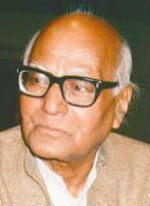
» Jagdish N. Singh is a senior journalist based in New Delhi.
Filed under: india, tibet | Tagged: dalai lama, diplomacy, diplomatic offensive, india-china border dispute, india-china relations, mcmahone line, narendra modi, state visit, xi jinping | 1 Comment »