











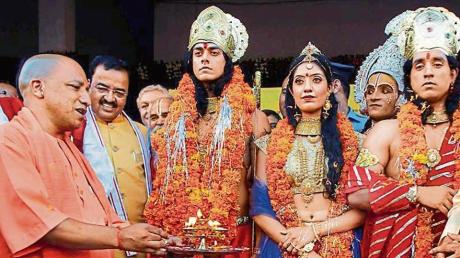
Indians—Hindus and Muslims—must face their past squarely. No true reconciliation is possible by denying or distorting facts, however unpleasant they may be. Today’s Muslims cannot be blamed for what happened centuries ago, but then they should distance themselves from the misdeeds of their “heroes”. – Punarvasu Parekh
Mahant Avaidyanath was prophetic when he said “Ayodhya mein Ram mandir ka nahi, Hindu rashtra ka shilanyas hua hain,” after Rajiv Gandhi allowed the foundation-laying ceremony to be performed at the Ram Janmabhoomi complex in late 1989.
The last millennium opened with wanton destruction of Hindu temples at the hands of fanatic invaders. In a fitting preamble to the Hindu renaissance, the current one has opened with the successful culmination of a centuries-old struggle to restore one of the holiest among them. Happily, the success has been unambiguous, peaceful and legally sanctified.
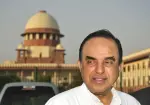
The Supreme Court judgment in Ram Janmaboomi-Babri Mosque case is arguably the most important verdict in the history of independent India. No other judgment has had or is likely to have such far reaching influence on our society and polity. It is also among the best judgments delivered by any Indian court. It has settled a dispute that traced its origins to the medieval ages, had been a festering sore in the body politic through centuries and threatened to tear apart the social fabric of the country.
It is to the eternal credit of the Supreme Court that it decided such a complicated case in an unequivocal manner and through a unanimous judgment. If the sole Muslim judge had dissented, the whole bench would have looked communally polarized, seriously eroding the credibility of the judgment. While all the five judges share the credit, special mention must be made of the Chief Justice Ranjan Kumar Gogoi for his initiative, drive and determination to see the case through without compromising in any manner rights of the parties to present their case.
A mere title suit on the face of it, the Ayodhya dispute at a deeper level raised profound issues related to the legal sanctity of religious faith and belief, cultural content of Indian nationalism, nature of Indian society, interpretation of Indian history and, above all, the role and direction of the Indian State.
For this reason, there was a strong view that the matter should not be left to the courts to decide, but resolved through negotiations or legislative process. In retrospect, however, it is just as well that the solution had a stamp of approval of highest court of the land. In any negotiated settlement, the parties would have been vulnerable to the charges of naivety, intimidation or sellout. A law passed by parliament would have been viewed as a majoritarian act.
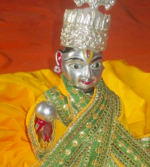
The Hindus have won not just a title suit, but vindication of their age-old faith, a 500-hundred-year old struggle to reclaim one of their holiest shrines and a symbolic but significant reversal of the tide of Islamic iconoclasm that has led to the destruction and desecration of thousands of their temples small and large across the sub-continent through the ages.
Ram, and not the temple, had been the core issue from the beginning. The Ram Janmabhoomi Movement was an expression of the collective consciousness of the Hindu ethos, a struggle for their cultural resurgence and national identity.
Was Babri Mosque a deep wound on India’s bosom, a symbol of national disgrace and humiliation at the hands of a fanatic foreign invader or was it part of “our composite cultural heritage”?
Before you begin to answer this question, you run into several others. Thus, is India the repository of a great ancient civilization or is it a “nation in the making”? Are Vedas, Upanishads, Ramayana and Mahabharata treasures of the spiritual heritage of the Indian nation, or merely old texts highly regarded by “a section of the population”? Are Ram and Krishna symbols of India’s nationhood, or are they mythological figures revered by some sections of a community? Was Babur a fanatic foreign invader who inflicted a deep wound on the Indian nation by destroying the Ram Janmabhoomi Temple at Ayodhya, or just one among the many kings who ruled India in the medieval era? Were Rana Pratap and Shivaji national heroes fighting alien rule, or rebels against a central authority? Finally, do Hindus constitute the national society, or are they just one of the several communities inhabiting India?
The Supreme Court cannot address these issues and has not ventured to do so; but it has created an opportunity for the modern India to find correct answers to these questions.
The people of the country have shown great maturity in receiving the judgment. No chest thumping, no victory processions, no taunting or abusing by one side; nor any wailing, self-pitying, breast beating or victim playing by the other. Not a single untoward incident or a law-and-order problem anywhere. Only a quiet, dignified acceptance of the verdict in a long-standnig feud by the highest court of the land.
The self-styled “eminent” Leftist “historians” stand thoroughly discredited and exposed. There is blood on their hands. They must bear the largest portion of blame for all the violence and bad blood related to this dispute in the last three decades. With their lies and distortions on the history of the place, they misled the Muslim leadership, prompted it to take up a hard conciliatory position and effectively prevented an amicable solution which looked possible in late 1980s.
There have been some discordant noises, to be sure, by the usual suspects. We must respect their democratic right to dissent. One allegation is that the court has placed faith above facts, that it has succumbed to the majoritarian impulse of the ruling elite and has conferred a veneer of legality on the fait accompli presented by Hindu-appeasing governments and rowdy karsevaks from time to time.
This is not true. Yes, the court has said that “once the court has intrinsic material to accept that the faith or belief is genuine and not a pretense, it must defer to the belief of the worshipper. This, we must do well to recognize, applies to across the spectrum of religions and their texts, Hinduism and Islam among them. The value of a secular constitution lies in a tradition of equal deference.” However, it has also added that “the court cannot adopt a position that accords primacy to the faith and belief of a single religion as a basis to confer both judicial insulation as well as primacy over the legal system as a whole.”
Since faith and beliefs of all religions are entitled to equal respect in law, they cancel each other out when they conflict. Then the judgment must rest on factual evidence. This is what the court has done in the present case by applying principles of adverse possession, law of limitation and general rules of evidence to ascertain whose version is more cogent, consistent and probable. In a bid to do complete justice, it has used special powers under Article 142 to order grant of five acres of land at a prominent place in Ayodhya for a mosque to compensate Muslims for loss of a religious place.
Some commentators have accused the court of inconsistency and self-contraction. If the Muslims were wrongly deprived of a 450-year old mosque through its demolition in December 1992, as the court has said, then how can it go ahead and hand over the entire disputed area to the perpetrators of demolition? This is nothing short of rewarding vandalism and desecration, say the critics. Some leaders have used this argument to announce that “our fight was for mosque and not for 5 acres of land in charity.”
However, in totality of things, the mosque itself was a symbol of vandalism and desecration. If there was any doubt about it, the ASI report clinched the issue. The karsevaks, at worst, can be accused of taking the law in their hand.
What now? There is some loose talk of liberating Kashi and Mathura. However, the law of religious places passed by Narasimha Rao government in 1991 froze the status quo at all places except Ayodhya. More importantly, such a movement is unlikely to gain much traction among Hindus, at least in foreseeable future. The general mood in the community is to rejoice in the legal victory, build a grand temple in Ayodhya and get along with other, pressing problems of life.
Instead, Hindu organizations should focus their energies on liberating major temples from the government control. They should also take up the fight for the right of Hindus i.e. the numerous communities within the Hindu fold, to establish and manage religious and educational institutions of their choice.
Secondly, Indians—Hindus and Muslims—must face their past squarely. No true reconciliation is possible by denying or distorting facts, however unpleasant they may be. Today’s Muslims cannot be blamed for what happened centuries ago, but then they should distance themselves from the misdeeds of their “heroes”.
In fact, viewed in a proper historical perspective, Ram Janmabhoomi Movement was an opportunity for Muslims to rediscover and re-forge their links with their parent i.e. the Hindu society. The Hindus whom Babur sought to humiliate by desecrating the Ram Janmabhoomi Temple and building a mosque there, were ancestors of the present-day Muslims also. By distancing themselves from vandals of Islam, Muslims could gain ample goodwill and gratitude of among Hindus. The Hindus must always bear in mind that Muslims are their blood brothers, alienated by a foreign ideology of power masquerading as religion.
Leave the vicissitudes of history to historians. Let them write it honestly, in a clear and forthright manner. We ordinary folks must move on. Let Ram, who united the royalty and laity of his kingdom with tribals in forests and mountains in distant lands, bring together estranged brothers in his homeland. Let Ram, who liberated Sita from the bondage of Ravan, liberate us from the bondage of past and the past of bondage, and lead us to Ramarajya.
› Punarvasu Parekh is an independent senior journalist in Mumbai.

Filed under: india | Tagged: ayodhya verdict, hindu-muslim relations, ram lalla virajman, ramjanmabhumi dispute, supreme court of india | 2 Comments »





 BHARATA BHARATI