












 “Hindi as an exclusive national franchise would give rise to surreal scenarios: it would be a sight to behold Fali Nariman, Soli J. Sorabjee, K. K. Venugopal, K. Parasaran or Ashok Desai getting lost in translation as they fumble with delicate matters and nuances in the language. Will the Thirukkural and Gitanjali be sung in Hindi? Will English be spoken and taught in Hindi? Will Prasoon Joshi write the new national anthem?” – Ravi Shankar
 All language is an amalgam of cultures, some extinct and some thriving. Yet, it is a vehicle of proto-ideas that shape the world. Language is the story of mankind, and as sacred as the word of god. To claim that one language alone represents a nation is a betrayal of the cultures that gave it form. Last week, a petition was filed in the Supreme Court pleading for Hindi to replace English as the official court language since the latter is a “ghulami bhasha”, or the language of slavery. Hindi, too, has a ghulami legacy, unlike other Indian languages. It is an amalgam of Persian, Arabic and Turkish, reflecting the pre-British conquests of India. In the form of Urdu it was in the Mughal court that Hindi first gained prestige, where it was the official language. Hindi’s inherent sophistication comes from Sanskrit. And ironically, Rigvedic Sanskrit is one of the earliest Indo-European languages, which include English and most European languages.
Has the cow belt’s position as the BJP’s power base led to the preponderance of the Hindi lobby as a political bloc? The government recently had to rescind instructions that all government correspondence and social media be in Hindi, in the face of opposition from the states. Hindi as an exclusive national franchise would give rise to surreal scenarios: it would be a sight to behold Fali Nariman, Soli J. Sorabjee, K. K. Venugopal, K. Parasaran or Ashok Desai getting lost in translation as they fumble with delicate matters and nuances in the language. Will the Thirukkural and Gitanjali be sung in Hindi? Will English be spoken and taught in Hindi? Will Prasoon Joshi write the new national anthem? The national narrative is a vast babble of myriad tongues giving the single message that “We are India”. The 1961 census recorded 1,652 mother tongues, including dialects, sub-dialects, dialect clusters and non-subcontinental languages. India hosts 415 living languages of the world’s 6,912. Hence, no language is superior to another; to assume so is to hide a deep insecurity about the endurance and limitations of one’s own.
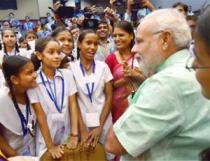 The majority of Indians do speak Hindi. Its best ambassador is Bollywood, which has a pan-Indian influence. Bollywood, however, has created a vocabulary of its own, a mix of Punjabi and Hinglish which shows that language is a living, breathing thing that is constantly evolving. But to engage other nations, a country needs a linguistic identity. Hindi is India’s linguistic identity as much as English is the world’s lingua franca. Hence when Narendra Modi conducts global dialogues in Hindi, it is a signal that the Indian identity will not be compromised. It, however, does not mean that every Indian should speak, write and conduct all business only in Hindi. Ironically, the Indian judicial system, the Indian Penal Code and our very democracy are derived from the colonial experience. But the world has moved on, and India’s colonial past is as relevant as Vikramaditya sitting on a stone and passing sentence in bucolic majesty.
Over 220 Indian languages have become extinct in the last 50 years. The challenge is to preserve our manifold languages, which would certainly become diminished by the imposed spread of one language. A language does define the identity of a people, but not of all people. Hence a bridge between cultures is important for an exchange of ideas without an interpreter present. English is the language that unites the modern world as well as all Indian states. It translates the cultures of the world, bringing Plato or Sartre to India and taking the Bhagvad Gita to the world. At a point when India is engaging the world with greater ferocity, Hindi could be its ceremonial ambassador but not the coinage of its cultural, economic and technological prowess. French, German, Finnish or Russian are the identities of their respective countries. Of India, Hindi is not. Thinking national today is thinking global. Jai Hind cannot be misunderstood as Jai Hindi. – The New Indian Express, 24 August 2014
» Ravi Shankar Etteth is an author, cartoonist and columnist for The New Indian Express. Email him at ravi@newindianexpress.com
Filed under: india | Tagged: english, hindi, india, india government policies, indian politics, narendra modi, national language, politics, psychological warfare, sanskrit | 7 Comments »







 BHARATA BHARATI