









 The free nation that was born in 1947 was unapologetically Hindu. And Nehru, despite being a sceptic, initially went with the Hindu mood of the nation, but later conspired with his progressive Leftist minions to steal the innate “Hinduness” of the country. – Utpal Kumar
On Sunday, 28 May 2023, when Prime Minister Narendra Modi dedicates the New Parliament Building to the nation, a golden Sengol, loosely called sceptre, which had been handed over to the then Prime Minister Jawaharlal Nehru on the eve of India’s Independence, will find a place of honour in the new premises. The saga of Sengol, however, manifests everything that has—and could have—gone wrong in post-Independence India.
In 75 years as a free nation, the golden Sengol—the sacred emblem used to legitimise the transfer of power from one king to another by the rajguru (state priest)—was reduced to a “golden walking stick gifted to Pt. Jawaharlal Nehru”. Its sacred nature was invaded by the secular state to consign it to a museum in Prayagraj—dumped, desolated and degraded. As it is now slated to be purified with holy waters and installed in the new parliament, next to the Speaker’s seat, the “discovery” of Sengol, in a way, marks the rediscovery of civilisational India that had deliberately been relegated to the margins in the name of cultivating “scientific tempers”.
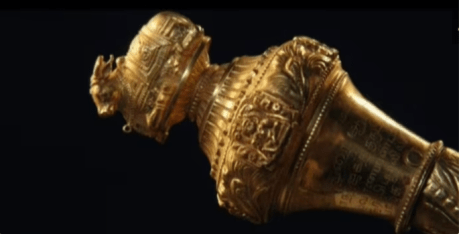
It’s ironic but full of symbolism that the last time a Sengol was used to legitimise transfer of power, it was on the eve of India’s Independence. Before the transfer of power on 15 August 1947, Lord Mountbatten, the last Viceroy of British India, reportedly asked Nehru about the rituals needed to mark the occasion. Nehru reached out to C Rajagopalachari, popularly known as Rajaji, who recommended him to follow the Chola model of power transfer, wherein a priest would present a sceptre to the new ruler to convey the idea of power transition. Rajaji, in fact, took the lead in approaching Thiruvavduthurai Adheenam to assist in the making of a Sengol. The 5-ft long intricately carved gold-plated silver sceptre, with a finial of a bull (a symbol of dharma) on top, was ready before the transfer of power.
On 10 August 1947, two sannyasis from the Thiruvavduthurai Mutt left for New Delhi in a special plane. Just like the ancient Hindu kings, Nehru was handed over the Sengol right before his historic “Tryst with Destiny” speech in the Constituent Assembly that marked the birth of the nation freed from British rule.
In his 1950 book, Betrayal In India, Journalist D.F. Karaka reminisces the festive mood in Delhi that was suddenly marked by upsurge of “religious spirit”. It was the rise of Hindu spirit that the author erroneously, and in sync with the Nehruvian consensus, called “superstitious”. He writes, “In Delhi, as the great day approached, the enthusiasm and excitement grew. Then, for some inexplicable reason, a religious spirit spread over the capital. Time magazine in its report said: ‘As the great day approached, the Indians thanked their various gods and rejoiced with prayers, poems, hymns and songs.’ Even Pandit Nehru, who had never been known to frequent the temples or to indulge in much religious ceremony, consented to have the blessings of the religious pandits. From Tanjore there came emissaries of the head priest the Sanyasis, an order of Hindu ascetics. It was traditional in ancient India to derive power and authority from the holy men. Pandit Nehru yielded to all this religious ceremony. … The mood of New Delhi had become almost superstitious.”
Karaka continues, “In the evening the priests walked ahead of these religious processions. They carried the sceptre, the holy water which they had brought with them from Tanjore, and rice. They laid their gifts at the feet of the Prime Minister. Holy ash was marked on the Pandit’s forehead and the priests gave him their blessings.”
The free nation that was born in 1947 was unapologetically Hindu. And Nehru, despite being a sceptic, initially went with the Hindu mood of the nation, but later conspired with his progressive/Leftist minions to steal the innate ‘Hinduness’ of the country.
Even Dominique Lapierre and Larry Collins, in their book Freedom at Midnight, capture the Hindu mood at the dawn of Independence. They write, “As once Hindu holy men had conferred upon ancient India’s kings their symbols of power, so the sannyasin had come to York Road to bestow their antique emblems of authority on the man about to assume the leadership of a modern Indian nation.” Lapierre and Collins also mention how Nehru, “who had never ceased to proclaim the horror the word ‘religion’ inspired in him, their rite was a tiresome manifestation of all he deplored in his nation, … submitted to it with almost cheerful humility”. Now that’s called having the cake and eating it too! Nehru had no reservations in legitimising his rule through Hindu mores while working tirelessly thereafter to decimate each and every edifice that had Hindu markers.
Still if anyone had doubts about the innate “Hinduness” of the just-freed India, one should read the following lines from Freedom at Midnight, minutely detailing the mood in New Delhi at the midnight of 14 August 1947: “No arsonist’s hands had lit the little fire burning in the New Delhi garden of Dr. Rajendra Prasad, the president of India’s Constituent Assembly. It was a Sacred Fire, consecrated and purified according to Vedic rite by the Brahmin priest who sat beside it rhythmically chanting his mantras. … As he repeated his atonal chant, the learned men and women who would shortly become the first ministers of an independent India, filed past the fire. A second Brahmin sprinkled each with a few drops of water. Then they stepped over to a woman waiting with a copper vessel, its exterior white-washed, its lip covered with palm leaves. As the ministers paused before her, she dipped her right forefinger into the vessel, then, with the liquid on her fingertip, pressed a bright vermilion dot on their foreheads.”
But why just confine oneself to the mood on the eve of Independence? The civilisational idea of Bharat wasn’t an antithesis to the modern idea of India—not at least till 1950, when Sardar Vallabhbhai Patel died and the Right-wing elements were undemocratically hounded out of the Congress. Such was the Nehruvian disdain for these people that Nehru, the democrat par excellence, who all his life preached the one-person, one-post theory, assumed the charge of the party while simultaneously leading the nation. He continued to do so till the Hindu elements in the Congress were largely purged from the party.
At the time of Independence, the makers of modern India never saw its civilisational past with the typical Nehruvian suspect. Even the Constitution of India was Hindu in its appearance. Harsh Madhusudan and Rajeev Mantri write in their seminal book A New Idea of India (2020), “When the Constituent Committee finished the task of drafting the Republic of India’s Constitution, India’s leadership at the time—composed chiefly of figures from the Congress party—tasked the renowned Indian artist Nandlal Bose to illustrate the Constitution.” The front cover of the original Constitution featured Ram, Sita and Lakshman from the Ramayan. It’s, therefore, not a surprise that the term “secularism” was conspicuous by its absence in the Constitution of India.

So, the minority-first secular order wasn’t what India was reborn with in 1947; it was an act of Nehruvian perversion which had nothing but distrust for Hinduism and the Hindu way of life. As Swapan Dasgupta writes in his 2019 book Awakening Bharat Mata, it was “under the leadership of Jawaharlal Nehru” that “the post-Independence Congress slowly attempted to become consciously ‘secular’ and shed explicit identification with Hindu imagery”. In fact, the post-Independence fate of Vande Mataram “from being the icon of the national movement to becoming an extra—something which couldn’t be repudiated but which was at the same time awkward and embarrassing”, as Dasgupta writes, exposes the ills of Nehruvian India.
In that way, Prime Minister Modi, through his Sengol move, has signalled the advent of a new India that is fast unshackling itself from Western idioms. It no longer judges itself from the European/American parameters, and being civilisational isn’t antithesis to modernity anymore. In fact, all the achievements that PM Modi highlighted in his speech in Australia early this week, spanning digital, startups, fintech, etc, point in that direction: That new India is not just getting alive to, but also is confident of its civilisational role. It is comfortable in its own Sanatan boot. Something that the makers of modern India had dreamt of but was unfortunately hijacked and stolen by those who lorded the Lutyens for most parts of post-Independence India. – Firstpost, 26 May 2023
› Utpal Kumar is Opinion Editor, Firstpost and News18.

Must Read
Filed under: india, UK | Tagged: golden sceptre, hindu nation, hindu shaiva mutt, india's independence, sengol | 2 Comments »




 BHARATA BHARATI