















 “The government has used both the law and brute force, said scores of villagers I interviewed, to gain possession of their land. Often the state has also simply seized the land, labelling any resistance rebel-inspired. Hundreds of thousands of people have been dispossessed and displaced. Many now live in what could become permanent refugee camps, where they are easy converts to radicalism.” – Megha Bahree
 After the May 25 attack by Naxals in Chhattisgarh, in which 28 people, including members of the state Congress Party were killed, there has been a lot of noise by all political parties — as well as in the opinion pages of several newspapers — that it’s time for a serious crackdown on the Naxals.
But this conflict can never be resolved unless the government cleans up its own act first. In order to do that, the government will have to first acknowledge that it—and the private sector—has played a critical role in strengthening the Naxal movement. The Naxals have at times expressed regret for the deaths of innocent people, including cops, in their fight against the state. The state is yet to do that.
In December 2009 and January 2010, while traveling through Chhattisgarh for a story I was working on for a business magazine, I saw first-hand how the government’s actions fuelled discontent amongst the villagers, making them easy prey for Naxals.
Chhattisgarh is rich in coal and bauxite, valuable resources for a developing country like India. Over the last decade, the Indian government has tried to lock up land for public projects like power plants and, more recently, for private enterprises like the Tata group. Some of this land is occupied by tribal communities and under the law non-tribal people are prohibited from directly acquiring land in certain parts of the country, so the government must obtain it on their behalf and sell it to the companies.
But in the name of economic development, both the state and corporate India have been callous in their dealings with those who are affected the most—people who will lose their land.
The government has used both the law and brute force, said scores of villagers I interviewed, to gain possession of their land. Often the state has also simply seized the land, labelling any resistance rebel-inspired. Hundreds of thousands of people have been dispossessed and displaced. Many now live in what could become permanent refugee camps, where they are easy converts to radicalism.
 I went to a town called Jagdalpur, which is about 80 kms from Dantewada in Bastar, the epicenter of Naxal activity. Tata Steel Ltd. had planned a factory there to produce five million tons of steel a year because it’s close to iron ore mines to feed the plant. At the time of my visit, the government had been trying for five years to acquire 5,050 acres across 10 villages that would affect 1,750 landowners. The villagers told me that people representing the company had been telling them to sell the land and had offered them jobs in the new factory, something that was unacceptable to many.
India is the world’s largest democracy, but resistance to so-called development is not always welcome as the villagers in Jagdalpur and the surrounding areas found out. When two busloads of villagers went to meet the governor of Chhattisgarh to complain that they were being bullied into selling their land for the Tata plant, the police stopped their buses and hauled them off to jail. (A Tata spokesman said the company was not involved with the land acquisition as that was the government’s job.)
Gatherings of even small groups of five had been banned around the time of my visit and people were arrested on the strangest of charges like in the case of Mashre Mora, a farmer in a nearby village who had refused to sell his land. He was arrested a third time after returning from a weekly village gathering where farmers discussed issues like water supply, crop infestation and disputes with their neighbours. Charge: disturbing the peace.
That evening about 40 cops came to his house, broke down the door and dragged him out. “I’ve told them I won’t give up my land,” he told me. “I’m uneducated and can’t get a job in an office, so once the money runs out what will I do? I only have the support of my farming, I don’t have anything else.”
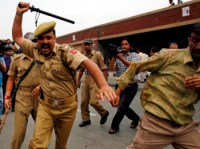 The police say they have no involvement in land acquisition and show up only to hunt Naxals.
In that hunt for Naxals—and their sympathisers—the state has been brutal. A few weeks before my visit, police forces had killed 16 people in a remote village called Gompad in Chhattisgarh. The victims included an old couple and their 25-year-old daughter, who was stabbed in the head with a knife and had her breasts sliced off. Her two-year-old son survived, but three of his fingers were chopped off. A neighbour who witnessed the massacre was shot in the leg as she tried to escape.
Reason: The cops suspected the villagers of sympathising with Naxals, believing that some were informants.
Such incidents are hardly rare and Tata is just one of the several companies trying to set up shop in that area.
Thousands of villagers—displaced by the state or by Naxals—are whiling away their lives in refugee camps. These camps have been around for more than half a dozen years now—when I went there were 45,000 people in 23 camps in the area, including in Bastar district—and yet they don’t have decent facilities for their residents. Thousands of these refugee villagers, who once farmed their own land, grew their own food, now live on meagre government handouts. There are still no decent schools, no real health workers, nothing at all to make these refugees feel that someone is looking out for them and will get them back to the homes and lives they once knew.
 No one knows if these villagers were Naxals or if they supported the Maoist philosophy. But what we do know is that they have been beaten and abused and dispossessed of their own land, their way of life, all their rights. Where do you think they will turn to for justice? To the government which arrives with representatives of corporate India, or to the rag-tag gangs of armed men and women who stand against them? – The Asian Age, 4 June 2013
» Megha Bahree is a correspondent in India for the Wall Street Journal. She won the Overseas Press Club of America award for best business reporting from abroad for her story on Naxals in India in 2011.
Filed under: india | Tagged: bastar tribals, bauxite, big industries, BJP, chhattisgarh, civil rights, civil war, communism, economic development, economics, forced land acquisition, forest products, globalisation, human rights, INC, india, indian parliment, indian police service, indian politics, industry, jarkhand, jarkhand | chhattisgarh, land ownership, lifestyle, maoism | naxalism, maoists, marxism, mineral wealth, mining, nation-state, naxalites, police brutality, politics, psychological warfare, refugee camps, sessionism, tata steel, UPA-2, west bengal | Comments Off on Chhattisgarh: Government must clean up its act – Megha Bahree










 BHARATA BHARATI