
















There is no haven in a nation that does not value your life or your contributions. This does not mean abandoning America or rejecting the genuine bonds many Indian Americans have formed. But it means recognising a fundamental truth: betting your future exclusively on a foreign nation, regardless of its promises or prosperity, is dangerous. – Sanbeer Singh Ranhotra
The greatest irony of American democracy is on full display today. A nation that prides itself as a beacon of pluralism is systematically demonising one of its most economically productive and law-abiding communities—Indian Americans.
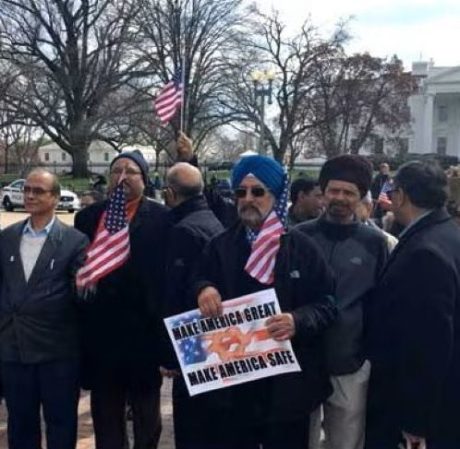
The evidence is stark. Hate crimes targeting people of Indian origin surged by 91 per cent over the past year. In recent months alone, Hindu temples have been vandalised repeatedly across California, Virginia, Texas, and beyond. In some cases, CCTV footage captured the perpetrators, yet police made no arrests. Racist memes depicting Indians as outsiders flooded social media platforms. Political figures (mostly Republicans) are openly questioning whether Indian Americans assimilate, demanding they “go back to India”. This is not fringe extremism anymore. It is becoming normalised discourse.
Success Without Protection
Indian Americans comprise just 1.5 per cent of the US population—5.1 million people. Despite this tiny footprint, they contribute 6 per cent of all federal income taxes annually, amounting to $250-300 billion. They lead 16 Fortune 500 companies, collectively employing 2.7 million Americans and generating nearly $1 trillion in annual revenue. Sixteen Fortune 500 CEOs. Let that sink in. These individuals did not inherit dynasties. They climbed from nothing to the apex of American capitalism.
The economic reach extends far beyond the boardroom. Indian Americans own approximately 60 per cent of all US hotels. That’s approximately 34,000 properties generating $700 billion in annual revenue and creating over four million jobs. In states like Texas, Oklahoma, and Louisiana, this figure reaches a staggering 90 per cent. Walk into any convenience store across America, and there is a significant probability an Indian American owns it. They collectively run 35 to 50 per cent of the nation’s convenience stores, generating $350-490 billion annually.
These are not abstract statistics. These are jobs for American families, tax revenue for American towns, and economic activity that binds the American ‘capitalist’ nation together.
In innovation and research, the contribution is equally remarkable. Indian-origin scientists now receive 11 per cent of National Institutes of Health grants, up from 6 per cent in 2015. That is $4.8 billion dedicated to research that saves American lives. Indian Americans co-founded 20 per cent of America’s billion-dollar startup companies. The list includes Cambridge Mobile Telematics, Reify Health, and Innovacer—companies solving critical problems in healthcare, transportation, and technology. They hold 10 per cent of all physician positions in America, with many serving rural communities that lack adequate medical care. They contributed roughly 8 per cent of all American technology startups and hold 13 per cent of patent contributions. They represent over 25 per cent of international students at American universities, contributing $10 billion annually to the education sector.
Yet this is the community being scapegoated.
The timing reveals the real motive. Hate crimes spiked dramatically after political figures and media personalities began blaming Indians for job losses. In December 2024, following a debate about visa policy and immigration, 76 per cent of documented threats against Indians were explicitly tied to claims that “Indians are taking American jobs.” This is the classical playbook of a desperate political class searching for external enemies to distract from internal failures.
The American dream is collapsing for millions of citizens. Inflation has eroded purchasing power. Job security has disappeared. Political polarisation has become toxic. The middle class is drowning. In this environment of despair and anger, who becomes the easiest target? Those perceived as outsiders. Those with visible differences. Those who cannot effectively fight back through electoral politics or cultural dominance.
But here is what the architects of this hatred fundamentally miscalculate: any disruption to Indian-American economic participation would shatter American prosperity, not enhance it. The hotels would close. The startups would collapse. The research would halt. The hospitals would lose physicians. The technology sector would lose engineers. Entire supply chains, entire industries, entire communities depend on Indian-American participation. America cannot function without this community, whether its political leaders acknowledge it or not.
America’s Breaking Contract
This raises an uncomfortable question about American democracy itself. If the nation’s most economically productive, law-abiding, educated and ‘rich’ minority can be threatened with deportation, violence, and institutional harassment simply because they have succeeded, what does this say about the supposed sanctity of American constitutional protections? What does it say about the country’s commitment to diversity and equal citizenship?
For Indian Americans, the answer carries a different weight. For decades, the narrative has been straightforward: immigrate to America, work hard, achieve success, and secure a better life for your children. The implicit promise was safety and acceptance in exchange for contribution. Today, that promise is being shattered. No amount of wealth shields you from a mob. No number of Fortune 500 positions guarantees your safety. No tax contribution buys you dignity when politicians question your loyalty.
A man like Vivek Ramaswamy, a leading voice in American conservative politics, is targeted with racial slurs and dehumanising language by far-right figures. A woman like Usha Vance, the wife of the vice president, faces racist attacks based on her heritage. If even these pinnacles of American success offer no protection, what hope exists for ordinary Indian Americans?
The End of Assumptions
This is the stark realisation many in the community are confronting. There is no substitute for home. There is no haven in a nation that does not value your life or your contributions. This does not mean abandoning America or rejecting the genuine bonds many Indian Americans have formed. But it means recognising a fundamental truth: betting your future exclusively on a foreign nation, regardless of its promises or prosperity, is dangerous.
For Indian Americans, the path forward must be dual. Continue contributing to American society, absolutely. Fight against discrimination and hate crimes with the full force of law and public opinion. Take a leaf out of the Jewish community’s playbook. But simultaneously, invest in India. Build enterprises here. Contribute to scientific research here. Create jobs here. Transfer skills and capital here. Strengthen India’s economy, institutions, and security architecture. Because ultimately, India offers something no other nation can: an irreplaceable belonging that cannot be revoked by political winds or social upheaval.
America built its greatness partly on immigrant labour and ingenuity. The current trajectory suggests that era is ending. Indian Americans must adjust their strategies accordingly. The time for absolute reliance on Western democracies is over. The time for building parallel centres of power and prosperity in India has begun, for American democracy is being tested by its contradictions. – News18, 30 Decemeber 2025
Filed under: india, USA | Tagged: american democracy, anti-indian racism, indian-americans, religious bigotry, scapegoating indians |









 BHARATA BHARATI