















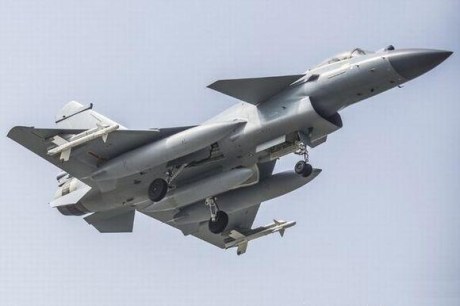
The apparent involvement of Chinese aircraft in shooting down a Rafale has ricocheted through defence circles. But defence analysts remain cautious of reading too much into the technological battle between the two systems. Pilot error, or the rules of engagement, could have contributed to the Indian Rafale’s demise. – Memphis Barker
At 4am on Wednesday, China’s ambassador to Pakistan hurried to the foreign ministry to celebrate an unprecedented military success.
Pakistan had reportedly shot down several Indian aircraft in the hours before using Chinese J-10C fighter jets.
“Our jet fighters … shot down three Indian Rafales, three Rafales [that] are French,” Ishaq Dar, Pakistan’s foreign minister, told parliament on Wednesday. “Ours were J-10C.”
The Chinese delegation, roused from their sleep by the outbreak of conflict between two nuclear-armed nations, was thrilled with the success of the Pakistani defence, Mr Dar said.
“Being a friendly nation, they expressed great happiness.”
India has not officially responded to reports that it lost as many as five fighter jets. But the apparent involvement of Chinese aircraft in shooting down a Rafale has ricocheted through defence circles—and sent stock in its maker, Chengdu Aircraft Corporation, surging by as much as 20 per cent.
Until now, Chinese weaponry had not been field-tested against Western-made systems like the Rafale. The Indian Air Force (IAF) operates a fleet of 36 Rafale F3Rs, the most advanced model of the aircraft.
A French intelligence source confirmed to CNN on Wednesday that at least one had been shot down, marking the first time a Rafale has been lost during combat.
In an official statement, China’s foreign ministry said it was “not familiar with the matter” when asked whether Chinese jets were involved in the skirmish.
Later on Thursday evening, a US official told Reuters that there was “high confidence” a J-10C had shot down two Indian fighters, using air-to-air missiles.
That appeared to confirm the aircraft first known “kill”, having entered service in its earliest form in 2003. It has been described as a “4.5 generation fighter”, like the British Eurofighter Typhoons and almost at the level of fifth generation systems like the US-made F-35.
Hu Jixin, the former editor of the Chinese state-owned Global Times, said the battle showed that “China’s level of military manufacturing has completely surpassed that of Russia and France”, adding that Taiwan should feel “even more scared”.
Defence analysts remain cautious of reading too much into the technological battle between the two systems. Pilot error, or the rules of engagement, could have contributed to the Indian Rafale’s demise.
But open-source intelligence analysts are poring over images of the wreckage of a Chinese-made PL-15 missile, broadcast on Indian television and shared on social media.
The missile, which is carried by the J-10C, has never been used in combat before. But its ability to fire at targets far beyond the visual range of pilots appears to fit with the outlines of the clash on Wednesday morning.
Neither Pakistani nor Indian aircraft crossed the border, engaging instead in a “stand-off” conflict at a distance of more than 100km at times. The wreckage of a Rafale was discovered near the city of Bathinda deep inside India, according to multiple open-source analysts.
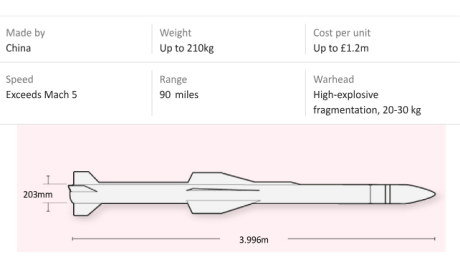
China’s development of the PL-15 prompted the US military to invest in a missile specifically designed to outrange it.
The PL-15E, the version exported to the Pakistani armed forces, can travel up to 145km, somewhat less far than the domestic equivalent.
Chinese military observers have long viewed it as a “very capable missile”, said Fabian Hoffmann, a missile technology researcher and non-resident fellow of the Centre for European Policy Analysis.
“But obviously [if a hit is confirmed] this is now a very public demonstration of the prowess of Chinese military aerospace technologies” that “carries outside the bubble”.
“This is another point of indication that, if there was a Taiwan conflict, you probably should not assume that Chinese technology would fail at the same rate as Russia’s during the war in Ukraine.”
On April 29, with cross-border tensions rising, Pakistan’s army published a YouTube video showcasing its military arsenal.
In the video, a Chinese-made JF-17 Block 3 fighter jet, less advanced than the J-10C, can be seen equipped with PL-15 missiles. The combination offers “potent punch”, a caption reads.
For pilots in the Pakistani Air Force, the PL-15 missile has several advantages. Once fired, it has a large rocket booster that briefly propels the projectile to above Mach 5, or hypersonic, speeds.
In the middle of its flight, it is guided to target by an active electronically scanned array (AESA) radar that can be held on the launch system or a separate vehicle. Close to the target, it switches on its own AESA radar, locks on, and homes in with deadly accuracy.
A dual-pulse motor means that, after the initial blast falls away, a second burst of speed can be generated within 10 or so kilometres from the target.
“Because they are very, very fast, they basically have what you call a ‘no-escape zone’,” Mr Hoffmann said.
The switch from the first radar system to the missile’s onboard version also allows the jet that launched it to turn away from the target and flee any counterfire.
“There’s survivability for the [launch] platform, but also lethality for the [missile] itself.”
When India and Pakistan clash, so do their military backers. In recent years, the two nations have rapidly diverged in terms of where they source their weaponry.
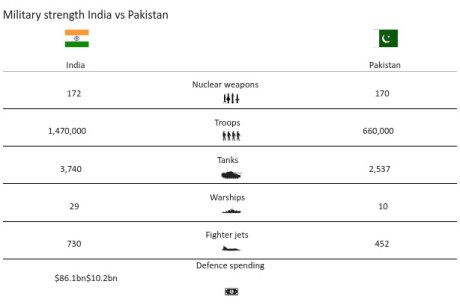
Now, Islamabad buys the vast majority of its arms from China. Some 82 per cent of imports between 2019 and 2023 came from its “iron brother”, according to the Stockholm International Peace Research Institute (SIPRI), which tracks global arms flows.
Imports from the US, meanwhile, have collapsed.
At the same time, Delhi has stepped up arms purchases from Western allies and reduced its reliance on Russia. Since 2006, purchases from France, Israel and the US have surged. Imports from Moscow have fallen from 75 per cent of the total to 36 per cent, according to the SIPRI.
“The big advantage the Pakistanis have is that their primary weapon supplier is China,” said Dr Walter Ladwig, an associate fellow at the Royal United Services Institute, a London-based think tank.
“The Indian defence budget is bigger on paper, the modernisation budget is bigger.”
But Beijing “delivers”. It has rapidly supplied Pakistan with armour, a jointly developed fighter jet (in the form of the JF-17 Block 3) and missile systems.
For various reasons, India’s main suppliers, Russia and France (who provide 36 per cent and 33 per cent of imports respectively) have been slower to fulfil their orders, said Dr. Ladwig. India’s air force is “still operating these antiquated MiGs”, he added.
China’s foreign ministry has urged both sides to exercise restraint and avoid a full-scale war. But there will be some in Beijing hoping for further, explosive field tests. – Yahoo! News, 8 May 2025
› Memphis Barker is a senior foreign correspondant for the Telegraph, London.
Filed under: france, india, pakistan | Tagged: chinese jet fighters, french jet fighters, india-pakistan relations, indian air force, missle systems |










 BHARATA BHARATI
India confirms it lost fighter jets in recent Pakistan conflict – Bloomberg – May 31, 2025
India’s military confirmed for the first time that it lost an unspecified number of fighter jets in clashes with Pakistan in May, while saying the four-day conflict never came close to the point of nuclear war.
“What is important is that, not the jet being down, but why they were being down,” Anil Chauhan, chief of defense staff of the Indian Armed Forces, said in an interview with Bloomberg TV on Saturday, while attending the Shangri-La Dialogue in Singapore.
He called Pakistan’s claims that it shot down six Indian warplanes “absolutely incorrect,” though declined to specify how many jets India lost.
“Why they were down, what mistakes were made — that are important,” Chauhan said when asked about the fighter jets. “Numbers are not important,” he added.
“The good part is that we are able to understand the tactical mistake which we made, remedy it, rectify it, and then implement it again after two days and flew all our jets again, targeting at long range,” Chauhan said.
The comments are the most direct yet from an Indian government or military official on the fate of the country’s fighter jets during the conflict with Pakistan that erupted on May 7.
Earlier this month, Pakistani Prime Minister Shehbaz Sharif said his country shot down six Indian fighter jets, an assertion that hasn’t been independently verified. India’s government had earlier refrained from commenting on whether it lost aircraft in the fighting.
The clash was the worst between the nuclear-armed neighbors in half a century, with both sides trading air, drone and missile strikes, as well as artillery and small arms fire along their shared border. It was triggered by a gruesome attack in Indian-controlled Kashmir on April 22, which saw gunmen kill 26 civilians in what India called an act of terrorism orchestrated by Pakistan. Leaders in Islamabad denied involvement.
Chauhan declined to comment on President Donald Trump’s claim that the US helped to avert a nuclear war, but said it was “far-fetched” to suggest either side was close to using atomic weapons.
“I personally feel that there is a lot of space between conduct of conventional operations and the nuclear threshold,” Chauhan said. Channels of communication with Pakistan “were always open” to control the situation, he added, noting that on the escalation ladder there were “more sub-ladders which can be exploited for settling out our issues” without needing to resort to nuclear weapons.
‘Red Lines’
Chauhan also downplayed Pakistan’s claims about the effectiveness of weaponry deployed from China and other countries, saying they “didn’t work.” A research group under India’s Defense Ministry said this month that China provided Pakistan with air defense and satellite support during its clash with India.
“We were able to do precision strikes on heavily air-defended airfields of Pakistan deep 300 kilometers inside, with the precision of a meter,” the Indian military chief said.
India and Pakistan have sent delegations to global capitals to influence international perception of the conflict. Chauhan said the cessation of hostilities is holding, and will depend on Pakistan’s actions in the future.
“We have laid clear red lines,” he said.
LikeLike
Rafale Controversy: Is The West Sidelining India’s BIG WIN Over Pakistan? – Prakash Nanda – The EuroAsian Times – May 14, 2025
Is the number of fighter aircraft lost in a war or armed clashes the criterion in determining the victor?
If the Pakistani authorities and some quarters in the Western media are to be believed, Pakistan emerged as the clear winner in the “Operation Sindoor” that India had launched because “India’s air bases and at least six fighter aircraft were destroyed by the Pakistani Air Force”.
Incidentally, one of the Western journalists writing in a British paper made some big claims in favor of Pakistan. He appears to have built close relations with the Pakistani establishment, as he was based in Islamabad for years. But that is a different story.
And then we have a few American publications publishing quite a few articles saying how as many as four IAF aircraft, including French-made Dassault Rafale fighters, were shot down, resulting in “a stunning and even unexpected victory for the PAF, the biggest winner following last week’s aerial dogfight”.
One does not discuss the merits of such arguments, which are literally ludicrous in the absence of verifiable facts. Their writings seemed more like orchestrated propaganda that suited the Chinese-Pakistani narrative of technological superiority.
The point to ponder over is this—assuming India lost some fighter planes, does that deny India achieving its intended goal of teaching the Pakistan-based terrorists and their military backers a salutary lesson?
Whose DGMO first picked up the phone to talk to his counterpart to stop the aerial war? The answer is too obvious to be elaborated on.
That a real winner in a war has to be the party that does not incur any loss is something that even any fiction writer or a writer on comics on war will not venture. However, the fact that some Western journalists have done so to gladden the hearts of Pakistan and China reflects on the credibility of the publications concerned.
Let us see some concrete, hard facts that are easily available on open sources.
Records from the now-defunct U.S. Army Air Forces indicate that at least 100,000 planes were destroyed during World War II. The U.S. is said to have lost 65,164 airplanes in combat, training accidents, and other incidents between December 1941 and August 1945 while destroying 40,259 enemy aircraft during the war.
In other words, in World War II, Americans lost more planes than they destroyed of the enemy. But ultimately, it is they who won, not America’s enemies.
One may overlook losses of American fighter planes during the war in Vietnam, since it was a war the U.S. lost.
However, during the 1991 Gulf War, the U.S. lost 28 fixed-wing aircraft in combat and 12 in non-combat situations. Additionally, 23 U.S. helicopters were lost, with 5 in combat and 18 in non-combat situations. In total, the US was reported to have lost 75 aircraft, with 63 U.S. aircraft and 12 allied aircraft.
During the 1999 air campaign over Serbia, the US and NATO forces lost two fighter planes. One was a USAF F-16C fighter jet, and the other was a cutting-edge F-117 Nighthawk stealth attack aircraft. Both were shot down by the Serbian air defense systems.
Apparently, after the gruesome attack on New York on September 11, 2001, in its decade-long fights against “global terror”, including that in Afghanistan during “Operation Enduring Freedom”, the U.S. Air Force lost more than 160 aircraft to accidents and enemy action. And overall, 103 Air Force personnel had died supporting the battles in Iraq and Afghanistan by December 2009, more than half of them on the ground.
Similarly, in the last 10 years, there have been several instances of U.S. fighter jets lost in the Middle East, including at least three F/A-18 Super Hornets in the last six months. There have been multiple instances of US drones (including MQ-1 Predators, ScanEagles, and RQ-21s) being shot down by Houthi forces in Yemen.
So, should we, going by the yardstick cited by the Western journalists in the “Operation Sindoor”, say that America lost in fighting the terror?
One may also cite the British example during the Falklands War in 1982. The British lost nine aircraft, including two Sea Harrier FRS.1 and three Harrier GR.3.
As many as 255 British personnel lost their lives defending the Falklands, of whom 86 were Royal Navy, 124 Army, 27 Royal Marines, six Merchant Navy, four Royal Fleet Auxiliary, and eight Hong Kong sailors. Seven ships were also lost to enemy action.
Given this fact, can we say that the British lost and Argentina won?
Against this background, Professor Amit Gupta, Senior Fellow at the National Institute of Deterrence Studies, USA, suggests that India needs to forcefully challenge Pakistan’s information war, helped by a few foreign journalists.
“Islamabad got Al-Jazeera to announce that an Indian woman pilot had been shot down and captured, and this forced India to ask for a ceasefire. How difficult is it to put this officer on TV and to then tell Al-Jazeera that they are a totally incompetent and biased news outlet?”.
However, Gupta does not find anything wrong with the IAF not clarifying whether India has lost fighter aircraft and, if so, how many.
“It has done the right thing to not bring up losses during the air campaign,” he says, adding, “It is unrealistic to expect that no aircraft can or should be lost in a military campaign. Militaries accept that in waging a war, there will be casualties and loss of equipment.”
Other experts, however, say that there is nothing wrong with disclosing the truth for transparency and public trust. In the Kargil war in 1999, India lost two aircraft, but won decisively over Pakistan.
And the same is the case this time. Indian missiles did hit almost all the major cities and air bases of Pakistan, something the satellites have clearly proved. One of the principal centres of global terror has been demolished, with a globally designated terrorist admitting that 12 of his family members died in the process.
Had India not achieved victory in this limited war, Prime Minister Narendra Modi would not have asserted that for India, there is no difference now between terrorists and those who patronise them, and they will be hit, whoever they are and wherever they are.
And if (and it is a big if) some aircraft have been lost in the process, let it be.
> Author and veteran journalist Prakash Nanda is Chairman of the Editorial Board of the EurAsian Times and has been commenting on politics, foreign policy, and strategic affairs for nearly three decades. He is a former National Fellow of the Indian Council for Historical Research and a recipient of the Seoul Peace Prize Scholarship.
LikeLike