










The Maha Kumbh Mela 2025 has been proclaimed as the ‘Maha Yagya of Unity’ by Prime Minister Narendra Modi. The bathing fesitival will be held in Prayagraj from January 13 to February 26 and is expected to see 40-45 crore devotees. – News 18
The Maha Kumbh Mela, that comes after 12 Kumbh Melas, has been proclaimed as the Maha Yagya of Unity by Prime Minister Narendra Modi. The Maha Kumbh Mela, which will be held in Prayagraj (Allahabad) from January 13 to February 26, is expected to see 40-45 crore devotees.
The Maha Kumbh Mela is not just a festival, but a spirited cultural event, which has historical roots that date back to thousands of years. The festival is a testimony of ancient Hindu mythology, astronomy and India’s rich religious heritage.
Let us understand the origins, history and significance of one of the largest Hindu festivals.
The Mythological Origins of the Maha Kumbh Mela
It is believed that eighth-century Hindu philosopher Adi Shankaracharya promoted regular gatherings of spiritual leaders and ascetics, and instituted the math system and the 13 akharas (warrior-saint orders).
The Kumbh Mela is celebrated four times in a period of 12 years, that is, once every three years, and is held in four places in rotation, which are Prayagraj, Haridwar, Ujjain and Nashik. While the Ardh Kumbh is celebrated in six years in Haridwar and Prayagraj.
The history of Maha Kumbh is linked to the Hindu myth of the Samudra Manthan (churning of the ocean). When Lord Vishnu, in the guise of Mohini, carried the pot of amrit (nectar) during the Samudra Manthan, a fight between the Devas and Danavas led to four drops falling at Prayagraj, Haridwar, Nashik and Ujjain—creating four tirthas (holy sites).
Devotees believe that a dip in the rivers flowing through these tirthas—Ujjain – Narmada, Nashik – Godavari, Haridwar – Ganga and Sangam at Prayagraj – Ganga, Yamuna and Saraswati—will lead to salvation.
How was it Celebrated in the Past?
The earliest references to the Kumbh Mela are found in Hindu Puranas and ancient texts, which described it as a time when Gods would descend to Earth to bless the devotees.
In the Gupta period (around 4th-6th century CE), Kumbh Mela began to attract large crowds as kings and rulers supported the event, built temples and bathing ghats along the sacred rivers. This period marks the beginning of the event’s transition from a local festival to a pan-Indian spiritual celebration.
From the 12th century onwards, the Kumbh Mela became an event with royal patronage. Kings and rulers from various parts of India participated in the festival, offering riches and performing rituals that added grandeur to the event. The Mughal emperors, especially during the reign of Emperor Akbar, showed respect for the Kumbh Mela, granting land and resources for the festival.
During the British Rule, the festival saw citizens from all walks of life, apart from the sadhus, attending the event to increase the momentum for the freedom movement. According to the Centre for Cultural Resources and Training (CCRT), even Mahatma Gandhi took part in the Maha Kumbh Mela in 1918 and interacted with other attendees.
Gradually, the British began controlling the Maha Kumbh Mela’s functioning, with the imposition of pilgrim tax, rapid expansion of railway infrastructure, institutionalisation of the Shahi Snan, preparation of housing, sanitation, and food facilities for the pilgrims and policing, thus limiting clashes between the akharas.
How Akharas and Shahi Snan Became Significant
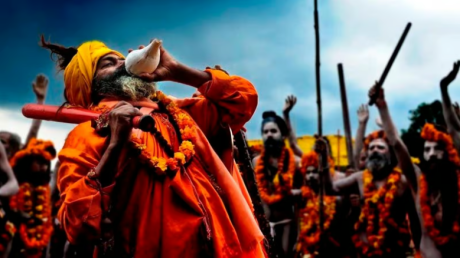
Since the 8th century, sadhus (monks) from various akharas (orders) would gather at Prayagraj to perform the Shahi Snan or the holy dip on auspicious days. These akharas would be led by Naga sadhus, who are naked and covered in ashes and wear only weapons like tridents, swords, lances, coaches and drums. The Naga sadhus carry out traditional processions from various akharas to the river for bathing.
There are 13 recognised akharas, which participate in the Shahi Snan: the Shaivite akharas— Nirvani, Atal, Niranjani, Anand, Juna, Awahan and Agni; the Vairagi akharas—Nirmohi, Digambar Ani and Nirvani Ani, the two Udasin akharas (Naya and Bada) and the Nirmala akhara.
In 2019, a group of 15-20 transgender saints as part of the Kinara akhara—a 14th century sect—from Rajasthan, Uttar Pradesh, Madhya Pradesh, West Bengal, Assam, Tamil Nadu, Odisha, Maharashtra and other took part in the Shahi Snan, as reported by The Hindu.
From the 9th century to the 18th century, it was the akharas, which organised the month-long Kumbh festivities and decided the Shahi Snan order, which became a point of contention. But now the Shahi Snan order has been institutionalized, though the akharas still have an upper hand.
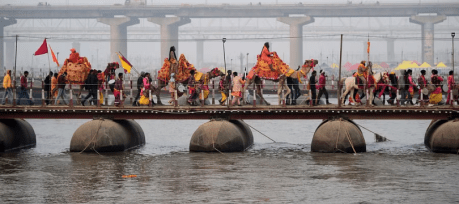
The chief monks or mahamandaleshwars of the akharas seated on chariots, palanquins or elephants lead the Shahi Snan in the early hours of Makar Sankranti, Paush Purnima, Mauni Amavasya, Basant Panchami, Maghi Purnima and Mahashivratri.
Kumbh Mela After Independence
The first Kumbh Mela after Independence was organised in January 1954 by the Indian authorities. In 1966, more than 7 lakh devotees took the holy dip on Magha Purnima—the fifth important bathing day, reported The Hindu.
While Emergency was imposed from 1975 across the country, the year 1977 marked the completion of 12 Kumbh Melas and the flow of Ganga in two streams had created two sangams (confluences).
In 1989, the Kumbh area was expanded to 3,000 acres, with more pontoon bridges built by the Army over the Ganga. The crowd swelled to 1.5 crore for the holy dip in Prayagraj, and Kumbh Mela was recorded in the Guinness World Book of Records as the world’s largest gathering of people.
The Kumbha Mela began being broadcast by government’s media channel Doordarshan from 2001. India’s remote sensing satellite (IRS-ID) captured the landscape of the Kumbh area, including the confluence of the two rivers Ganga and Yamuna, as per The Hindu.
In 2013, a record 3 crore pilgrims reached the Sangam on the biggest bathing day, Mauni Amavasya, as the government arranged 22 ghats spread across 14 sectors and spanning 18,000 feet of the Ganga’s river banks.
In 2019, several new features were introduced in the Ardh Kumbh at Prayagraj including the inclusion of the Kinnar Akhara in the Shahi Snan. Moreover, the 10,000 sanitation workers who kept Kumbh premises clean were felicitated by Prime Minister Narendra Modi at a public event.
How is the Location of Kumbh Mela Decided?
The timing of the Kumbh Mela is based on the astrological alignment of planets. The position of Jupiter, the Sun and the Moon is taken into consideration and the zodiac sign in which it lies is also checked.
As Jupiter takes about 12 years to orbit around the Sun, the Kumbh Mela is celebrated four times over the course of 12 years.
The four locations—Haridwar, Prayagraj, Ujjain and Nashik—are believed to be sacred places and there is a belief that bathing in the holy rivers will cleanse all the sins.
Tragedies During Kumbh Mela
1954: On January 23, a tragedy unfolded in Kumbh Nagar leaving 300 pilgrims stranded and 600 houses being burnt. On the main bathing day on February 3, a stampeded occurred in Kumbh Nagar, killing at least 300 and injuring over a 1,000.
2013: On February 11, at least 10 people were killed and 39 injured after a footbridge collapsed due to the heavy rush of pilgrims at Allahabad railway station. After a few hours, another tragedy took place, killing 26 people in a stampede. A minor fire also occurred at the Kumbh site killing one and injuring five after a two-wheeler caught fire, which then spread to the huts, gutting them. – News18, 9 January 2025
See also
Filed under: india | Tagged: bathing festival, hindu dharma, hindu festivals, kumbh mela, naga sadhus |






 BHARATA BHARATI
Why Western Universities Are Studying Mahakumbh Mela At Prayagraj – The Economic Times – Mumbai – January 11, 2025
Mahakumbh Mela is a unique event in the world with none matching it in size or scale. Prayagraj, a city with a population of 5.5 million, will host nearly 40 crore pilgrims during Mahakumbh, compared to the 25 crore footfalls in 2019. The grand event is celebrated every 12 years when the sun, moon and Jupiter align in a specific way.
More than two dozen prominent universities and other educational and research institutes from around the world as well as in the country are going to camp in Prayagraj during Mahakumbh to study various aspects related to the largest religious gathering in the world. Harvard, Stanford, London School of Economics, Kyoto University, AIIMS, IIM Ahmedabad, IIM Bangalore, IIT Kanpur, IIT Madras and JNU are some premiere institutes that are going to send professors, research scholars and students to stay in Prayagraj.
What attracts different researchers is how the gargantuan management of the Mela works without any major disruptive incident, accident or crime.
Why the ‘pop-up metropolis’ is a feast for researchers
Mahakumbh will see a veritable pop-up metropolis, constructed using tents, pontoons and bamboo structures, which will house millions of pilgrims and be completely dismantled after the festival. The temporary metropolis will feature everything from spatial zoning and infrastructure supply lines to food distribution networks and public gathering spaces.
A 400-km-long temporary road network has been readied for the Mela. 30 pontoon bridges have been laid on rivers and rivulets. A 1,250-km-long water supply pipeline has been set up to distribute water, which would be drawn from 85 borewels. There will be 200 water-vending machines, 96 power sub-stations, 366-km-long transmission cables, 67,000 streetlights, 2,750 CCTV cameras for surveillance, 80 variable display message screens, three viewing centers having LED walls to showcase key religious events and proceedings and a 50-seater command and control room.
“For the first time, we would have institute backed studies on the economic impact, crowd management, socio-cultural manifestation, food distribution chain, anthropological study through ethnographic accounts, faecal sludge management among other areas,” an official stationed in the Mela area told TOI. Eight different fields and subjects have been shortlisted by the state government which would be covered by the researchers. Opening the event for global participation, the urban development department had floated the idea of carrying out exhaustive study, sources told TOI.
“While till 2019, global and domestic institutes used to approach us, this time we thought of opening the Mela to researchers from our end in advance. The research papers would help the state government in plugging the gaps for future events. We are going to provide accommodation to the researchers during their stay and offer some stipend upon successful submission of the papers,” said the official who added that chief minister Yogi Adityanath had suggested the idea to invite the institutes well in advance.
Divided into two comprehensive categories, the research studies would be focused on planning and implementation of Maha Kumbh and estimating the economic impact and outcome of the Mela. While expenditure done by tourists across various categories including accommodation, food, transportation, religious activities and leisurely activities would provide estimates on the outcome of the Mela, study on spending done by state and central government would provide insights over infrastructure development which helped shape up the pop-up city ahead of the festival.
What Western researchers found at Mahakumbh 2013
MahaKumbh 2013 was far better organised than Fifa World Cup in Brazil and Commonwealth Games in New Delhi, said a book on world’s biggest religious congregation, produced by scholars and students of Harvard University along with architects and town planners of international repute. The book, ‘Kumbh Mela – Mapping the Ephemeral Megacity’, went on to add: “For a country notorious for its ‘lethargic’ bureaucracy, the success of Maha Kumbh is truly noteworthy.” If there was a national outcry and uproar over the poor preparations for the World Cup in Brazil in 2014, the 2010 CW Games were marred by scandals and corruption, despite the fact in the two events there were much more funds and involvement of the federal/central governments, it said.
The book mentioned that barring a few countries hardly any matches its aspirations with the capability. “So is India, which has high ambition to provide everyone everything from farmers to migrants to factory worker. Its ambitions are very high but capability very low, and then it generates disappointment. But the Maha Kumbh management and success belies this notion,” it said.
The book details the “sheer human achievement of creating the temporary and yet complex infrastructure of the 24-square-mile Kumbh city, compared to almost 2/3rd of Manhattan. Calling the entire process of making this city with an expiry date as “astonishing”, the book also described how this city came up for 45 days and took in millions of devotees.
Speaking on the business aspect that his team studied at the Kumbh, John Macomber, senior lecturer in finance and real estate, Harvard Business School, said, “We focused on two aspects: one, lessons from administration and leadership, and two, lessons from infrastructure design, delivery and finance.”
A team comprising mainly medical doctors from Harvard University was “largely impressed” with the orderliness of the Mela and the lack of any major disease outbreak.
The main objective of the Harvard team, which had the support of the National Disaster Management Authority and the Allahabad Medical College, was to map patterns of diseases, water distribution, sanitation and disaster management plans. The first reaction of the team was the amazement at the degree of organization. “The electrical grid, wide boulevards, street lights, water supply, sanitation, crowd control, security, sector hospitals and a central referral hospital would be impressive anywhere—but the fact that this is all temporary and will be gone by the end of March—makes it an absolutely astounding organizational feat,” said the doctors.
“The systems are indeed streamlined. But while there are parts that worked, some didn’t,” said Dr Satchit Balsari, who led the team of 25-odd doctors from Harvard University’s FXB Center for Health and Human Rights to Allahabad. A researchers said Kumbh could be better managed if some minor issues such as smoke from choolahs and ambulance management were ironed out. – With inputs from TOI.
LikeLike