














There is a high degree of urgency in recognising Hinduphobia, studying its underlying patterns and motivations, and also examining the linkages between Hinduphobia and the vicious political targeting of the Indian state by certain stakeholders. – Rati Agnihotri
The government of Bangladesh is considering a ban on ISKCON, the International Society for Krishna Consciousness, labelling the global Hindu spiritual organisation a “religious fundamentalist organisation.” This comes amid disturbing reports and footage of temple attacks and violence against Hindu minorities in Bangladesh. Although the Bangladesh High Court has refused to ban ISKCON, the situation remains tense. The crisis has escalated to the extent that more than 60 prominent Indian citizens, including retired judges, former civil servants, and a sitting member of parliament, have submitted a letter to Prime Minister Narendra Modi, urging urgent intervention to address the atrocities inflicted on Hindus in Bangladesh.
Meanwhile, in the United States, Tulsi Gabbard, President-elect Donald Trump’s nominee for Intelligence Services, is facing criticism for her Hindu religious background. A recent opinion piece in the Financial Times referred to Gabbard as a “devotee of an obscure religious cult.”
In Toronto, Canada, Hindu students recently gathered at a university to voice concerns about rising Hinduphobia and Khalistani extremism.
These three incidents, occurring in different parts of the world, may appear disconnected on the surface but what unites these seamlessly is the strong undercurrent of Hinduphobia.
Hinduphobia or anti-Hindu sentiment lies at the root of these incidents. The world is currently witnessing an unprecedented rise of Hinduphobia which has an underlying distinctive pattern. In most cases, anti-Hindu sentiment is accompanied by a strong anti-India sentiment. Thus, attacks on Hindu places of worship and hate crimes against Hindus invariably become a “political statement” against the Indian government. At least, that’s the narrative being manufactured.
The atrocities and violence inflicted on Hindu minorities in Bangladesh following the resignation and subsequent departure of Sheikh Hasina as prime minister were frequently framed by the Mohammad Yunus establishment and Western media as isolated incidents targeting supporters of Sheikh Hasina’s party, the Awami League. This narrative has repeatedly downplayed incidents of communal violence against Hindu minorities in Bangladesh, portraying them instead as politically motivated attacks on Awami League supporters.
One also saw the disturbing trend of gaslighting anti-Hindu violence as online misinformation. India is often implicated in these scenarios, with some Western media reports, such as coverage by France 24, alleging that “Hindu-majority India” is spreading rampant misinformation regarding perceived attacks on Hindus in Bangladesh. Similarly, attacks by Khalistani extremists on Hindu temples in Canada and the United States are frequently accompanied by hateful and abusive graffiti targeting the Indian government and Prime Minister Narendra Modi. In such cases, anti-Hindu and anti-India sentiments are deeply intertwined. What else explains the simultaneous targeting of Indian consulates and Hindu temples in Western countries?
Thus, Hinduphobia is often used as a strategic tool by extremist groups and radical organisations worldwide to interfere in the internal affairs of India and disrupt its sovereignty and integrity. Similarly, political targeting of India is used as an excuse to perpetuate Hinduphobia. For example, Hindu advocacy organisations in Western countries like the US, UK, and Canada are routinely accused of propagating “radical Hindutva” and being mouthpieces of the “Hindu majoritarian Modi government.
In this way, the demonisation of Hindu advocacy diaspora groups becomes a double-edged sword. It serves to further perpetuate Hinduphobia by accusing these groups of being agents of the Indian government, thereby gaslighting the issues they raise. Secondly, it systematically targets the Indian government by using Hinduphobia as a strategic weapon. This is precisely why the Canadian government casually cites “freedom of expression” each time Hindus in Canada are threatened by Khalistani extremists and told to go back to India, rather than condemning those threats.
Thus, to understand the alarming rise in incidents of attacks and intimidation of Hindus and their places of worship worldwide, it is imperative to recognise the existence of Hinduphobia and further analyse the linkages between Hinduphobia, anti-India sentiment, and the increasing attacks on Hindus and Hinduism.
In April 2023, Georgia became the first US state to pass a resolution condemning Hinduphobia. In April 2024, US Congressman Shri Thanedar introduced a first-of-its-kind resolution in the House of Representatives condemning anti-Hindu hate crimes and Hinduphobia. The resolution cited the US Federal Bureau of Investigation’s Hate Crime Statistics Report, which showed that hate crimes targeting Hindus and their places of worship were rising annually in the US. However, Thanedar’s bill was demonised by a section of the media as one supported by “far-right Hindu groups.”
“House Bill Aims to Condemn ‘Hinduphobia’ but Draws Concern from Progressive Groups,” read the headline of an April 2024 NBC news report. Similarly, an article published by Counterview in April 2024 claimed that the US Hinduphobia Bill has been “inspired by Hindu far-right groups.” The piece further suggested that the resolution stands the danger of being weaponised against critics to shut down criticism of Hindu nationalism or Hindutva.
Thus, one can clearly see how, in the Western context, the fabricated discourse on “Hindutva” and “Hindu nationalism” is routinely used to gaslight Hindu issues and further perpetuate Hinduphobia. Any entity or individual vocal on Hindu issues is immediately demonised and branded a “Hindutva ideologue”. This framing of “Hindutva” ultimately targets the Indian government. Thus, Hinduphobia and anti-India sentiment are conflated to target India and Hindus simultaneously.
The Coalition of Hindus of North America (CoHNA) and the Centre for Israel and Jewish Affairs (CIJA) recently hosted a summit at the University of Toronto to address rising Hinduphobia and antisemitism in Canada. Organised in the aftermath of the recent horrific antisemitic attacks in Montreal, the summit saw the participation of speakers from the Network Contagion Research Institute (NCRI), who provided in-depth analyses of hate speech patterns across various social media platforms. Dr Joel Finkelstein, one of the key speakers at the summit and the Chief Science Officer and Co-Founder of the US-based Network Contagion Research Institute, highlighted AI-based strategies adopted by the Jewish community to tackle antisemitic threats and urged the Hindu diaspora, particularly the tech workforce, to leverage their expertise in machine learning, AI, and similar technologies to identify and tackle extremist threats faced by the Hindu community.
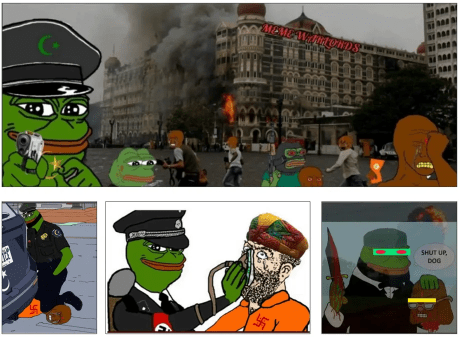
A 2022 NCRI report provided an eye-opening account of the use of social media to disseminate anti-Hindu disinformation. The report used quantitative analysis to study the portrayal of Hindus across social media platforms like Telegram, X, and others. The research found that anti-Hindu disinformation on social media is masked through the use of coded language, slurs, and ethnic pejoratives. It also discovered that the circulation of dehumanising and genocidal memes against Hindus is carried out by both fringe web communities and state actors. It further emphasised that state actors use Hinduphobic tropes as part of their large-scale information operations. To illustrate this, the study focused on the case of Iranian state-sponsored trolls disseminating anti-Hindu stereotypes.
Most importantly, various NCRI studies establish that extremist hateful content targeting vulnerable communities like Hindus and Jews on social media is a leading indicator of real-world violence inflicted on those communities. A study conducted by the organisation, focusing on anti-Hindu attacks and hate speech in Canada, the findings of which were released in 2023, found that inauthentic cyber activity from Khalistani bot accounts precedes and amplifies attacks on Indian government buildings and Hindu temples.
All these studies thus establish that acts of anti-Hindu violence, hate, and intimidation are not random and disconnected one-off acts but rather a part of systematically planned campaigns by extremist groups targeting Hindus.
As we have seen in the case of anti-Hindu attacks in Canada and Bangladesh, these extremist groups often receive overt or covert support and patronage from state authorities. Thus, acts of Hinduphobia perpetrated on foreign soil also become a vicious political targeting of the Indian government. As we’ve seen in the case of Canada, Khalistani groups routinely threatening Hindus and attacking temples are portrayed as critical interrogators of the Indian state. Similarly, in the case of Bangladesh, hapless Hindu minorities voicing their right to be heard get classified as “political elements”, exaggerating things and furthering the agenda of the “Hindu majoritarian” Indian government.
A new law passed by a local city council in Canada is a glaring example of the conflation of Hinduphobia and anti-India sentiment. Brampton Mayor Patrick Brown promised to pass a new by-law to protect places of worship from chaotic protestors in the aftermath of the violent attacks on Hindu devotees at the Hindu Sabha Mandir in Canada on November 3 and 4. However, when the by-law was finally passed by the Brampton City Council, it added an expectation to its provisions that “protests against foreign governments are still allowed near a place of worship”. This defeated the very purpose of the law, argued various Hindu advocacy organisations in Canada. Such a clause in the law indeed seems a deliberate provocation, giving a free pass to Khalistanis to target the Indian government and harass Hindus in the process.
The United Nations, even though it explicitly condemns hateful discourse and attacks against Islam, Judaism, and Christianity, hasn’t condemned Hinduphobia yet. India has consistently raised this issue at the UN, demanding that phobias against religions like Hinduism, Sikhism, etc., be also recognised and condemned by the UN. In January 2022, India’s then-US envoy T.S. Tirumurthi highlighted the UN’s discriminatory posture on hateful discourse against Hindus, Sikhs, and Buddhists. He also observed how certain UN member states had tried to categorise terrorist acts, based on political and religious motivations, and criticised the attempt by a few member states to define terrorism through subjective categories like “right-wing extremism”, “violent nationalism”, etc. Such labelling clearly shows how, in the context of India, phrases like “Hindutva terror”, “Saffron terror”, and “Hindu majoritarianism” are used widely by a certain section of the media and think tanks to further demonise Hindus and Hinduism, and thus not just gaslight incidents of Hinduphobia but create a conducive environment for Hinduphobia to flourish.
What Canada and Bangladesh are witnessing at the moment is the pinnacle of the conflation of Hinduphobia and anti-India sentiment. There is, therefore, a high degree of urgency in recognising Hinduphobia, studying its underlying patterns and motivations, and also examining the linkages between Hinduphobia and the vicious political targeting of the Indian state by certain stakeholders. – News18, 3 Decemeber 2024
› Rati Agnihotri is an independent journalist and writer currently based in Dehradun, Uttarakhand.
Filed under: canada, india, UK, USA | Tagged: anti-india sentiment, geopolitics, hinduphobia, khalistani separatists, western media |









 BHARATA BHARATI