








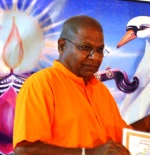



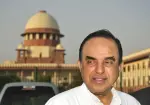



Deputy chief minister of AP, Pawan Kalyan, came down heavily on Jagan Mohan Reddy and his party, and has claimed that the management of temple affairs under the previous YSRCP government had led to many illicit activities inside the temple complex. – BT Desk
The YSRCP is in big trouble. The ongoing controversy over the adulteration of raw materials, like ghee, used in preparing the prasadam at the highly revered Sri Venkateswara Swamy Temple in Tirumala in Andhra Pradesh, is refusing to quell. And at the core of this is Jagan Mohan Reddy‘s involvement in temple affairs.
Today, deputy chief minister of the state, Pawan Kalyan came down heavily on Jagan and his party, and has claimed that the management of temple affairs under the previous YSRCP government had led to many ‘illicit’ activities inside the temple complex, which affected the sanctity of the place.
“When people of no commitment and no value and no respect for the sanctity of the temple, if they take charge this is what happens. … It is not just about prasad, maybe liquor and non-veg was supplied, people were having parties there,” Kalyan said.
Kalyan further pointed out that the ghee used was very cheap, and ghee is usually not found cheap.
“You need 15,000 kgs of ghee per day to make prasad. They claim that they changed vendors because it is Rs 1000 plus something and they changed and brought it down. They said that they supply was given to them at Rs 360-400. Ghee is made at a high price. So, how could they source such cheap ghee,” he asked.
Kalyan further alleged that people for long have been complaining about the quality of the prasadam, with many saying that a certain foul smell used to come from it, which is not natural.
“People were complaining regularly about the smell which is not usual with the prasad,” Kalyan alleged.
Earlier in the day today, Tamil Nadu-based A.R. Dairy, which had the contract to supply ghee, resolutely refused the allegations.
“First of all, the NDDB lab test report does not say that the ghee sample was from A.R. Diary. The report also mentions that there is a possibility of false positive results. TTD accepted the tankers of ghee we provided this June and July only after test reports were to their satisfaction. We stopped supplying after July as TTD changed the vendors. There are a number of reasons why traces of foreign fat may be found in ghee, including cow feed,” a top executive from the company told media persons today. – MSN-Business Today, 21 September 2024
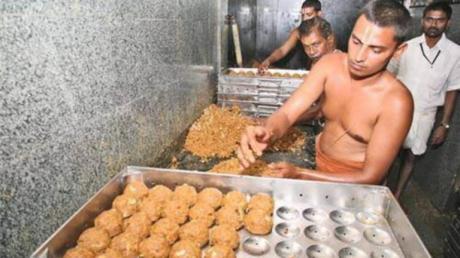
Tirupati Temple Ghee Controversy: KMF implements GPS tracking on vehicles to prevent adulteration – FP Staff
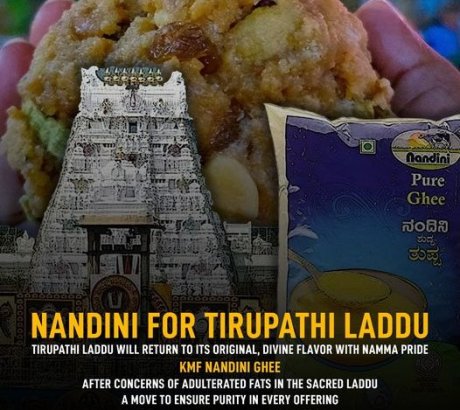
The Karnataka Milk Federation (KMF) has equipped its delivery vehicles with geo-positioning systems to monitor the supply of Nandini ghee to the Tirumala Tirupati Devasthanams (TTD), following allegations of substandard ghee used in the famous Tirupati laddus, an official said Saturday (September 21).
KMF Managing Director M.K. Jagadish stated that ghee deliveries to the TTD, which oversees the operations of the Tirupati temple, resumed last month after KMF was awarded a new tender.
“We reinstated the ghee supply about a month ago. GPS and geo-location devices have been installed in our vehicles to track their movements, ensuring no adulteration occurs during transit,” Jagadish told AP.
The contract involves KMF supplying 350 tonnes of ghee to the temple, with shipments made on an as-needed basis, he added.
The move comes after a laboratory report released by the TTD on Friday indicated the presence of lard and other impurities in certain ghee samples. TTD Executive Officer J. Shyamala Rao confirmed that lab tests had detected animal fat, including pig fat, in the adulterated ghee. The TTD is reportedly in the process of blacklisting the contractor responsible for supplying the tainted product. – MSN-Firstpost, 22 September 2024
Filed under: andhra pradesh, india | Tagged: ghee controversy, laboratory report, laddu prasad, sri venkateswara swami, tirumala tirupati devasthanams |








 BHARATA BHARATI
Not Allowing Non-Hindu Employees In Hindu Temples Is A Good Step, But Bigger Challenge Is Issue Of ‘Concealed Identity’ – S. Rajesh – Swarajaya – Aug 30, 2024
Andhra Pradesh Chief Minister Chandrababu Naidu recently said that non-Hindus would not be allowed to work in Hindu temples in the state.
Coming after the tenure of the Yuvajana Sramika Rythu Congress Party (YSRCP) government led by Y.S. Jagan Mohan Reddy, during which a number of non-Hindus were allegedly appointed in temples, including the renowned Venkateshwara Temple in Tirupati, the statement was seen as a welcome relief by many.
Among the allegations that surfaced during the tenure of Jagan, were that he had appointed fellow Christians as the chairpersons of the Tirumala Tirupati Devasthanam (TTD) board. While one of them was his uncle, Y.V. Subba Reddy, the other was Bhumana Karunakar Reddy, the party’s MLA from Tirupati.
Additionally, controversy arose over advertisements for a government aided ‘Jerusalem tour’ printed on bus tickets in Tirupati, with critics accusing Jagan of subtly encouraging religious conversions in the sacred town.
Naidu Is Not The First To Talk About Non-Hindu Employees
While Naidu’s recent remarks may appear to introduce a new policy, the issue of non-Hindus working in temples has been addressed by previous administrations as well.
Even Jagan’s government issued a similar order for the Tirupati temple. Before this, two significant orders on the matter were issued: one in 1989 and another in 2007.
However, despite these regulations, some non-Hindus were allegedly appointed after 2007.
Christians In Real Life, Hindus On Paper
In November 2023, the Andhra Pradesh High Court upheld the dismissal of P. Sudershan Babu, who had worked in a temple in Srisailam. Investigations revealed that although he was a Christian, he had falsely claimed to be a Hindu from the Scheduled Caste (Mala) community to secure the job.
Therefore, while it is good that the issue of non-Hindu employees in temples has been recognised once again—given that some of them have been found to be indulging in proselytisation activities—there is a much larger challenge that Naidu has to face.
This challenge is the concealment of identity, as highlighted by the case of the Christian employee mentioned earlier.
This issue is particularly prevalent among Scheduled Caste communities in Andhra, which have high conversion rates. Identifying as Christians places them in the Backward Class category, reducing their share of reservation benefits. [In Andhra, Scheduled Caste converts to Christianity are classified as Backward Class (C-category) and allocated a 1 per cent quota.]
At the moment, they benefit from both identities—as Christian minorities and also as Hindu Scheduled Castes.
What also helps them get away is that there are a large number of such people at every level of the administration, who would be more than willing to help their co-religionists.
Unofficial estimates put the Christian population in Andhra at around 25 per cent, with converts from almost every community.
Hence, unless there are stringent checks from time to time, with measures such as surprise raids, or cross-referencing names with church membership lists, Naidu, despite his seemingly good intentions, may struggle to implement this effectively.
LikeLike
Tirupati Laddu Shocker: A letter to Andhra CM – Shankkar Aiyar – The New Indian Express – 22 Sept. 2024
Dear Nara Chandrababu Naidu,
I am writing to you as one of the millions of devotees of Lord Venkateswara to express anguish and anger at the shocking revelations about the use of ghee adulterated with fish oil, beef tallow and animal fat in the preparation of sacred offerings at the Tirumala temple. The violation of sacred sentiments stems from systemic apathy blessed by political insurance. The focus of this letter is not the who, but the what, why and how factors that enabled this outrage.
I am sure you recognise the risks of supply chain neglect and its catastrophic consequences for the lakhs who visit Tirumala. Having known you since the 1990s when you were chief minister of the unified Andhra Pradesh, I write in the hope that you will devote the attention the issue deserves. Allow me to share a few troubling questions and make a few suggestions to begin the process of healing and the restoration of trust.
Let’s start with the known unknowns. What is the process of detection of fraudulent conduct and what does the decision tree look like? The government’s revelations show that the report on adulteration was received in July. Why did the government wait till September 20 to make it public? The Tirumala Tirupati Devasthanams (TTD) prepares around 3.5 lakh laddus every day. Pilgrims share the precious prasadam with friends and family across India and the world. Early dissemination about the dastardly act would have alerted the faithful. So what explains the gap between the receipt of the report and its revelation?
Detection is normally followed up by action. We know from CEO Shyamala Rao that a panel of four dairy experts has been formed to advise the TTD on the process for procuring quality ghee for the temple. But critically, the public is yet to be informed if it is just one company. And what action has been taken against the perpetrators? Has the TTD or the government proceeded with filing of cases since the discovery in July?
Secondly, what is the process of audit of quality and detection of adulteration? It has been stated in a news report that “four tankers of ghee supplied by a private company appeared suspicious”. Does ‘suspicion’ pass scientific rigour? Surely the TTD can do better. What’s worse is that officials admitted that suppliers “took advantage of the lack of in-house testing facilities”. It does seem the TTD lacks an established process to ensure palatability of ingredients and sanctity of sentiments.
Mercifully, a blessed soul at the water and food analysis lab at TTD alarmed by the risks, sent samples for testing to the Centre of Analysis and Learning in Livestock and Food (CALF) in Gujarat. The choice of CALF—one of the 210 FSSAI-certified labs that include half a dozen in Andhra Pradesh—has strained many political eyebrows. Be that as it may, was a parallel testing organised? It is also unclear if samples of only one or all suppliers of ghee were sent for testing. Ideally, after adulteration was detected, samples of all the suppliers should be sent for testing. This should be mandatory.
The much-valued laddu is only one of the offerings the pilgrims seek and take home. Millions of devotees are now wrestling with fears of what else may be adulterated. What is the process of identifying adulteration in other inputs used in the preparation of the naivedyam—ranging from the ghee pongal to gudannam, from sakannam to shakkarannam, besides other savouries—offered to Lord Venkateswara and distributed to pilgrims? Is procurement dictated by competitive bidding or quality?
Are the inputs for these offerings subjected to quality tests, and if so, how often? The TTD should make the reports public to build confidence and credibility. Indeed, the TTD must go a step further. Justice Louis Brandeis, in his essay ‘What publicity can do’, observed, “Sunlight is said to be the best of disinfectants.” The TTD should enable transparency and publish the names of all suppliers of all ingredients.
The blunt truth, dear chief minister, is that the desecration of sentiments is fostered by the status quo, systemic gaps left open by rent seekers. The TTD is among the richest institutions. With a budget of over Rs 5,000 crore, deposits of over Rs 18,000 crore and over 1,000 kg of gold, it has the resources to design a template for managing resources in tune with the times.
It must set up a modern, in-house, FSSAI-certified laboratory, perhaps in one of its universities. The IITs and IT giants in Hyderabad, Chennai and Bengaluru can surely help engineer and set up enterprise solutions to manage the input and output flows of the prasadam—a system that tests ingredients, logistics that ready them a day in advance, and to share reports on quality and use food robotics to mechanise that which can be mechanised. The adoption of modern systems applications and technology will mitigate the challenges of scale and complexity, and enable safety and trust.
Nothing, it would seem, is sacred at the confluence of power and pelf—and this is ominous. It is manifest that the Lord of the Seven Hills has alerted and shielded the faithful from greater harm. As believers in divinity, it is imperative we preserve that which is sacred.
Let me conclude with the chant reverberating in Tirumala: “Edukondalavada Venkataramana, Govinda, Govinda” (Hail Venkataramana, Lord of the Seven Hills).
Best regards
Shankkar Aiyar
> Author of The Gated Republic, Aadhaar: A Biometric History of India’s 12 Digit Revolution, and Accidental India.
LikeLike
LikeLike
LikeLike