








 The internet and print organisations—foreign and Indian—have declared open warfare against the current political dispensation, as well as socio-cultural institutions that are committed to the cause of Indian civilisation. – Jay Bhattacharjee
For many decades after Independence, India was a regular playground for external forces and agencies. This is well documented and researched. Initially, India was of limited interest to the two superpowers. India was a new entrant in the global arena and was not a force that carried much weight.
From the mid-1960s, after the residual effects of the 1965 war with Pakistan played out and the effects of the Green Revolution started manifesting themselves, India attracted some attention from the two great powers, with China following closely.
Till the early 1980s, even after we had exerted our weight in the local South Asian arena and crafted the birth of a new nation, we were bit players on the international realpolitik stage.
However, the proxy forces in India of the two international power blocks and China were playing out a no-holds war for the minds and hearts of Indians. Admittedly, the ordinary Indian citizen, the proverbial “man or woman on the street”, was a mute spectator.
The warriors who contested the conflict between the two or three contesting ideologies were in the lobbies of power and influence, ranging from Parliament and state assemblies to the maze of the bureaucracy at all levels, business houses, industrial organisations, academia, and media groups.
After the collapse of Communism and the Soviet Union, the battlefield did not necessarily see less intense clashes. Only the underlying ideologies changed. From the late 1980s to the early 1990s, India saw the emergence of political forces, groups, and parties that were influenced by or drew their sustenance from this country’s ancient Indian heritage.
n 1998, the BJP-led Union Government under Atal Bihari Vajpayee came to power in the country. The same ideological dispensation continues now in the Centre under Narendra Modi.
For the past ten years and earlier in 1998–2004, the ruling dispensation in India, which can broadly be described as one that is primarily influenced by our Indian heritage, has had to contend with an array of socio-political forces that we will broadly describe and assess. Some of them are indigenous, while others are foreign or non-Indian.
Some important foreign institutions had set up shop in the country as early as the late 1950s or early 1960s. These organisations were ostensibly private entities, like the Ford Foundation, the Rockefeller Foundation, the American Institute of Indian Studies, et al., and they functioned outside the official diplomatic umbrella. The others in this category included the British Council, the Fulbright Scholarship, the Rhodes Scholarship, etc.
All these players cannot strictly be described as ‘state agencies’, but they clearly had umbilical ties with their home governments. They were versatile in hiding their true ownership and control structures.
The three Western media organisations—the BBC, Voice of America (VOA), and Reuters—also had a significant Indian presence by the late 1950s and early 1960s. The poor Soviets, with their Radio Moscow that broadcast in a number of Indian languages, were also-ran, even though their print presence (in a number of Indian languages and English) was much more successful.
In this essay, we will focus on the BBC to start with. Recently, a path-breaking and incisive book on this iconic organisation has been published. The book, BBC’s True Lies (Garuda Prakashan), authored by Binay Kumar Singh and Prashant Pandey, is a true landmark and milestone in Indian studies on foreign media. It meticulously studies this organisation from its birth in Britain, its pivotal role in the life and politics of its homeland, and the long history of its Indian operations.
Readers may remember the dictum of Hitler and Goebbels on the big lie. “If you tell a lie big enough and keep repeating it, people will eventually come to believe it. Thus, by extension, the truth is the greatest enemy of the State.” This applies equally to the big media, whether in the international arena or the domestic one. In the case of TV, people will believe a big lie sooner than a little one. If it is repeated frequently enough, the general audience will believe it sooner or later.
Hitler’s primary rules were: never allow the public to cool off; never admit a fault or wrong; never concede that there may be some good in your enemy; never leave room for alternatives; never accept blame; concentrate on one enemy at a time and blame him for everything that goes wrong. People will believe a big lie sooner than a little one; and if you repeat it frequently enough, people will sooner or later believe it.
Goebbels did describe the big lie in different languages in an article he wrote in 1941, “Churchill’s Lie Factory”, but he was accusing the British of the ploy: The English follow the principle that one should lie big when one lies, and one must stick to it. They keep up their lies, even at the risk of looking ridiculous.
In the case of the BBC’s telecasts in India, in Hindi and other languages, this writer has collected a few of the most egregious and dishonest ones that portray India as a country where the main minority community is routinely harassed and victimised. The most glaring and flagrant was a recent interview with the leader of the Popular Front of India (PFI), an organisation that makes no bones about its intention to set up an Islamic state in India. It has a terrible history of communal violence and terrorist attacks on the Indian Republic.
There have also been reports of the BBC India office having committed some income-tax offences or of having resorted to questionable financial policies in its Indian operations. The official agencies of the Central government have initiated legal action under various legal provisions that govern these offences.
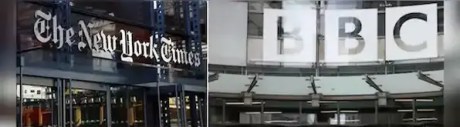
The New York Times is another international media organisation whose entire Indian focus is on negative coverage of the country, its policies, and its public life. Reuters is no longer as important in the news dissemination field now as it was in its heyday, but it continues with its condescension.
Then, there are internet and print organisations that have declared open warfare against the current political dispensation, as well as socio-cultural institutions that are committed to the cause of Indian civilisation. Readers will be fully aware of the identities of the players that are engaged in this all-out war.
We would not be indulging in hyperbole if we were to say that the Indian Republic may need to strengthen its firewalls much more resolutely than what prevails in the open arena currently. – Firstpost, 1 April 2024
› Jay Bhattacharjee is an analyst and student of economic, financial and socio-political issues.

Filed under: india, UK, USA | Tagged: academic hinduphobia, BBC, left-liberal media, media hinduphobia, the new york times |



 BHARATA BHARATI
BBC’s bias defeats its purpose, makes it Britain’s liability in a multipolar world – Abhijit Majumder – Firstpost – Mumbai – April 3, 2024
“Let me stop you right there!” thundered Irfan Ali, the President of Guyana, at BBC interviewer Stephen Sackur.
The Hard Talk host had tried to lecture President Ali on carbon emissions from Guyana’s newfound oil reserves worth $150 billion in the next decade or two.
Stating that his country does more than enough of forest conservation for which it is not paid or given credit while the developed world enjoyed the fruits of energy since the industrial revolution, he asked the BBC interviewer point blank: “Are you in the pockets of those who damaged the environment?”
This interview instantly went viral. From every corner of the world praise poured in for Ali, who embodied the voice of the Global South. But more strident than the support was the sheer anger and disgust towards the BBC’s hypocrisy, its chastising coloniser tone, and what seemed to be its advocacy for the globalist elite and invested interests.
In a multipolar world, the BBC—as also a handful of western media outlets like The New York Times, The Washington Post, Financial Times, or Deutsche Welle—has squarely sided with powerful Left-leaning, globalist networks which want to weaken every government unwilling to do their bidding.
By its over bias, the BBC violates the first premise of Britain’s Royal Charter which defines its ‘Public Purposes’:
“To provide impartial news and information to help people understand and engage with the world around them: the BBC should provide duly accurate and impartial news, current affairs and factual programming to build people’s understanding of all parts of the United Kingdom and of the wider world.”
The BBC has long failed to convince the world that it is spending British taxpayers’ money to provide “impartial news and information”.
The Conservative Party of the UK has long called out its strong pro-Labour, pro-Left leaning. Tory MP Peter Bruinvels famously called it the Bolshevik Broadcasting Corporation.
Then prime minister Margaret Thatcher said: “I have fought three elections against the BBC and don’t want to fight another against it.”
Indarjit Singh, the chief of Britain’s Network of Sikh Organisations, said: “Stations like BBC Asian Network do little to encourage integration and social cohesion because they allow communities to ghettoise themselves.”
In October 2019, Singh quit ‘Thought for the Day’ on BBC Radio 4, exposing BBC’s “misplaced sense of political correctness”. The BBC stopped the broadcast of a show commemorating Sikh Guru Tegh Bahadur, who had been beheaded for opposing forced conversion of Hindus to Islam in India in the 17th century, “because it might offend Muslims”.
Russia banned the BBC in 2022 accusing it of circulating fake news on the war against Ukraine. China has banned the BBC too. The Beeb has been accused of deep-seated bias against Israel in its coverage of the Palestinian conflict.
In India, the BBC’s list of transgressions is long. It has always been seen as pro-Pakistan, a stand consistent with Labour’s.
Recently, the BBC was found guilty of tax evasion. After initially trying to make it seem like vengeance by the Indian government, the BBC admitted that it underreported Rs 40 crore ($4.8 million) of income in its tax returns.
It followed a suspiciously timed documentary in the run-up to the 2024 elections called ‘India: The Modi Question’. The documentary, through a slew of opinion and innuendo, raked up the 2002 Gujarat riots and tried to implicate then Gujarat CM and now Prime Minister Narendra Modi, whom courts had exonerated a decade ago.
“This is politics at play by people who do not have the courage to come into the political field. They want to have that teflon cover saying that I am an NGO, media organisation etc. They are playing politics,” said Indian external affairs minister S. Jaishankar about the film. “Look who the cheerleaders are. What is happening is, just like I told you—this drip, drip, drip—how do you shape a very extremist image of India, of the government, of the BJP, of the Prime Minister? This has been going on for a decade.”
Whether it is the anti-CAA protests or farmers’ agitation, abrogation of Article 370 in Kashmir or Ram Mandir pran pratistha, Leicester riots or the hijab-in-schools controversy, the BBC has consistently taken anti-India, anti-Hindu positions.
All this begs the question: is the BBC doing the once-Great Britain a great disservice?
The answer is pretty clear.
The BBC undermines the UK’s economy, security, law and order, and demographic destiny by consistently taking a Left-tainted, pro-immigrant stance. It pussyfoots on Islamic radicalisation and terror.
But more importantly, it is damaging Britain’s image in a multipolar world by pissing off potential allies and coming across as the UK’s entitled and sanctimonious attack dog. The BBC cannot claim to be independent of Britain nor can Britain shake off the BBC baggage in foreign relations, especially when there is no wall of solid, impartial journalism to separate the two.
› Abhijit Majumder is a contributing editor at Firstpost in Mumbai.
LikeLike