











 The disclosures on Katchatheevu Island make it very difficult from here on for the DMK to claim that it is the sole guardian of Tamil Nadu’s interests. – Rahul Shivshankar
We’re all asking the wrong questions on the Katchatheevu disclosures. In all honesty, the issue will have a minimal bearing on the outcome of the 2024 Lok Sabha election in Tamil Nadu. The elections won’t be won or lost on the alleged omissions of the Congress-DMK on an issue that dates back to 1974. The voter, at least at this very advanced moment in the poll campaign, is unlikely to reorient toward the BJP for exposing that Indira Gandhi colluded with DMK supremo and chief minister M. Karunanidhi to ‘gift’ the Katchatheevu Island to Sri Lanka at a cost to Tamil Nadu.
Nonetheless, the revelations around Katchatheevu are important. They should be welcomed because they serve a greater, more beneficent purpose.
The disclosures make it very difficult from here on for the DMK to claim that it is the sole guardian of Tamil Nadu’s interests.
For decades now, since 1974, at least two generations of voters in Tamil Nadu have been told that the Centre gave away this strategic island in the Palk Straits. They were told that the central government under Indira Gandhi did this because politicians in the north have a callous disregard for Tamil Nadu’s sentiments. Or for that matter the interests of anyone south of the Vindhyas.
The DMK has thrived by perpetuating this north-south rift myth for decades all together.
In July 1974, DMK MP Era Sezhiyan, for instance, fumed at Indira Gandhi for hiding the Island pact from Tamil Nadu. For betraying Tamil sovereignty and identity.
Even today, for instance, when fisher-folk are arrested and brutalised by the Lankan navy for drifting too close to Katchatheevu in search of depleting fish stocks, the DMK curses the Centre for cheating the people of the south. For depriving poor fishers of a right to a decent living by restricting their access to waters that are rightfully theirs.
But now it turns out that the DMK’s own founder Karunanidhi had acquiesced in the decision. In fact, a record of the discussions between the Indira Gandhi-led Congress government at the Centre and the M. Karunanidhi-led Tamil Nadu state government in 1974 shows that the DMK supremo may have got to know of the prospective agreement with Lanka ahead of many in even the union government.
Now, with the DMK’s first family having been exposed as co-conspirators in the decision to give up India’s claims over Katchatheevu, the party’s fulminations at the Centre come across as severely hypocritical. Some might even use the more unforgiving term—lies.
Ironically, it is the BJP, which has often been accused of being a Hindu upper caste, Hindi belt party—an interloper in Tamil Nadu politics—that can take credit for unmasking the DMK before the Tamil Nadu public.
By placing never-before-seen government documents in the court of public opinion, the BJP has left the DMK with no leg to stand on. The historical record simply can’t be disputed. – News18, 1 April 2024
- “No importance attached to little island”: Nehru on Katchatheevu, DMK accepted proposal for “obvious political reasons”
- Karunanidhi, taken into confidence by Indira Gandhi on Katchatheevu deal, agreed to give Sri Lanka the island
- Jaishankar calls Congress and DMK irresponsible, says responded to Tamil Nadu CM 21 times

Filed under: india, sri lanka | Tagged: DMK government, india-srilanka relations, katchatheevu island, NDA government, tamil politics |





 BHARATA BHARATI
Three former foreign secretaries ask parties not to rake up Katchatheevu – Kumar Chellappan – The Pioneer – Chennai – 03 April 2024
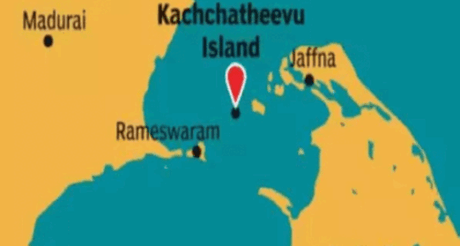
The DMK’s game plan to bring in Katchatheevu, a 285 acre uninhabited islet 20 km off Rameswaram coast, an issue in the upcoming Lok Sabha poll has backfired as three former Foreign Secretaries of the country have issued a stern warning to the major political parties which are behind the move.
It all started with the DMK’s manifesto for the 2024 election blaming the BJP Government at the Centre for failing to retrieve the islet that was seceded to Sri Lanka in 1975 by the then Prime Minister Indira Gandhi as part of the move to settle the international maritime boundary line between the two countries.
It has also been revealed that a technology innovation by Union Government’s INCOIS laboratory to keep the fishermen away from international maritime border line did not take off because of the lack of interest in it by a political party in Tamil Nadu.
Shiv Shankar Menon, who was the Foreign Secretary and later national security adviser under the UPA Government led by Manmohan Singh has alerted the parties not to rake up the Katchatheev issue.
“It is like scoring a self-goal and will be counter productive,” Menon told media persons who asked him about the possibility of retrieving the islet, a bone of contention between fishermen of Tamil Nadu and Sri Lanka.
Nirupama Rao, former Foreign Secretary who too was the High Commissioner to Sri Lanka reminded the political parties that international agreements, however, unjust they might be, have sanctity and they cannot be repudiated by successor Governments.
“If India abrogates the agreement unilaterally, its image will suffer; the best possible solution is to get the Island of Kachchatheevu and the adjoining seas on lease in perpetuity,” said Rao in her social media post,
G. C. Shekhar, chronicler of Tamil Nadu politics, pointed out that at no point of time Prime Minister Narendra Modi had said his Government would retrieve Katchatheevu from Sri Lanka. “Former attorney general Mukul Rohatgi had told the Supreme Court that India has to wage a war with Sri Lanka to retrieve Katchateevu. The matter ends there,” said Shekhar who expressed his doubts over the DMK’s move to rake up the issue at this point of time.
“It seems they have run out of issues,” he said.
The Indian National Centre for Ocean Information Service (INCOIS), a research laboratory under the Union Ministry of Earth Sciences had developed a technology with which Tamil Nadu fishermen approaching the maritime boundary line with Sri Lanka are given real time warning that they were about to cross the “danger zone”.
But the Tamil Nadu fishermen switched off the warning system installed on the fishing boats and hence the project did not succeed,” said Dr. T. M. Balakrishnan, senior scientist, INCOIS, who led the team of researchers in developing the technology.
LikeLiked by 1 person
LikeLike