














 By what moral right might the Muslim side now press forward with its claims for Gyanvapi Mosque? What is fuelling such extreme intransigence? Who is actively promoting such uncompromising positions? Why is such a stance being maintained even when it is visibly incorrect and so terribly counterproductive to society? – Venu Gopal Narayanan
A Varanasi court today, 31 January, ordered that Hindus can recommence prayers in a cellar under the Gyanvapi Mosque. This follows the recent submission of a report by the Archaeological Survey of India (ASI), which uncovered numerous Hindu idols, motifs, and inscriptions, and which concluded that this mosque was built on the ruins of an earlier temple.
But this is not breaking news because Hindus had been offering prayers regularly at that very cellar, in the presence of those very idols, until late 1993, when the Mulayam Singh government arbitrarily stopped prayers and banned access for Hindus to the cellar.
The simple inference is that the presence of these idols, motifs and inscriptions were public knowledge. Both the Hindus and the Muslims knew this, as did they about the copious epigraphical evidence from history, including Mughal records, which record the construction and maintenance of a mosque at this site in the 17th century.
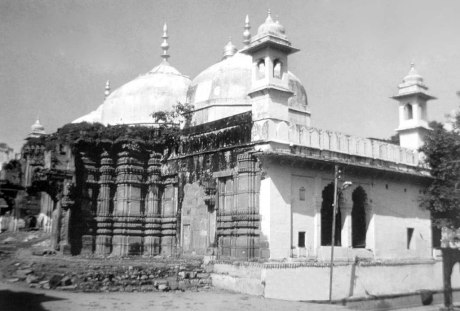
Now, if doubters still wish to believe in, and pursue, the secular argument, that there was no temple there, they are urged to look at the remnant western wall (above) upon which the three-domed structure was built: it still retains all the features of a medieval Hindu temple. Or, they can look at the Nandi bull (below) who faces away from the present temple towards the three domes.
Obviously, then, this case was a non-starter. It should never have gone to the courts, and instead, the land should have been gracefully handed over to the pujaris of the Kashi Vishwanath Temple. There would have been no acrimony, no bad blood.
And yet, there are those who continue to persist with a fallacious argument, bolstered by emotional rhetoric, that Muslims are being dispossessed; that they are losing their place in society.
This is pure bunk. And if the intent to continue a legal battle remains, then people need to understand that today’s verdict is a paradigm point. Just think of it from a simple standpoint first: one side says that the three domes make the structure Muslim, while a judgment allows Hindus to resume rituals and prayers in the cellar underneath.
How on earth can the religious character of a structure’s cellar be Hindu, and that of its ground floor, Muslim? It cannot. This is a patent absurdity.
Unfortunately, the very real fear is that there are those who will refuse to accept this reality and senselessly stride forth on their set path with no care for consequence. To understand this fully, let us set the legal aspects aside for a moment and ask ourselves a few simple questions:
By what moral right might the Muslim side now press forward with its claims? What is fuelling such extreme intransigence? Who is actively promoting such uncompromising positions? Why is such a stance being maintained even when it is visibly incorrect and so terribly counterproductive to society? Why is the average Muslim not asking these questions to its own community leadership?
We don’t know, and frankly, it would be impolite to speculate. But we cannot avoid the feeling that the Gyanvapi imbroglio has been reduced to an ego battle for one side. If yes, then the counter question is: how can ego and faith coexist in the same space? They can’t, because morality demands that ego make way for reason.
That is the foundational basis of all value systems. And anyone saying otherwise is a postmodernist or a Marxian.
Why would anyone breach the limits of obstinacy? Has anyone factored in the social cost? Are the communal carnages of the past century not pointers enough?
Sadly, we know the truth. We just don’t say it bluntly enough because of a very human tendency to be politically correct, and because no one wants to hurt another’s feelings.
It is a legacy issue. At its core lies a visceral cultural separatism born of a pernicious two-nation theory, itself spawned by aristocratic fantasists. Its time is up, and in its stead has re-emerged a far older truth; one which was supressed by historical forces: that you are Muslim because you are Indian, and that you are Indian because you are Muslim. God and country. And there can be no confusion on either aspect.
Thus, today’s judgment offers welcome, and long-overdue, options for an end to an infernal obduracy which has needlessly vitiated and cleaved our sacred land for far too long. It is time for the Muslims of India to start asking the moral questions of self-appointed community leaders, and those who fuelled a baseless minority victimhood narrative for petty political gain. – Swarajya, 1 February 2024
› Venu Gopal Narayanan is an independent petroleum consultant who focuses on energy, geopolitics, current affairs and electoral arithmetic in Ahmadabad.

Filed under: india | Tagged: ASI gyanvapi mosque report, egotism vs reason, gyanvapi mosque, islamic iconoclasm, kashi vishwanath temple |








 BHARATA BHARATI
LikeLike
Hindu devotees refer British era govt stand taken in 1936 suit over Gyanvapi mosque dispute – PTI – The Print – New Delhi – May 23, 2022
Hindu women plaintiffs who have filed a civil suit before Varanasi court seeking declaration and asserting the right to darshan and worship Hindu deities whose idols are located on an outer wall of the Gyanvapi mosque in Varanasi has referred to stand taken by the British government in a 1936 suit seeking it to be declared as Waqf property.
In an affidavit filed through advocate Vishnu Shankar Jain, three of the five women devotees said that in 1936 one Deen Mohammed has filed a civil suit without impleading any member of the Hindu community but impleading only the Secretary of State for India through District Magistrate, Benares and Anjuman Intajamia Masajid, Benares for granting declaration that the land bearing situated in the city measuring (1 Bigha 9 Biswa and 6 Dhurs) together with enclosure all-around described in the plaint was Waqf in possession of that plaintiff (Mohammed).
The affidavit has been filed in response to the plea of the Committee of Management Anjuman Intezamia Masjid which manages Gyanvapi Mosque in Varanasi seeking quashing of the recent survey of the mosque.
The affidavit said that the 1936 suit said that Muslims had the right to say their prayers especially ‘Alvida’ prayers and to exercise other religious and legal rights as the need and occasion arise.
“It is submitted that the Muslims had filed the above-mentioned suit only for declaration without seeking any consequential relief. This suit was filed even without impleading any person from the Hindu community. Therefore, the judgement passed in the suit is not binding upon any member of Hindu community but any document, map, evidence or statement of any witness can be referred to or relied upon by the members of Hindu community,” the affidavit said.
It referred to a written statement filed in the Civil Suit on behalf of the Secretary of State for India in Council refuting the plaint allegations and it was stated that “the idols and the temple which stand there exist since long before the advent of the Mohammedan Rule in India”.
The affidavit said that in substance the Government of India (during British era) in the written statement filed in Civil Suit…stated that: ”The entire plot of land on which the Mosque, ‘pacucca’ courtyard stray grave, staircase in front of the gate, together with ‘pucca’ enclosures all around and a ‘pipal’ tree stand belongs to Government and has never been dedicated nor could have been dedicated to the Mosque.” It further stated the written statement had said that “the idols and the temple which stand there have existed since long before the advent of the Mohammedan Rule in India. The other allegations made in the said paragraph are denied. It is submitted that the non-Muslims have been using the land for their religious purposes as a matter of right and have got a right of way over it. The allegation that they were permitted by persons in charge of the Mosque is unfounded and baseless.”
The affidavit further said it was stated in the statement that “the land in question was ever stamped with the character of ‘Waqf’ land. It was never dedicated to God, nor could it have been dedicated and God has no proprietary interest. … The Mohammadans of that time or for the matter of that Aurangzeb himself was not the owner of the site in which the old temple of Vishwanath existed and which was demolished by Aurangzeb owing to the religious antipathy, hence it could not have been dedicated according to the true spirit of the Mohammadan faith.”
It further said that the historians have confirmed that Islamic ruler Aurangzeb had issued an order on April 9, 1669, directing his Administration to demolish the temple of Lord Adi Visheshwar (Kashi Vishwanath temple) at Varanasi. “There is nothing on record to establish that the then ruler or any subsequent ruler has passed any order to create a Waqf over the land in question or for handing over the land to any Muslim or body of Muslims. The copy of ‘farmaan’/ order issued by Aurangzeb (see above) is reported to be maintained by Asiatic Library Kolkata”, the affidavit said.
It said that the property in question does not belong to any Waqf and the property had already vested in deity ‘Adi Visheshwara’ lakhs of years before the start of the British Calendar year and is continuing to be the property of the deity. “No Waqf can be created on the land already vesting in a deity. In the historical books written during the Mughal regime and thereafter even Muslim historians have not claimed that Aurangzeb after demolishing the temple structure of Adi Visheshwara had created any Waqf or thereafter any member of the Muslim community or Ruler was dedicated such property to Waqf,” it said.
The affidavit added that a Mosque can be constructed over the property dedicated by a Waqif, who should be the owner of the property, and construction raised under the orders of any Muslim ruler or by any Muslim over the land of a temple cannot be construed as Mosque. The Hindu devotees in the 2021 civil suit said that their plea be decided first by the district judge to whom their case has been transferred on Friday last.
“The religious character of the property has to be determined first before deciding the application filed by the Petitioner (Mosque committee) herein under Order 7 Rule 11 for proper adjudication of the matter in issue”, it said, adding that the appeal of the Mosque Committee is not maintainable.
LikeLike