
















 The Arabs trace their origin to Ishmael, and the Jews trace their origin to Isaac. The struggle between them, therefore, dates back to the question: Who was the rightful heir to Abraham? – Prof. Arvind Sharma
The current tensions in the Middle East compel one to probe the roots of the hostility of the Christians and the Muslims towards the Jews, especially the hostility between the Jews and the Muslims. To trace the roots, one needs to go back to around 1800 BCE. That is the age in which Abraham, who is venerated by all three traditions, lived.
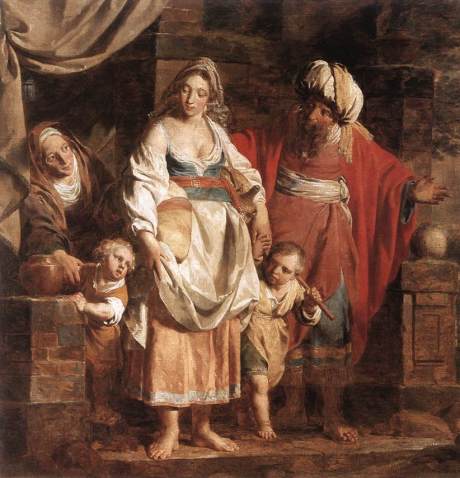
The Arabs trace their origin to Ishmael, and the Jews trace their origin to Isaac. The struggle between them, therefore, dates back to the question: Who was the rightful heir to Abraham? This issue has been the source of a lasting sibling rivalry.
It is not all conflict, however. According to the standard narrative, both the brothers buried Abraham together when he passed away.
The Jews, descendants of Isaac, finally found their kingdom in the promised land. They prospered, especially around 1000 BCE, giving us the legendary figures of David and Solomon. Thereafter, however, the Jewish kingdom fell prey to the various empires which arose in the Middle East, such as the Assyrian, the Babylonian, the Persian, and the Roman.
We fast forward now to the beginning of the Christian era when the Romans were ruling over the Jews. The prolonged period of political servitude had instilled in the Jews the hope that a great saviour, a messiah, would arise in due course to restore their sovereignty. It was in such an atmosphere of messianic expectation that Jesus was born. His charismatic personality and the miracles he performed raised the expectation in some quarters that he might be the messiah. But others wondered whether that could be the case, because of the aura of non-violence around him. Those who continued to believe that he was the messiah, even after his crucifixion, became the founders of Christianity. In other words, the key issue between the Jews and the Christians is whether Jesus was the messiah. The Christians accept him as such, and the Jews reject him as such.*
Just as the difference between the Jews and the Muslims goes back to the legacy of Abraham; the difference between the Jews and the Christians goes back to the legacy of Jesus Christ.
The difference between the Jews and the Christians is aggravated by the fact that, in the Christian scriptures, the Jews are depicted as responsible for the crucifixion of Jesus, although the crucifixion was formally carried out by the Romans. In Christian theology, Jesus is sometimes identified with God and, therefore, the Christians held the Jews responsible not just for the killing of Jesus Christ, but for killing God, or what is known as deicide.
Some historians argue that this was the result of the spread of Christianity in the Roman Empire. The Romans could not be held responsible for killing Jesus, because they were proving receptive to the message of Christianity, and therefore the blame for the death of Jesus Christ had to be shifted to the Jews. Christian theology not only aggravates but also complicates the relationship between the Jews and the Christians. Because Jews and Christians worship the same God, the Christians felt that God’s word to the Jews had also to be redeemed in some form. That is why Jews survived as a sect in the Roman Empire even though Christianity eliminated all other rival sects within the empire once it became the official religion.
Thus the hostility of both the Muslims and the Christians towards the Jews has deep historical roots. In recent times, however, the hostility between the Christians and the Jews has diminished because of the Holocaust, in which almost six million Jews were eliminated during the Nazi regime. Many Christians now feel guilty about this, and therefore tend to favour Israel.
The hostility between the Jews and the Muslims also went through a period when it was not as acute as it is now. During the sixteenth century, when the Jews were expelled from Christian Spain, they found shelter in the Muslim Ottoman Empire. Therefore, although the hostility between the Jews and the Muslims and the Jews and the Christians has deep historical roots, one should not fall prey to historical determinism and imagine it must always be so. It is possible that a modus vivendi may yet emerge. – News18, 23 November 2023
* Jews also reject the prophethood of Muhammad. – Editor
› Prof. Arvind Sharma is the Birks Professor of Comparative Religion at McGill University in Montreal Canada, where he has taught for over thirty years. He has also taught in Australia and the United States and at Nalanda University in India. He has published extensively in the fields of Indian religions and world religions.
Filed under: israel, palestine, world | Tagged: abrahamic god, abrahamic religions, hostility between religions, messiahship, prophethood |










 BHARATA BHARATI