











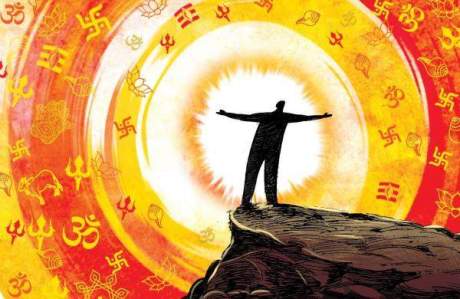
 Sanatana Dharma refers to the essence of dharma which is sanatana, meaning perpetual and ever-renewed. Sanatana Dharma does not refer to one aspect of dharma, but generically to the unity of dharmic principles, which are the laws of life and consciousness of the self-aware universe. – Dr. David Frawley
The current political assault on Hinduism/Sanatana Dharma from the Opposition I.N.D.I.A. coalition is clouded by a misuse of terms, derogatory stereotypes and wrong translations. It descends into an abyss of denigration and demonisation of humanity’s oldest, most profound and transformative tradition of self-knowledge and cosmic knowledge, which is the enduring core of India’s civilisation.
Sanatana Dharma refers to the essence of dharma which is sanatana, meaning perpetual and ever-renewed. Sanatana Dharma does not refer to one aspect of dharma, but generically to the unity of dharmic principles, which are the laws of life and consciousness of the self-aware universe.
A Thousand Names and More
In Hinduism, each deity/devata has a thousand names. Such compilations are Shiva Sahasranama, Vishnu Sahasranama, Lalita Sahasranama, and the thousand names of Shiva, Vishnu and Devi. Chanting the thousand names of the deity is regarded as especially powerful. This doesn’t mean that the thousand names are for separate deities. So, Sanatana Dharma or Hinduism cannot be reduced to a single name, term or application. It has many levels, dimensions and expressions and has seen many changes in culture and language over thousands of years.
Here are a few of the synonyms for Sanatana Dharma in Sanskrit, relative to how the highest dharma is defined.
- Satya Dharma, the dharma of eternal truth, not just transient information or opinions.
- Atma Dharma, the dharma or self-realisation, reveals our true immortal nature, the divine self that dwells in the hearts of all.
- Brahma Dharma, Parabrahman, the boundless reality of sat, eternal being, chit, all-knowing consciousness, and ananda, supreme bliss.
- Moksha Dharma, which grants liberation from all death and sorrow, not just the freedom to pursue outer desires.
- Yoga Dharma, including all the paths of yoga as jnana, bhakti and karma, as yoga is the traditional way of fulfilling our Moksha Dharma.
- Veda Dharma, referring to transcendent knowledge arising from the rishi vision, with Vedanta as its prime philosophy.
- Vishva Dharma or the Universal Dharma, relevant to all living beings, all worlds and lokas from the physical to higher realms beyond name and form.
- Manava Dharma, the dharma for all human beings, not just for one community, who are all manifestations of the same atman.
- Arya Dharma, dharma of noble and refined minds, a term also used for Buddha Dharma and Jain Dharma.
In addition to Sanskrit, Sanatana Dharma has different names in various languages in India and throughout the world, including the commonly known terms of Hinduism and Hindu Dharma.
Semantic Reductionism
Modern Western languages, notably English, lack the linguistic diversity and multileveled meanings as Sanskrit. They suffer from what I would call “semantic reductionism”, which is reducing something to one name or term as a final judgement.
Western scholars insist that what is not verbally called Hinduism in a text cannot be regarded as Hinduism because the word “Hinduism” is not there. This means Hinduism cannot be called Sanatana Dharma, Yoga, Vedanta or any of the traditions that are part of it because of differences in name, though the content and practices are the same. We also find such narrow thinking in the reduction of Hinduism to literal worship of cows, and caste as its view of society, ignoring its cosmic vision, Yoga and Vedanta.
Political Reductionism
This reductionism easily gives way to stereotypes, dualistic thinking and name-calling. Today, Indian leaders who are proud of being Hindus, including Prime Minister Narendra Modi, are subject to this denigration by calling them far right, intolerant Hindu nationalists, or even fascists.
The term fascist, which originally referred to Italian Catholic nationalists following Mussolini, has become a way of demonising anyone who doesn’t agree with you. It can be used to justify depriving those who disagree with you of their human rights or even destroying them. Such reductionist terms are like the Middle Ages when people were called Satanic or children of the Devil, which caused witch-burning and numerous religious wars.
Sanatana Dharma Will Prevail
Sanatana Dharma and its universal teachings tower above reductionist political ideologies left or right, their narrow opinions, self-promoting political agendas, and propagandistic media toolkits. It offers a transformative aspiration to humanity that those trapped in the body, senses and the material world cannot appreciate.
Those who think they can eradicate Sanatana Dharma should just as well try to eradicate the Himalayas. Sanatana Dharma is the teaching of the Himalayan yogis and rishis since the dawn of history, taking us to the Eternal and the Infinite. It is rooted in the mountains, waters, nature and the Earth itself.
Certainly, there have been misapplications of Sanatana Dharma over time and constant adaptation is necessary to sustain such a vast tradition from human inertia. But since Swami Vivekananda and the Indian independence movement, and after centuries of suppression under foreign rule, Sanatana Dharma and its dharmic traditions has gone global, is renewing India, and can help us embrace the whole of life as a single family. Let us look at what Sanatana Dharma truly means in its many dimensions, not simply according to the political expediency of adharmic forces. – News18, 23 Septemeber 2023
› Dr. David Frawley (Pandit Vamadeva Shastri) is the director of the American Institute of Vedic Studies and the author of more than 30 books on Yoga and Vedic traditions.

Filed under: india, world | Tagged: adharmic forces, hinduphobia, political reductionism, sanatana dharma, semantic reductionism |






 BHARATA BHARATI
Hindus In Hindu Rashtra: A Book That Tells It Like It Is And What We Are Up Against – R. Jagannathan – Swarajya – September 27, 2023
Hindus in Hindu Rashtra: Eighth-Class Citizens and Victims of State-Sanctioned Apartheid by Anand Ranganathan – BluOne Ink – Pages 135 – Rs 164 (Amazon).
One of the big failures of Hindus relates to their historical inability to fight unitedly for their collective rights.
We have often focused on settling scores with the near rival by aligning with civilisational enemies, which ultimately leads to the loss of collective rights—rights that are vital to preserving our Dharmic core.
Worse, after Independence, Hindus have chosen to ignore their constitutional and other handicaps, choosing instead to focus on economic progress at the individual and group levels. We are scripting our own civilisational demise.
Anand Ranganathan, scientist, author and nemesis of the political hypocrites who appear on prime time TV channels every news-night, has written a slim volume to remind Hindus of what they are up against.
Running barely into 135 pages, including Foreword, Prologue, Epilogue, Afterword, notes and an index, the book—Hindus In Hindu Rashtra: Eighth Class Citizens and Victims of State-Sanctioned Apartheid—can easily be read cover to cover even on a short-distance flight.
But don’t go by the small size, for it packs a mighty wallop—wallops as good as the verbal blows Ranganathan rains on his opponents in two-minute (plus “just 30 seconds”) interventions in TV appearances.
With this book, Hindus now have the ammo to take on their intellectual opponents.
It also calls out those who claim to be fighting on for Hindu causes but end up reinforcing the same religious ‘apartheid’ that is baked into our ‘liberal’ Constitution, our various laws, our judicial verdicts and day-to-day ‘secular’ discourse.
Ranganathan explains the use of the word ‘apartheid’, as it is not just about appeasement of ‘minorities’. He writes in the prologue: “No, the issue … is not appeasement. The issue is apartheid. The issue is of state-sponsored, state-sanctioned discrimination against a particular community. And that community is the majority community—the Hindus”.
The eight chapters list five laws that discriminate against Hindus, and three other supporting pieces that result in this discrimination.
These include the judiciary’s exclusive focus on Hindu reform and protection of so-called minorities, the inability of the state to protect even the lives and liberties of Hindus (as in Kashmir), and the control of academic institutions by Leftists and Secularists who glorify even rulers who tormented and converted Hindus on an industrial scale.
The five ‘apartheid’ laws that Ranganathan mentions are those that allow the state to control temples (and only temples), the Waqf Act, which gives Waqf boards extraordinary powers to claim and expropriate properties claimed as belonging to the Waqf (with very little legal remedies), the Right to Education Act (which imposes obligations only on majority institutions), and the Places of Worship Act, which stands in the way of Hindus reclaiming temples that were forcibly demolished and built over by Islamist rulers, often using the same building materials.
The question that Ranganathan does not explicitly seek to answer is why a majority community puts up with this discrimination?
This is where I have a minor quibble with the author, who chooses to think of Hindus as a majority, when every Hindu is Hindu in his own way. Hindus are not organised like a majority community.
The words majority and majoritarian emerged in a European context, where the Westphalian model defined the nation-state as having a common ethnicity, language, heroes and enemies.
In this model, protection of minorities becomes important, for they are technically outside the concept of the nation-state even though living within.
Moreover, the primary schism in Europe was the religious one between Protestants and Catholics, where states with one kind of religious majority often oppressed the other.
This has never been the case in India, and Hindus were never Hindus based on scripture, or having a historical founder and holy book.
Hinduism grew from the ground up, where spiritual ideas, religious traditions, rituals and practices evolved differently in different geographies. But once travel and the institution of the pilgrimage enabled these ideas to interact and borrow from one another, Hinduism emerged as the common descriptor.
Hinduism’s core ideals are about plurality, acceptance of religious and other differences, and an ability to let and let live. Atheism is also acceptable, and this is what makes Anand Ranganathan, a self-professed atheist, identify with Hinduism.
These core principles are, however, not the basis on which the two Abrahamic religions expanded to become global majorities. It was done by adopting predatory, imperialist and expansionist strategies as key to global dominance.
The yogi’s ideals were always at variance with the ideals of the Abrahamic commissar, whether religious or irreligious.
In short, Hindus are not a majority in the way Europe created its own local majorities. We are a loose aggregation of spiritual and religious ideas, with a common willingness to accept difference and divergence.
We are not easily able to differentiate between benign differences—as between Dharmic religions—and dangerous ones, which seek to eviscerate and destroy our civilisational values.
We are not a majority, but a confederation of minority spiritual and religious practices and traditions that cannot easily defend our common civilisational interests.
This is what makes the idea of Hindutva vital for our collective renaissance. Hindutva is not about creating a theocratic state, but about building a larger sense of Hindu identity that can defend its collective interest and reduce internal fault lines.
This is what the Abrahamic religions see as a threat to their predatory instincts.
Despite this quibble, I strongly recommend this book to every Hindu looking for ways to understand what he or she is up against, and build a common sense of purpose to defend our plurality, our Dharmic civilisation.
The book has strong endorsements from Indic historians like Meenakshi Jain and a foreword by J. Sai Deepak, lawyer and indefatigable fighter for Hindu causes.
The book is already a best-seller, but Hindus should buy and read it in order to internalise the challenges they face, and gear up for collective action.
> Jagannathan is Editorial Director at Swarajya.
LikeLike