











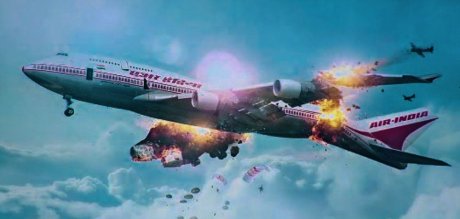
 With India and Canada sparring once more over Canadian support for Khalistani terrorists acting against Indian interests, it is important to remember that the Canadian state has been callous to Indian security interests on Canadian soil for more than four decades now. What follows is a story of the worst airline terrorist attack before 9/11. – Shaunak Agarkhedkar
Murder Most Foul
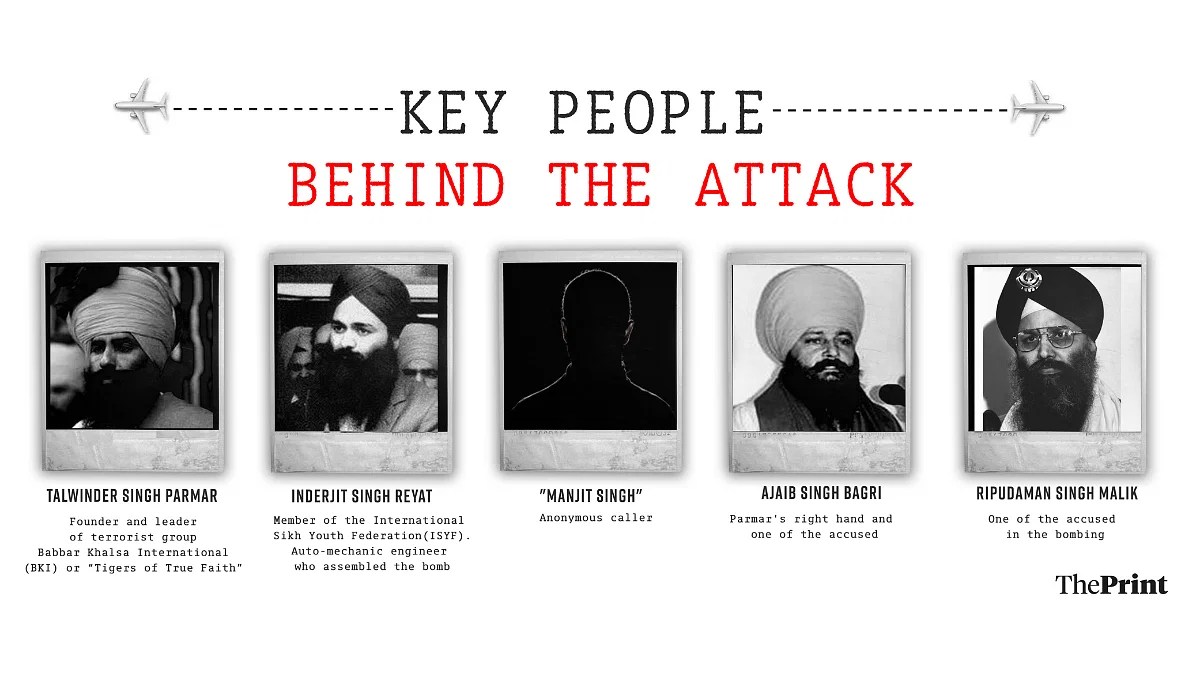
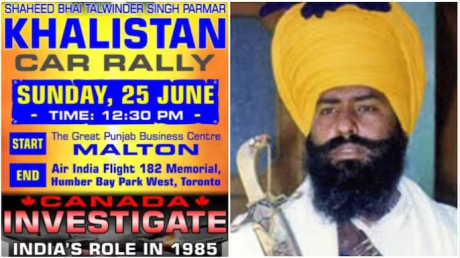
On 19 November 1981, members of a terrorist group known as Babbar Khalsa shot and killed two police officers in Punjab, India. Soon afterwards, one of those involved in the killings fled to Canada. His name was Talwinder Singh Parmar.
Shortly afterwards, Indian courts issued a warrant for Parmar. There were six charges framed against him for the killings, including two for murder. On 29 April 1982, the Indian government formally requested that Parmar be extradited to India to face those charges.
Pierre Trudeau’s government denied the request in July that year. The reason given was extraordinary: Even though India was a member of the Commonwealth, since India did not recognise the Queen as head of state, Trudeau claimed that the Commonwealth extradition protocol did not apply.
CSIS Finally Takes Heed
During his time in Canada, Parmar travelled extensively and portrayed himself as the leading pro-Khalistan voice in Canada, demanding the creation of an ethno-religious sovereign state (Khalistan) out of parts of India.
He publicly called for violence and terrorism against the Indian state and people in Canada.
On 21 July 1984 during a speech in Toronto, he called for the killing of 50,000 Hindus in addition to blowing up Indian embassies all over the world. During June 1984, Indian diplomats and missions in Canada were attacked.
Parmar’s activities led to tensions within the Indian diaspora in Canada, and particularly within the Sikh community there.

Moderate leaders of the community reached out to Canada’s intelligence service, Canadian Security Intelligence Service (CSIS), providing information on Parmar and begging the Canadians to act.
These requests to CSIS were augmented by a few supporters of the Khalistan movement in Canada who were worried by Parmar’s extremism.
Taking heed of these inputs, Archie M. Barr, deputy director of CSIS filed an affidavit along with a request for a warrant under Section 21 of the Canadian Security Intelligence Service Act to tap Parmar’s communications and place him under surveillance from 5 March 1985.
Everything written up until this point is reflected, among other places, in Archie Barr’s affidavit.
Informants Ignored
But months prior to that affidavit, informants were desperately contacting Canadian security services with intelligence about a bomb plot.
Informant 1
In August 1984, Gerry Boudreault of Calgary went to the police. Gerry was an acquaintance of Parmar. He was also a petty criminal. He reported to the police that Parmar had shown him a suitcase filled with $200,000 in banknotes.
The money was his, Parmar had told him, if Gerry would only plant a bomb on an Air India plane.
He opened it up and there it was stuffed with $200,000, and all I had to do was put a bomb on an Air India plane. I had done some bad things in my time, done my time in jail, but putting a bomb on a plane … not me. I went to the police. – Gerry Boudreault, Calgary Sun, 14 February 1999, by Peter Smith.
Gerry’s warning was ignored.
Informant 2
A month later, Harmail Singh Grewal of Vancouver informed CSIS and the Royal Canadian Mounted Police (RCMP) of the same plot.
In September, 1984, Vancouver liquor store employee Harmail Singh Grewal tried to bargain down his sentence on theft and fraud charges with information to the Canadian Security Intelligence Service and the RCMP about a plot to put a bomb aboard an Air India flight out of Montreal. … Grewal told the agents the story how he and a French-Canadian man had become involved with a group of Sikh militants who wanted to plant a bomb… – Ottawa Citizen, 23 September 1987, by Neil Macdonald and Terry Glavin.
The sentencing deal, however, fell through. Afterwards, in an unbelievable display of callousness, CSIS and the RCMP both dismissed Grewal as unreliable, and the intelligence he shared was ignored. It later became clear that the French-Canadian man he had referred to was none other than Gerry Boudreault.
Informant 3
In June 1985, an RCMP informant was working undercover with suspected drug dealers in Port Alberni. Paul Besso was wearing a device to record conversations with the suspects. This was monitored by the RCMP, and Besso later confirmed that the RCMP had transcripts.
“I was wearing a body pack and my van was wired, so the RCMP actually have a transcript of a tape telling them of a plot against Air India days to a week before it happened.” – RCMP informer Paul Besso on CBC’s The National, 22 September 1987.
He was interviewed by CBC’s The Journal by Barbara Frum.
Besso: “That turned my head around. Wait a minute—this is not drugs, this is not about making a little money we’re talking about, this is weapons. We’re talking about killing people. This is not cool. … All they basically said to me was that Air India was a target of theirs.”
Frum: “Did they wiretap that meeting?”
Besso: “Yes.”
Frum: “And they had transcripts of that session with these guys saying that Air India was a target?”
Besso: “Yes.”
Besso’s claims are borne out by a 167-page affidavit later filed by RCMP Constable Gary Lamont Clark-Marlow:
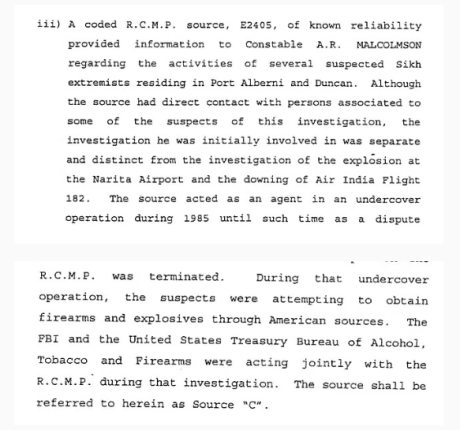
Evidently, suspects talking about blowing up a commercial airliner and attempting to obtain firearms and explosives isn’t a big deal in Canada, and the security apparatus is under no obligation to take these things seriously.
Informant 4
Once again in June 1985, another source informed the RCMP that Gurmej Singh Gill, a leader of Babbar Khalsa in London, had stated in November the previous year that anyone flying Air India would be killed either in Britain or in India by Babbar Khalsa.
Clark-Marlow’s affidavit states that this information was neither substantiated nor refuted. After everything narrated until now, it’s safe to assume that this input was also ignored.
CSIS Surveillance
On 4 June 1985, CSIS agents followed Parmar to the residence of Inderjit Singh Reyat, and then to a deserted area. The agents observed Reyat take a device into the woods.
The agents later heard a loud bang, which they dismissed as a gunshot. Testing later revealed that Reyat had detonated a blasting cap to test his bomb circuit. The agents did not see fit to have the police stop and search the suspects.
Informant 5
Sometime before 9 June 1985, Parmar and a collaborator visited the Malton Sikh Temple near Toronto. On 9 June, an informant warned the police that Parmar had warned the congregation there:
“it would be unsafe” to fly Air India.
Vancouver police intercepted a conversation of a leader of the International Sikh Youth Federation (ISYF) with a known extremist. When the ISYF leader complained that no Indian consuls or ambassadors had been killed, he was told, “You will see. Something will be done in two weeks”.
Consequences
Shambolic security and intelligence efforts usually lead to horrific consequences, and this case wasn’t any different.
On 23 June 1985, a bomb hidden in a suitcase transiting through New Tokyo International Airport exploded at 06:19. The premature detonation was on account of Reyat and Parmar not knowing that Japan did not follow Daylight Savings Time. Two baggage handlers were killed and four others were injured.
An hour later, a Boeing 747-237B operated by Air India from Montreal to Bombay disintegrated in mid-air off the coast of Ireland due to a bomb blast. All 329 people on board were killed.
Botched Investigation
The CSIS and RCMP botched the investigation as well, and only one person was ever convicted: Inderjit Singh Reyat. On 28 January 2016, he was released on parole.
The prosecution was hampered substantially because CSIS had erased 156 out of 210 tapes of telephone conversations involving Parmar, Reyat, and their collaborators. No transcripts were made.
If the cavalier manner in which Canadian Security Intelligence Service (CSIS) ignored warnings from multiple informants about Parmar’s plot to bomb Air India aircraft seemed strange, their destruction of 156 out of 210 tapes of telephone conversations involving Parmar, Reyat, and their collaborators was downright absurd.
Making the theatre of Canadian absurdities even less believable was the fact that no transcripts were ever prepared.
Blame Game
CSIS tried to explain it away as a consequence of retention policies extant at that time, and the Security Intelligence Review Committee (SIRC) claimed in 1992 that the destruction of tapes had no impact on the Royal Canadian Mounted Police’s (RCMP) investigation of the bombings.
This, however, was contradicted by then RCMP Inspector Gary Bass who led the Air India inquiry from 1996.
Apparent Willingness To Share Intelligence
In his memo, Bass took exception to SIRC’s conclusion that RCMP had not asked CSIS to retain tapes.
He mentioned repeated reminders from RCMP Superintendent Lyman Henschel to Randy Claxton (the highest ranking CSIS official in Vancouver) beginning 26 June 1985—just two days after the bombings—about the need to “isolate and retain any intercept evidence CSIS had gathered”.
“Telephone conversation. Randy Claxton. CSIS. Re: Interceptions—any incriminating evidence off C.S.I.S. installations will immediately be isolated and returned for continuity.” – Henschel’s contemporaneous notes from 27 June 1985.
Claxton agreed to do what was asked, but mentioned that there were “one or two very sensitive installations which he would want to consider very carefully.”
Destruction Of Valuable Tapes After The Bombings
Further repeated requests were made for tape retention and other than 54 tapes recorded in May [1985], none were retained. … Numerous intercepts of high probative value between several of the co-conspirators leading up to the bombings were destroyed.
So CSIS retained some tapes recorded in May 1985, but destroyed tapes recorded in June 1985, the month in which the bombings took place.
CSIS Contradictions
Bass goes further in exposing CSIS. He notes that John Venner, CSIS member, asked RCMP Deputy Commissioner Inkster in September 1985 if RCMP wanted the tapes retained.
The implication is that the tapes still existed nearly two months after the bombings. He also mentions that CSIS correspondence states tape destruction began in July 1985, the month after the bombings, and highlights that CSIS’s explanation for tape destruction—how they were destroyed and when—is full of contradictions.
Misdirection And Lack Of Cooperation
Not only did CSIS hide intelligence from RCMP personnel investigating the bombings, it let RCMP waste valuable time and energy pursuing the wrong targets. As Bass notes:
“… Valuable wiretap evidence in possession of CSIS was destroyed. … Lack of disclosure by CSIS in the early days [after the bombings] allowed the RCMP to seek a wiretap authorisation on the wrong targets. … A great deal of evidence, primarily through CSIS investigation, existed by the time the bombings took place.“
CSIS’s deliberate sabotage of the investigation is borne out by a statement made by Henschel in 2007 that even two years after the bombings, CSIS did not inform him that they had taped phone conversations involving Talwinder Singh Parmar.
Bass concludes his memo with an unequivocal and damning observation: Had CSIS cooperated fully from 23 June onward, this case would have been solved at that time.
Why Did CSIS Sabotage The Investigation?
They may have had a multitude of reasons, but one motive bears looking into. And for that, it is necessary to take another look at the key conspirators involved in the bombings.
The story introduced Talwinder Singh Parmar and Inderjit Singh Reyat. Another person involved in the plot was Ajaib Singh Bagri, who was considered Parmar’s right-hand man in Babbar Khalsa. The fourth conspirator was Surjan Singh Gill, a resident of Vancouver, who had proclaimed himself the consul-general of Khalistan.
The Events Of 4 June 1985
On 4 June 1985, Gill drove Parmar and an unidentified person—Mr X—to Horseshoe Bay in Vancouver. They were tailed by CSIS officers who had Parmar under surveillance.
After dropping them off at Horseshoe Bay, Gill left. Why didn’t Gill accompany Parmar and Mr X on the ferry to Vancouver Island? RCMP provided the answer.
While interrogating Bagri on 28 October 2000 at the Vancouver Polygraph Unit, RCMP Inspector Lorne Schwartz and Sergeant Jim Hunter stated that the reason Gill didn’t accompany Parmar to Vancouver Island is that his handlers had told him not to, because they didn’t want him to get involved further in the plot.
Parmar and Mr X took the ferry to Vancouver Island and went to Inderjit Singh Reyat’s home on Kimberly Drive in Duncan. At 6:30pm that evening, Reyat, Parmar and Mr X left the former’s house and headed off highway 18 near Hillcrest.
Around this time, Gill rang Parmar’s residence. He told Mrs Parmar that he wouldn’t be able to pick up Parmar from Horseshoe Bay later that evening because he was sick, and asked her to do it.
Hunter brought this up in Bagri’s interrogation, explaining that Gill made this excuse because he had been ordered by his handlers to dissociate himself from the conspiracy.
Meanwhile, on the island, CSIS surveillance observes that Mr X remains in the car as Parmar and Reyat walk into the bush. A few minutes later, they hear a loud explosion: Reyat and Parmar have successfully tested their bomb.
They were now ready to plant two bombs on two Air India aircraft.
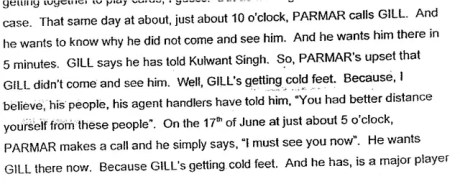
Parmar Realises Gill Is Getting Cold Feet
On 16 June 1985, Parmar called Gill and demanded to know why the latter hadn’t come to meet him. Gill made excuses, but Parmar was upset. Jim Hunter referenced this event, confirming that Gill is a significant co-conspirator:
Surjan’s Resignation
On 20 June 1985, just days before the bombings, Surjan Singh Gill resigned as Officer Director and member of Babbar Khalsa.
RCMP Sergeant Jim Hunter referenced his letter of resignation while interrogating Ajaib Singh Bagri, and mentioned Gill’s motivation for quitting:
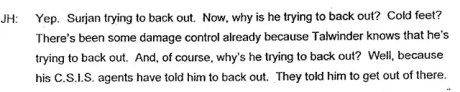
Hunter unequivocally told Bagri that Surjan’s handlers in CSIS told him to distance himself from the plot: Surjan Singh Gill, who was one of the co-conspirators in the Air India and Narita bombings, was a CSIS agent.
What reinforces this assertion is the fact that despite being intimately involved in the plot along with Parmar, Reyat, Bagri and others, Gill was never charged in the Air India 182 and Narita bombings.
Given this context, CSIS’s eagerness to destroy tapes and its unwillingness to cooperate with the investigation look less like incompetence or callousness, and more like malice. – Substack & Swarajya, 20 Septemeber 2023
Filed under: canada, india | Tagged: canadian security intelligence service, hindumisia, kanishka bombing, khalistani separatists, talwinder parmar |





 BHARATA BHARATI
Who killed Hardeep Singh Nijjar? – Hiranmay Karlekar – The Pioneer – 3 September 2023
The world of Khalistani terrorists, it appears, is not one of great mutual camaraderie and friendship, but one of sectional acrimony. Was Hardeep Singh Nijjar a victim of this internecine conflict, and the RCMP, CSIS and the CSE have been clueless about this entire matter as they were about the preparations to blow up the Air India flights? The question needs to be looked at seriously. – Hiranmay Karlekar
Prime Minister Justin Trudeau’s allegation that Indian agents had murdered the Khalistani leader, Hardeep Singh Nijjar, on June 18, 2023, in Canada, is reportedly based on inputs from intelligence sources. This raises the question as to how reliable these inputs are. No final judgement is possible until these inputs and the evidence behind them are made public. Nevertheless, one can have some idea of the efficiency of the Canadian intelligence and security establishment by looking at their performance in respect of the biggest ever terrorist outrage emanating from Canadian soil—the mid-air explosion that brought down Air India’s Boeing 747 aircraft, Emperor Kanishka, carrying flight AI 182 from Toronto to Mumbai via Montreal, off the coast of Ireland. All 329 persons, passengers and staff, on board the flight which had taken off on June 23, 1985, were killed. Only 131 of the bodies could be recovered.
The Air India explosion was a result of negligence, intelligence failure, inaction and lax security arrangement on the part of the Canadian authorities. For quite some time before the explosion there was a fear that Khalistani terrorists in Canada were planning a strike. Alerted, India’s Intelligence Bureau had sent a telex message on June 1, 1985, both to Air India’s management and the Canadian authorities asking them to beef up security measures to forestall a possible attack on an aircraft by Sikh terrorists.
James Bartleman, then head of Canada’s intelligence bureau, got a frosty response from an official of the Royal Canadian Mounted Police (RCMP), whose attention he drew to a highly classified Communications Security Establishment (CSE) document saying that Sikh extremists might be targeting AI 182. He was told that officials were probing the matter. Security measures remained lax. Sniffer dogs remained missing from all Canadian airports because they were under training at Vancouver. X-ray screens at Toronto’s Pearson Airport “broke down” on the day of the flight.
Days before the bombing, Canadian intelligence operatives who were tracking Talwinder Singh Parmar, founder and leader of terrorist group Babbar Khalsa International (BKI), and subsequently considered to be the mastermind behind the downing of AI-182– heard an explosives test that he conducted in a forest. They ignored it, thinking that it was a “gunshot!”
In its report submitted in 2010, a commission of inquiry, appointed by Stephen Harper, then Canada’s Prime Minister, in 2006, and headed by a retired judge of the country’s Supreme Court, John Major, condemned several security failures and blunders on part of Canadians that led to the bombing. According to the report, the RCMP and Canadian Security Intelligence Service (CSIS) had significant pieces of information that, taken together, “would have led a competent analyst to conclude that Flight 182 was at high risk of being bombed by known Sikh terrorists in June 1985.” Lack of coordination among them prevented the risk from being neutralised. The report called the security lapses “inexcusable” and termed Canadian security arrangements at the time “wholly deficient”.
Nor have the post-explosion developments shown any profound regret on the part of the Canadian authorities over what had happened. Nor have they reached out to the victims and their families the way they should have. The earnestness with which investigations into the outrage were conducted is reflected in the fact that only one person Inderjit Singh Reyat, was convicted and, that too, decades after the bombing. Talwinder Singh Parmer, who had returned to India, was killed in an encounter with the Punjab police in 1992. The other accused, including Ripudaman Singh Malik, who was subsequently murdered in Canada on July 14, 2023, were acquitted.
In a searing observation, judge John Major, had stated that Canada had relegated the biggest terrorist attack targeting their country to background. He noted, “I stress this is a Canadian atrocity. For too long the greatest loss of Canadian lives at the hands of terrorists has somehow been relegated outside the Canadian consciousness.” Given this background, one can hardly be blamed for doubting, prima facie, Canadian intelligence agencies’ conclusion that Indian agents had murdered Hardeep Singh Nijjar. This is particularly so in the context of Ripudaman Singh Malik’s subsequent murder. He had written a letter on January 17, 2022, to Prime Minister Narendra Modi, praising him for his initiative to redress some of the pending demands of the Sikhs. While thanking Modi for removing the names of some Sikhs from the blacklist which prevented them from visiting India, he accused certain “anti-India members” of the Sikh community of running an “orchestrated campaign” against Modi. Back in Surrey in British Columbia, his praise for Modi had prompted a section of Sikhs to accuse him of treachery towards the Sikh qaum. Was he murdered for the 180-degree turn in his attitude to India and Modi?
The world of Khalistani terrorists, it appears, is not one of great mutual camaraderie and friendship, but one of sectional acrimony. Was Hardeep Singh Nijjar a victim of this internecine conflict, and the RCMP, CSIS and the CSE have been clueless about this entire matter as they were about the preparations to blow up the Air India flights? The question needs to be looked at seriously.
> Hiranmay Karlekar is Consultant Editor of The Pioneer and former Editor of Hindustan Times. He has authored four books in English.
LikeLike
Ex Pentagon Official Michael Rubin Slams Trudeau’s Short-Sighted Approach In India Canada Dispute – Times Now – Washington – 23 Sept 2023
On allegations by Canada, Michael Rubin, former Pentagon official and a senior fellow at the American Enterprise Institute says, “… I suspect that the United States doesn’t want to be pinned in the corner to choose between 2 friends, but if we have to choose between 2 friends, increasingly we’re going to choose India on this matter simply because Nijjar was a terrorist and India is too important. Our relationship is too important. Justin Trudeau probably isn’t long for the Canadian premiership, and then we can get rebuild the relationship after he’s gone.”
LikeLike