














 “The Islam preached by the Taliban and their fellow travellers is also Islam; and if you ask them, they will also cite Koranic verses and Hadith to back their claims. Their methods may be extreme but their philosophy does derive legitimately from the same Islamic theology that the good face of Islam does. Muslims must stop being in denial about it.” – Hasan Suroor
 What is Islam?
I know Islam’s critics will be dying to answer this question, but it is more important to hear it from Muslims themselves because, after all, it is their conflicting interpretations of Islam which are behind so much of the confusion and mayhem around the world. A religion of peace, yet a religion which is invoked to wreak such mindless violence. A religion which is said to accord dignity, respect and equality to women; yet a religion in which a woman’s testimony is only half as good as a man’s. A religion which exhorts its followers to gain knowledge even if it means “going to China”; yet some of whose most noisy campaigners despise knowledge and are prepared to kill little girls for attending school. And a religion which preaches tolerance and coexistence; yet which has become synonymous with hate and intolerance.
So, what is Islam really about?
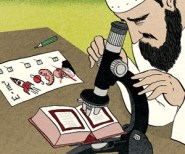 Islamic theology
In his book, What Is History?, E. H. Carr urged people to read the historian before they read his or her history in order to get a sense of where that historian is coming from. Many Muslims will say that the same analogy applies to Islam: its interpretation depends on who is interpreting it. So, extremists will interpret it to suit their own agenda while moderate Muslims would offer a different interpretation. But the trouble with this explanation is that it is at odds with the claim that Islam is so perfect, that it is beyond debate or interpretation. Its teachings and edicts are meant to be immutable. Take it or leave it. This claim itself then takes a knock when we hear so many bewilderingly different interpretations that, let alone non-Muslims, even ordinary Muslims are left confused and frustrated. A healthy internal debate is one thing, but tawdry public disputes over the fundamentals of Islam — jihad, sharia, caliphate — is quite another.
What, then, is the problem?
To be fair, it is not entirely the fault of interpreters, and in this I include those who wilfully misinterpret it to promote their sectarian or extremist ideas. The potential for misinterpretation and misunderstanding lies in Islamic theology itself. The Koranic text is a minefield of ambiguity, allowing people to cherry-pick its equivocal and often contradictory verses to back their argument. Similarly, it is easy to manipulate Hadith (a compilation of Prophet Mohammad’s sayings and teachings), another major source of legitimacy for Islamic acts. This is because they are too numerous, were pronounced in vastly different situations, and compiled many years after his death with the result that their precise meaning was frequently lost in translation. Sometimes they were quoted outside the original context. They are routinely plucked out of context to support bizarre claims.
Then there is the problem of “inauthentic” Hadith — sayings attributed to the Prophet which he may or may not have uttered. Even many authentic Hadith have been found to be flawed because of misinterpretation or contextual errors.
 On jihad
We have seen a great deal of quibbling over the meaning of jihad. Muslims insist that the “real” concept of jihad does not involve violence and bears no resemblance to Islamists’ interpretation of it. The “real” or “greater” jihad, they say, means a peaceful inner spiritual struggle. An armed struggle against an external enemy is regarded as “lesser” jihad and permitted only in specific circumstances — for example, in self-defence. Theoretically true. Yet, it is also true that around the dining table in Muslim households, the term jihad is invariably used in its violent sense and mentioned in the same breath as “kafirs.” I grew up in an extremely liberal environment, but I don’t recall, in private conversations, jihad ever being referred to in its philosophical sense. In Indian Muslim discourse, the term normally used for personal struggles, whether social, economic or emotional, is “jaddo jehad” derived from Urdu.
Extremists can be accused of inventing circumstances that, in their opinion, would justify violent jihad, or of targeting the wrong “enemy,” and using appallingly brutal methods of executing their “jihad.” But they cannot be accused of inventing the notion of violent jihad itself. There is no denying the streak of violence which — according to distinguished British Pakistani Islamic scholar Ziauddin Sardar — is “inherent” in Islam. But that is not the point. All religions, especially those which set out to gain followers through proselytisation and to conquer empires, have violent histories. Campaigns to “Christianise” Pagan Europe in the Middle Ages were not always peaceful, and then, of course, there is the bloody history of Inquisition and the Crusades.
To a large extent, Islam is often wrongly and wilfully portrayed as being somehow unique in having had a violent history. But what is unique about Islam is that while other religious movements, particularly Christianity, got over their early violent origins, it failed to move on and update its theological precepts. There has been no Islamic equivalent of Enlightenment and Renaissance, and the Islamic mindset remains awkwardly out of step with historical progress, and therefore with modern times — a hiatus reinforced by attempts to assert an Islamic identity through beards and hijabs.
But to return to the question, “what is Islam?” ask any Muslim and they will solemnly enumerate all its nobler aspects: its emphasis on community and oneness which has made it the world’s fastest growing religion; its rejection of caste or class; the spirit of inquiry it fosters; its command not to bow to any temporal authority (thumbs down for authoritarianism and dictatorship); its stress on simple and spartan living; a unique system of zakat to prevent concentration of wealth in a few individual hands; a complete “no, no” to social and economic exploitation; and its egalitarianism. Prophet Mohammed personally oversaw huge reforms in the pre-Islamic slavery practices in Arabia and appointed a former Ethiopian slave, Bilal Ibn Ribah as the first Muezzin in Islam after helping him gain freedom.
 Faces of Islam
Muslims will cite Koranic verses and Hadith to underline Islamic injunctions against violence; its command to treat women with respect and accord them equality; its message of tolerance, love, brotherhood, and its exhortation that we treat even our enemies with respect and try to win them over through love and persuasion rather than force. But this is one face of Islam. It also has another, less pleasant, face. For, the Islam preached by the Taliban and their fellow travellers is also Islam; and if you ask them, they will also cite Koranic verses and Hadith to back their claims. Their methods may be extreme but their philosophy does derive legitimately from the same Islamic theology that the good face of Islam does. Muslims must stop being in denial about it.
And this brings us back to what lies at the heart of the problem with Islam — namely the somewhat rough-and-ready nature of the fundamentals of Islamic sources, including the Koran, the central religious text of Islam comprising truths which, Muslims believe, were revealed to the Prophet by Allah from time to time until his death. The Koranic text, in the form of “aayts’’ (verses), is not thematically linked nor provides context with the result that an “aayt” which might have originated in a specific context is sometimes contradicted by another “aayt” on the subject but stated in a different context. This allows a free-for-all scramble for people to grab what might suit them in a given situation. Hence the confusion and the spectacle of extremists and their opponents both quoting the Koran in support of their positions. There is a similar confusion over Hadith, as explained earlier.
The way out is for an Islamic equivalent of the New Testament. Learned Islamic scholars need to put their heads together and present basic scriptures in a manner that the meaning and context of every “aayt” and every Hadith is made unambiguously clear, leaving no room for misinterpretation or misrepresentation. This annotated text should then be declared as the authorised version of Islamic beliefs. Otherwise, we will continue to struggle to understand what real Islam is while leaving the field open for fanatics to distort it at will. – The Hindu, 29 September 2014
» Hasan Suroor is the author of “India’s Muslim Spring” and is the former London correspondent for The Hindu. E-mail: hasan.suroor@gmail.com
Filed under: india | Tagged: india, islam, jihad, koran, muslims, prophet muhammad, religion of peace, shia islam, sunni islam, theology |










 BHARATA BHARATI
Hasan Suroor is only attempting to whitewash the historical record of islam.To borrow the words of sri Ram Swarup Islam is a brotherhood of bandits. According to Sri Sitaram Goel,Islam and Christianity are only predatory ideologies for imperialism par excellence. What about the record of slavery and also the creation of eunuchs in India by these rapacious islamic dacoits?What about the islamic crimes against humanity commited in India during the last 1200 years?The number of victims of the aforesaid crimes is reported to be larger than the victims of the Holocaust during world war II.A paedophile, prophet Mohhamed cannot be expected to establish a religion of peace.Mr Suroor,please do not try to fool everyone with your imbecile articles in newspapers edited by cretins.
LikeLike
Drone captures ISIS member having sex with a donkey? – Deccan Chronicle – Chennai – October 10, 2014
Mumbai: One can get really lonely in the hills, which might compel them to try different things. Well, this man seems to have found company.
An active coalition drone in Syria has reportedly captured images of an ISIS militant having sex with a donkey.
The footage shows the man in a compromising position with the animal.
LikeLike
Dear Mr Suroor,
You surely are familiiar with the doctrine of abrogation in the Quran. Essentially this means that when there are conflicting revelations on a single matter, the latter verses supercede the former. So by this the “Verse of the sword”, has superceded almost 100’s of peaceful ones. Also there is no direct context found in the quran . Many have to have the background of the “Hadith”. So your statement “Koranic text is a minefield of ambiguity,” is not right because the doctrine of abrogation resolves these ambiguities. Also the four schools of Islamic Jurisprudence, on the doctrine of Jihad are of the opinion that armed jihad is an obligation for muslims.
So a lot of the things you have said have been abrogated by the “Verse of the sword”. Surely the ISIS leader Abu Bakr Al Baghdadi cannot be wrong, when he invokes those very Verses/Hadith/Sunna to commit all atrocities. Also he being a native Arabic speaker, gives him more credence in the interpretation, than non-arabic muslims. Also he has a Phd in Islamic studies.
Also statistically speaking the Jihad related to armed conflicts have been used more than the “inner jihad” meanings. This study has been conducted by people like Bill Wagner. Also you have many Arabic speaking Apostates who affirm the teachings
It cannot be that Native Arabic Islamic scholars like the Muslim Brotherhood leader Sayyed Qutb, Al Zawahari (who is a quranic scholar), Bin Laden, Al Baghdadi, Al Qardawi from Egypt can be wrong and twist the scripture
As for slavery you see that in Mosul, and in Nigeria, the ISIS and Boko Haram have slave markets running. They say it is the Sunnah of the prophet and quote the relevant verses. What are your counter arguments to these?
LikeLike
Christians have had an authorised New Testament since the 4th century. This did not modify their prejudiced attitudes and violent behaviour. In fact it may have contributed to the wholesale massacre of European Pagans and American Natives, and the Crusades and Inquisition.
Islam cannot be reformed because it defines itself in absolute terms. Islam is a ‘perfect’ religion, the Koran is Allah’s own word and a ‘perfect’ scripture, Muhammad is the last and ‘perfect’ prophet (never mind that his murderous deeds are on record), the Muslim ummah is the ‘perfect’ brotherhood community (even if they are always killing each other).
So how can what is perfect be reformed?
But Muslims are not perfect and can change their attitude towards themselves and others. They are human beings just like the rest of us. They enjoy the benefits of modern life so it should not be too difficult for them to give up their medieval mindset and join the human endeavour for happiness and a better life.
So, ISIS are following the Prophet’s ‘perfect’ example to the letter. The Prophet’s example overrides all other arguments. What then is a conscientious Muslim to do? He cannot condone the head-cutting but he cannot deny the Prophet and abandon Islam either—for fear of losing his own head too!
And by the way, the reason Muhammad had 600 Jews and pubescent boys slaughtered is because they would not recognise him as a real prophet after their own prophet Moses.
LikeLike