













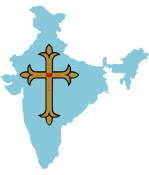

 “Even if we were to adhere to the homilies of pro-Chinese Indian “experts” advocating voluntary amnesia of China’s illegal occupation of 48,000 sq km of Indian territory and PLA’s border adventurism, there are issues which can’t be downgraded. One of them is the Brahmaputra River. Flowing from Tibet, the Tsangpo River, also known as the Brahmaputra, enters India. China reportedly desires to build its highest dam there, which will adversely effect India, particularly Assam and Arunachal Pradesh. Another Chinese irritant is its oft-repeated claim on Arunachal Pradesh, an integral part of India. There can be no peace if such policies continue. But China plays the public relations game with finesse.” – Prof Rakesh Sinha
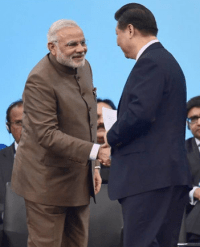 For Xi Jinping, this India visit has brought home the twin experiences of cultural exhilaration and realpolitik firmness, delivered by his host. The Chinese president enjoyed traditional Indian hospitality but also realised that India ruled by BJP is not India of the Nehrus. His country has to be now cautious and respectful in treating India. The present Indian leadership was groomed in the antithesis of Nehru’s China policy, which in the words of the late PM’s journalist friend—in the aftermath of the 1962 war—was “the road to dishonour”. War has never been India’s preference, irrespective of whoever is at the helm in South Block. However, India’s enhanced diplomatic hardball is a significant development now seen and felt in the international arena. Lest one mistakes diplomacy for soft talk, it bears iteration that diplomacy transcends mere “handling skills” pertaining to situations at hand. It is an outcome of politics and policies, and the leadership of a country.
To the Modi government must rightfully go the credit of liberating the country from its diplomatic deficit. Earlier, a “treat us as you want” mindset passed off for policy in New Delhi. India’s policymakers were perfect examples of Gandhi’s three monkeys —ears, eyes and mouths shut. Needless to say, the Chinese leadership is not only perturbed by the growing India-Japan relationship but also by a strong likelihood of the emergence of a Hindu-Buddhist corridor. It would be too early to judge China, whose worldview is reflected by the proverb “it does not matter whether cat is black or white so long it catches the mice”.
Mutual economic interests in a neoliberal world are one of the most important determinants of foreign policy. There is no way China can ignore the emerging Indian market. Its emergence as India’s biggest trading partner is now a binding factor even as it eyes a $100 billion target for 2015.
 Yet, burgeoning economic entente between two countries apart, there are reasons for institutionalised suspicion of China. Even if we were to adhere to the homilies of pro-Chinese Indian “experts” advocating voluntary amnesia of China’s illegal occupation of 48,000 sq km of Indian territory and PLA’s border adventurism, there are issues which can’t be downgraded. One of them is the Brahmaputra River. Flowing [from] Tibet, the Tsangpo River, also known as the Brahmaputra, enters India. China reportedly desires to build its highest dam there, which will adversely effect India, particularly Assam and Arunachal Pradesh.
Another Chinese irritant is its oft-repeated claim on Arunachal Pradesh, an integral part of India. There can be no peace if such policies continue. But China plays the public relations game with finesse. Chinese lobbying among Indian experts, academics, intellectuals, parties of all ideological hues is alarmingly successful. Most of them are Chinese propagandists and refuse to even listen to anything against China, using the cliché of “inevitability of interdependence”. When I raised the question of Arunachal Pradesh in a TV debate, my co-panelist dubbed it “old jingoism”. A fortnight later in another TV discussion, a senior journalist accused the Indian media of “jingoism” by “unnecessarily telecasting the Chinese army’s border violations”.
It has become difficult to even discuss Tibet. Mutual trade interests notwithstanding, Tibet cannot be ignored or forgotten. India is morally bound to support their cause. Tibet’s invasion by China, to use C Rajagopalachari’s phrase, was brutal colonialism. The loss of Tibet’s independence delivered strategic benefit to China. But Indian consensus on this issue is best represented by Jayaprakash Narayan: “Is Tibet lost forever? No. A thousand times no. Tibet will not die because there is no death for human spirit.”
China needs India more than India needs China. Our diplomacy cannot be a victim of the pro-Chinese leanings in public discourse. – The New India Express, 21 September 2014
» Prof Rakesh Sinha is Honorary Director of India Policy Foundation. E-mail him at Rakeshsinha46@gmail.com

See also
- Will Modi talk to Xi about Tibet? – Jagdish N. Singh
- India ignores Ladakh border, Chinese populate it – DC Reporter
Filed under: india, tibet | Tagged: arunachal pradesh, diplomacy, diplomatic offensive, india-china border dispute, india-china relations, mcmahone line, narendra modi, state visit, xi jinping |










 BHARATA BHARATI
Several times and in several places, I had stated that belittling Nehru will not help India-for a short while it will help the BJP; at the same time using the name of Nehru will not help the present Congress for ever! Getting loans either from Japan or from China or from the West will not help India to develop; the strength has to come from within India-in developing the attitude of the Indian people; how much they are prepared to work at home, how much they are willing to use home grown products, how much they are willing to sacrifice for India; how much has India to offer to all-not restricted to the Vote bank, teachers, Government servants etc.-her children; what is the contribution of each Importer to the reasonable good living of fellow Indians; whether we want Indians to live with at least some principles of India before she was invaded or whether we pat ourselves by saying that we are ensuring the the medically living of 126 crores of people. While we have severe restraints in the external front, we need the conviction and courage to act boldly within. I am afraid that like the Congress, the BJP too has succumbed to the existing order of things except marginal dressings like office timings and instructions to dispose of the files! The Congress was more dynamic, they could give the lead, though misuse and corrupt! We expected MODI to be more dynamic, but with much less misuse and corruption; but, may be, he is afraid to shake the officialdom lest it should boomerang as it did to JayaLalitha!!
LikeLike
Right on, Virendraji!
Indian politicians have yet to learn when to apply the Rule of Reciprocity to China, Pakistan, Sri Lanka and the USA.
When they do learn to apply it appropriately, they will be practising realpolitik and real diplomacy. And they will be acting in the interests of their country rather than in their own personal interests.
LikeLike
I have an increasingly uncomfortable feeling that Narendra Modi may turn out to be Jawaharlal Nehru-II in all aspects that matter, economic and political.
The Chinese people aided by army intrude deep into our territory, they refuse to leave until we stop some irrigation work in our space. And here is our prime minister who is bending backward to please, to propitiate the head of that very country.
The shrewd slit-eyed rascals are testing waters: how much bullying can Modi’s India take before reacting. They must be mightily pleased with themselves. No other country would reward an aggressor with such obsequious hospitality as India.
Do we have no sense of shame, self-respect or plain common sense? Have we forgotten how China rewarded Nehru for all the trouble he took to get it into UNO?
The least we could have done is to drastically scale down the hospitality and make the visit a pure official business-like visit, shorn of all emotions.
I know there are people who will regard Modi’s actions as statesmanship of the highest order.
But I am disgusted.
LikeLike