









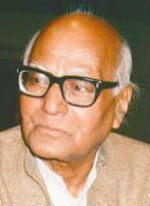
 Yogacharya B.K.S. Iyengar, the last of the legendary yoga gurus, passed into the ages on August 20, 2014. He would have turned 96 on December 14.
In an interview he had granted Rediff.com in September 2000, he had said, “The practice of yoga fulfils the need for enjoyment just as it provides enlightenment.” – Ronjita Das
The Interview
For Yogacharya B. K. S. Iyengar, winning the Lifetime Achievement Award at the Priyadarshini Awards ceremony for service rendered to humanity in the field of yoga, is just another accolade in a rich lifetime. Born in a poor family in Bellur, Karnataka, in 1918, he has come a long way from being a weak and sickly child to becoming one of India’s greatest yoga teachers.
He has received many prestigious awards like the Rajyotsava Award, 1988; the Patanjali Award, 1990; the Padma Shri in 1991; the Punya Bhushan Award, 1995; Health Care for 1996 Award; Swami Vivekanand Puraskar, 1999; and the Best Citizen of India Award, 2000, to name a few. Many international awards have come his way too, like the Man of the Year 1998, awarded by the American Biographical Institute; the International Man of the Year, 1998, awarded by the International Biographical Centre, Cambridge; and the Twentieth Century Award for Achievement.
His name has been included in many national, Asian and international lists of Who’s Who, men of achievement and prominent personalities of India. Titles like Yogi Ratna and Yoganga Shikshaka Chakravarti have also been conferred upon him.
The Film and Television Institute of India produced a film on Iyengar called Samadhi, which won the Silver Lotus Award. He was invited in 1985 to the Festival of India in France, where the film Guruji depicted his heroic struggle from poverty to prosperity.
♦ You have won the Lifetime Achievement Award for service rendered to humanity in the field of yoga. How do you rate this achievement?
♦ Yoga was a very dry subject 40 years ago. There were hardly three or four people learning yoga then, but now there are millions of people who learn yoga. The subject was not treated with respect in the early years, but I changed the whole scene. I brought life into yoga. I made it very lively.
♦ How did yoga become an important part of your life?
♦ I was suffering from tuberculosis, malaria and typhoid as a child. In those days, there was no treatment for these ailments. So I turned to yoga.
♦ How do you account for its popularity today?
♦ It spread by word of mouth. I have not made any conscious effort to promote yoga. No newspaper in Pune has ever given publicity to either my institute or to what is taught there. It became popular because of my dedication. When I was in England, I used to walk from Highgate to Hampstead, a distance of six miles, because I could not afford the bus. I used to send all the money I earned to my family in India. But I did not want to give up learning yoga. I was so dedicated!
♦ How receptive is the West to yoga?
♦ There are 180 Iyengar institutes in the world. There are 5,000 teachers abroad. In 1968, the educational department in London asked me if I could teach yoga in London without using Sanskrit words. I trained some teachers for 15 to 20 days before I too started teaching in London.
♦ Is your wife interested in yoga as well?
♦ Yes, very much. She used to teach yoga to women. In the early days, we were not really well off. But my wife encouraged me to learn yoga despite the financial hardships we were facing. Which is why I have named the Ramamani Iyengar Memorial Yoga Institute in Pune after her. My children also teach yoga. And now I have started training my grandchildren too.
♦ Is it an expensive way of keeping fit?
♦ Not at all. The Ramamani Iyengar Memorial Yoga Institute charges Rs 50 for four classes.
♦ You have devised several props with the help of which even a disabled person can perform various yoga postures. What made you think of this?
♦ Disabled people cannot perform yoga without help. So I had to think of a support system with which I could help such people do yoga. It is with this in mind that I devised some props. There are now 600 asanas which can be performed with props.
♦ Do you follow any special diet?
♦ No. I eat like any ordinary, middle-class Hindu man.
♦ Muscle vs meditation. Gymnasiums vs yoga. What are your views on these forms of exercise?
♦ The practice of yoga fulfills the need for enjoyment just as it provides enlightenment. A person should not be caught in the pursuit of enjoyment alone, he should experience enlightenment too. I mean, there should be action and motion. We must enjoy the action, not the motion. – Rediff, 20 August 2014

BERLIN, GERMANY: US-born Russian Jewish violinist Yehudi Menuhin, one of the most brilliant and celebrated violinists of the century and a yoga student of B.K.S. Iyengar, stands on his head in a yoga position as he conducts with his feet the Berlin Philharmonic Orchestra, which was playing the 5th symphony of Beethoven. Menuhin died 12 March 1999 in Berlin after a heart attack at the age of 82. (Photo credit AFP/Getty Images)
A Guru and a Maestro’s ‘Best Violin Teacher’ – TNIE Edit
Yoga guru B. K. S. Iyengar, who helped popularise yoga worldwide, died on Wednesday at the age of 95. Born in a poor family at Bellur village in Karnataka, Iyengar was a sickly child who suffered multiple illnesses including typhoid and tuberculosis. When he was 15, a relative introduced him to yoga in an attempt to build his resistance to disease. By the time he was 18, he moved to Pune to practise yoga and to teach its techniques. Iyengar created his own brand of yoga called “Iyengar yoga” and established studios in 72 countries where practitioners are taught ways to improve breathing, concentration and meditation. Despite suffering severe heart attacks in 1996 and 1998, the guru kept up an active schedule in recent years that included tours to China and Russia. Among his disciples were celebrated philosopher J Krishnamurti, Queen Elisabeth of Belgium, violinist Yehudi Menuhin, writer Aldous Huxley and cricketer Sachin Tendulkar.
Menuhin called Iyengar his “best violin teacher” for he made the aches and pains disappear and enabled him to conduct the opening movements of Beethoven’s fifth symphony for the Berlin Philharmonic Orchestra at its 100th jubilee celebrations standing on his head and conducting with his feet. Iyengar also helped the Belgian queen to recover partially from her stroke in 1965.
As Nehru wrote, there’s something quintessentially Indian about yoga, for it entails performing an “exercise” sitting motionless while in the West, exercising means running about till one is out of breath. Yet, in yoga, the body can be toned up without undertaking any violent exertions. Moreover, along with the body, the mind, too, can become alert and fresh. These are the reasons why many in the enervated West whose minds and bodies have become jaded because of the competitive lifestyle turn to yoga. There is a lesson in this for Indians, too. – The New Indian Express, 22 August 2014

Filed under: india | Tagged: b.k.s. iyengar, hatha yoga, hinduism, sanskrit literature, yoga, yoga postures, yogacharya |




 BHARATA BHARATI
The yogi who became a global brand – Nirupama Subramanian – The Hindu – 21 August 2014
On a visit to China in 2011, where B.K.S. Iyengar found himself surrounded by crowds of followers he did not know he had in that country, one young student told him: “I’ve been practising for seven years, but feel I can’t improve.”
The yoga guru’s reply was a succinct summing up of his belief that the discipline of bringing mind and body together was a constant journey. “I’ve been practising yoga for 76 years,” he told her. “And I’m still learning.”
A lifelong student of yoga as he was, Bellur Krishnamachar Sundararaja Iyengar, who died on Wednesday at the age of 95, will be remembered by his disciples foremost as teacher exemplar, who shared with his disciples the gift of his own knowledge without holding anything back, imposing only these conditions: sustained practice, discipline and rigour.
With these, anyone could attain the goal of self-realisation, he encouraged students in his celebrated work Light on Life. For, ultimately, that inner journey is what yoga is about. But even before achieving that, he promised, there would be “an incremental experience of greater freedom as we discover ever more self-control, sensitivity and awareness that permit us to live the life we aspire to, one of decency; clean, honest human relations, goodwill and fellowship; trust; self-reliance; joy in the fortune of others; and equanimity in the face of our own misfortunes.”
Iyengar’s journey
In his own life he had been through several ups and downs. Born in 1918 in Bellur village near Kolar in Karnataka in a family of modest means, Iyengar lost his father, a schoolteacher, when he was nine. The family had moved to Bangalore a few years earlier. Iyengar was a sickly child, his ill health compounded by the loss of a parent, and he did not fare too well at school. It was only when he was 14 years old that a sojourn at the Mysore ashram of his brother-in-law, T. Krishnamacharya, would lead to a life in yoga for Iyengar.
Krishnamacharya was a Sanskrit scholar who had learnt yoga at the feet of a master in the Tibetan Himalayas, after which he set up a school under the patronage of the Maharaja of Mysore. He had summoned Iyengar to Mysore initially to look after his sister while he was away travelling. Decades later, in an interview to CNN-IBN in 2010, Iyengar recalled that his brother-in-law and guru had taken him on as a pupil only because his “pet” student had left the ashram. Even then, he said, he created a “fear complex” in him, sometimes also threatening to starve him. As a fatherless boy, Iyengar said, he was treated like a kulak.
“I pushed myself to the limits in my practice in order to do my duty to my teacher and guardian and to satisfy his demanding expectations,” he wrote in Light on Life.
After four years at the Mysore ashram, he was sent off to Pune to teach yoga. He recalls in the book that he had nothing — no family or community to help him in a new city, no local language skills and no guarantee that he would find students — except his knowledge of asanas, but still clueless about the philosophy of yoga, its ancient texts, and about one of its most important aspects, pranayama, or breathing techniques.
All this he would discover on his own only in the coming years, and in that way he was self-taught. “[My] body became my first instrument to know what yoga is. The slow process of refinement started then and continues in my practice to this day. In the process yogasana brought tremendous physical benefits,” he wrote, “but I could already see that yoga could have as many as benefits for my head and heart as it did for my body.”
Iyengar’s own approach to teaching — his reputation was that of a disciplinarian, but a kind one — was perhaps influenced by his experience of learning from a man who offered no answers to curious questions, no step-by-step guidance, but “would simply demand a posture and leave it to me or his other students to figure out how it could be realised.” After a scooter accident left him with a dislocated spine, he also pioneered the use of props in yoga, making it easier and acceptable for students to achieve postures with the help of ropes, blocks, benches and suchlike.
His generosity as a guru who gave freely everything he knew, training more and more people to teach what they had learnt, was perhaps why disciples have continued to flock from all over the globe to his Pune institute, named after his wife Ramamani who died in 1973. The institute charges a modest Rs 1,100 a year. The students went away and set up schools all over the world, and his teachings are now a global brand — “Iyengar school of yoga” — with no marketing or advertising effort or hype by him. Nor did he ever put down any other kind, especially modern versions such as “power yoga”, or “flow yoga” that are aimed more at perfecting the body than the mind.
His influence was recognised by the Oxford dictionary under the entry “Iyengar: noun — a type of hatha yoga focusing on the correct alignment of the body, making use of straps, wooden blocks, and other objects as aids to achieving the correct postures.”
Iyengar’s visit to China, as the star guest at a yoga ‘summit’ in Guangzhou in 2011 was his first to that country, and he went with few expectations. Certainly, he did not imagine that he had some 30,000 followers in that country, and that translated versions of all his books were widely available and read. There is even a Chinese postage stamp in his honour. The enthusiastic reception he got bowled him over, and he told The Hindu: “I will not be surprised if China even overtakes India in yoga.”
Overseas conquests
China was the most recent addition to his overseas conquests. India’s community of hard-nosed strategic analysts could well celebrate him as one of the earliest and most enduring ambassadors of Indian soft power, decades before the Harvard academic Joseph Nye coined that term, his reach in the early decades of the Cold War far more pervasive than Bollywood’s popularity in Soviet bloc countries.
In archival photographs, he can be seen holding yoga demos, or instructing huge classes in various Western capitals, dressed unself-consciously in his trademark briefs, his long locks already an iconic style. In the 1950s, a host of American celebs were already eating out of his hands after he was introduced to the U.S. by Yehudi Menuhin. But the most often told story is about how Menuhin himself became Iyengar’s sishya after meeting him during a concert tour of India in 1951. The violin maestro already knew some yoga, but a meeting with Iyengar convinced him that here was the teacher he had been waiting for. Later, Menuhin would say that Iyengar was his “best violin teacher” because he had helped him become aware of the “mechanics” of playing the instrument such that his aches and pains disappeared forever.
Age should not deter practice was Iyengar’s belief, and he continued to practice asanas and pranayama until almost the end. In Light on Life, he wrote that death was inevitable, but that he did not think about it. “[B]oth birth and death are beyond the will of a human being. They are not my domain…The complexity of the life of the mind comes to an end at death, with all its sadness and happiness. If one is already free from that complexity, death comes naturally and smoothly.” A true practitioner of yoga would not die before he died, Iyengar believed. His own life was a testament to that.
LikeLike
May many such take birth in this Holy Land — the Land of Yogis’vara S’ri S’iva & Yoges’vara S’ri Kr.shn’a , Maharshi Patanjali & Siddhartha Gautama Buddha !!
LikeLike