















 “Shishir Gupta asserts, ‘The time has come for New Delhi to take up the Dalai Lama issue with Beijing, so that the spiritual leader can return home with minimum power and maximum dignity.’ This, he says, would push China to settle the border issue and end its aggressive moves in the region.” – Bhaskar Raman
 The book Himalayan Face-Off: Chinese Assertion and the Indian Riposte is not a dramatic, tension-filled account of the love-hate relationship between India and China. Anyone not already knowledgeable about the subject is likely to find the book daunting and a slow, heavy read. But then it is a book meant for those who are familiar with Sino-Indian ties, by an authority on the subject, Shishir Gupta, a journalist. What the book lacks in flair, it more than makes up for in depth and detail.
The author compiles a blow-by-blow account of the history of post-Independence India’s dealings with China, from the naïve idealism of the Nehru era to the last years of the Manmohan Singh administration, where “there is a pro-US lobby, a pro-Russia lobby, and a rapidly growing pro-China lobby … but no pro-India lobbyist exists to push its agenda in the world”. The book makes a particular point of delving into the diplomatic machinations behind the scenes in incidents such as the Chinese incursion into Depsang in 2013, where a humble tin hut constructed by the Indian Army at the other end of Ladakh, in Chumar, proved to be a “game changer” that helped to resolve the matter.
Gupta manages to juggle simultaneously all the complex aspects of the relationship — territorial disputes, the Tibet issue, relations with countries, trade and economy, technology, the two militaries, and the policies of various administrations on both sides, to name a few. Throughout, he maintains dispassionate neutrality as he delivers careful analysis backed up by meticulously compiled facts.
Along the way, he punctures several myths of Indian foreign policy. The conventional wisdom, for example, that the closer India moves to the United States, the more aggressive China becomes, is overturned. “India needs to learn to leverage trade, particularly market access, with China and other powerful countries as well,” Gupta writes, “or else Beijing will continue to dismiss New Delhi as a 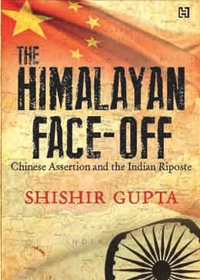 regional power incapable of delivering on the international stage.” He quotes from a speech by Shyam Saran, in which the senior diplomat observes: “My own experience has been that the closer India-US relations are seen to be, the more amenable China has proved to be.”
Another such deeply ingrained idea is that Tibet is a lost cause and the movement will fizzle out after the death of the current Dalai Lama. Gupta points out the risks of the Tibetan movement becoming radical, which would pose as grave a security risk for India as for China, and that allowing the status quo, where China clamps down in Tibet and puts pressure on Nepal, Bhutan and Myanmar is “not at all cost-effective for India without any diplomatic returns”. Instead, Gupta asserts, “The time has come for New Delhi to take up the Dalai Lama issue with Beijing, so that the spiritual leader can return home with minimum power and maximum dignity.” This, he says, would push China to settle the border issue and end its aggressive moves in the region.
One of the overarching themes in the book is China’s often duplicitous tactics and supercilious attitude. A striking example of the former is an incident from 1962, when Ratan Kumar Nehru met with Chinese Premier Zhou Enlai a few months before the war broke out. Nehru asked Zhou about signs that China was leaning towards accepting the Pakistani position that Kashmir is disputed territory, pointing out that in a previous conversation, Zhou had rhetorically asked, “Has China ever said it does not accept Indian sovereignty over Kashmir?” The Chinese Premier replied, “Has China ever said that India has sovereignty over Jammu and Kashmir?” The latter is starkly displayed through anecdote form a security conference in Washington, where a Chinese delegate created an awkward silence during a friendly drinks session by saying that Beijing was amazed at the quick rise of a “big, dirty country” like India.
One area the book steers clear of is suggesting a comprehensive roadmap to handling China. Gupta limits himself to outlining the challenges we face, leaving it to the powers that be to handle matters as they unfold. – The Sunday Guardian, 14 June 2014
» The Himalayan Face-Off: Chinese Assertion and the Indian Riposte by Shishir Gupta, Hachette India, 365 pages, Rs 650.
» Bhaskar Raman is the Managing Editor at The Sunday Guardian, New Delhi.

Filed under: india, tibet | Tagged: dalai lama, geopolitics, india, india-china border dispute, india-china relations, indian politics, politics, psychological warfare, refugees, tibetan independence movement, tibetan refugees |









 BHARATA BHARATI
Leave a comment