










“I have long felt that languages are subversive, and that sometimes they are masks of conquest. Over time I have begun to feel that, in particular, English is enormously harmful in subtle ways. Now this is a hard thing for me to admit since English is the language that I prefer to write in, and so in a way I am sawing away at the branch that I sit on, quite Kalidasa-like. Nevertheless, the memes that we absorb with the language essentially deracinate us, because they are so alien.” – Rajeev Srinivasan
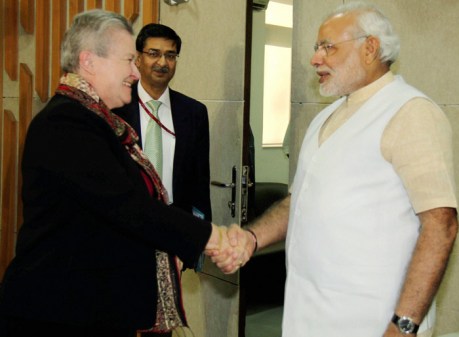
The fact that Prime Minister Narendra Modi has decided to speak Hindi with his foreign visitors is a clear statement of principle: there is no need to apologise for Indianness, nor is there the need to consider English the be-all and end-all. I liked this view in Firstpost that this helps put the Indian back in Indian-ness. The fact that a number of MPs took their oaths in Sanskrit is further evidence that the age of the unquestioned kowtowing to foreign tongues is coming to an end. Vive la difference, as the French might say.
I have long felt that languages are subversive, and that sometimes they are masks of conquest. Over time I have begun to feel that, in particular, English is enormously harmful in subtle ways. Now this is a hard thing for me to admit since English is the language that I prefer to write in, and so in a way I am sawing away at the branch that I sit on, quite Kalidasa-like. Nevertheless, the memes that we absorb with the language essentially deracinate us, because they are so alien.
For instance, it was intriguing to hear recently from British Prime Minister David Cameron that “the UK is a Christian country” and that he was intent on propagating his religion (“David Cameron: I am evangelical about my faith”, see The Guardian, 17 April 2014). This is about as bluntly unsecular as one can be: he was declaring that his country not only had an official religion, but that he would go to some length to give primacy to that religion.
In contrast, would any politician in India dare comment even on the fact that looting Hindu temples and transferring their wealth to the state was inappropriate? The government has in fact launched an attack on the Sree Padmanabhaswami Temple in Thiruvananthapuram with the possible intent of grabbing the billions in gold and antiques and gems in its vaults. But no such thought ever enters the European (Christian) mind. To say that the Vatican has immense wealth that should properly belong to the masses would be considered blasphemy.
The notion that Britain is a Christian country is not new. Years ago, I read the brilliant Raj Syndrome: A Study in Imperial Perceptions by Suhash Chakravarty, which, with voluminous research, showed that there was, in practice, little difference between the church and the imperial regime (as I described in my column The Predatory State).
I felt a sense of déjà vu when the famously secular The Economist magazine tweeted “ the Arab Muslim world is reacting negatively to a forthcoming movie about Noah, sacred history’s first boat-builder” (emphasis added). This is a plug for its religious blog, Erasmus, which generally talks – very positively of course – about Abrahamic religions, particularly Christianity. I shall focus on The Economist because I read it regularly, and it probably is the standard-bearer among wide-circulation English-language publications.
It amused me because ‘sacred history’ is a deliciously creative euphemism for ‘Christian mythology’: so concrete and real-sounding! The word ‘mythology’, I have noticed over time, is reserved by Anglophones for any non-Semitic stories, eg. Greek, Norse, Hindu, Buddhist, Roman, etc. Whereas when it comes time to describing their own mythology, Anglophones use ‘scripture’, and never ‘mythology’. But I think ‘sacred history’ is even better, implying there is ‘real’ history and then ‘sacred’ history. Which is true: there is history, and then there is myth.
The problem is that the Anglophone West, and their friends in India, have a tendency to conflate – often with malice aforethought – their myth with history. For instance, let’s take the founding myth of Christian dogma. There is no clear evidence that Jesus Christ actually existed. No relics, no artifacts, no contemporary historical records, nothing. Nada. Zip. (Well, to be precise, there is the historian Josephus Flavius, but if you believe him, then you must also believe his history of the Essenes which tell you that the reported teachings of Jesus were all in the Essene Gospels of a couple of hundred years earlier).

Similarly there is the beloved myth of St Thomas who, ‘sacred history’ says, arrived in Kerala around 52 CE, converted Nambudiri Brahmins, and was murdered in Chennai by Brahmins with a spear, and his skeleton is in Chennai. There are only three problems with this: Thomas never actually went to India, there were no Nambudiris in Kerala at the time, and the Vatican itself certifies that Thomas’ remains are in Ortona, Italy. But this has not stopped the myth from becoming “truth by repeated assertion”. There is also a nice little embellishment I heard from Shashi Tharoor, that a Jewish girl with a flute greeted the man on a Kerala beach. Those little details … sheer genius! There were Jews in Kerala around the time: so the plausibility quotient goes up.
For a history-centric set of religions – as in the Semitic/Abrahamic religions Christianity, Judaism, and Islam, along with the quasi-religion of Communism – it is important that major historic events that are supposed to have taken place are treated as true history, things that actually happened. Hence the desperate attempt to confuse ‘real history’ and ‘sacred history’: in other words, an assertion that myth is real. Or, in other words, a ‘sacred lie’.
Correspondingly, there is also the subtle denigration of Hindu history as myth. The Aryan invasion mythology is one such attempt – Hindu ithihasa (ithi-hasa: thus it happened) does not jell with the 4004 BCE creation mythology of the Abrahamics (Bishop Ussher’s 4004 BCE genesis date is the basis of Max Mueller’s assertions). Therefore, the Hindu ithihasa must be myth. QED. In fact, the exact opposite is likely to be the truth: ithihasa as history, Aryan invasion as myth.
The work of Bart Ehrman, Professor of Religious Studies at the University of North Carolina, Chapel Hill, including his book Forged, suggest that there is a great deal of forgery, extrapolation, errors, etc. in the New Testament. This is unlikely to be ‘history’.
The work of Thomas Thompson, a retired Professor of Theology at the University of Copenhagen and a leading archeologist, especially The Historicity of the Patriarchal Narratives, is notable. It suggests that the Old Testament (Jewish Bible) version of history “is not supported by any archaeological evidence so far unearthed, indeed undermined by it, and that it therefore cannot be trusted as history”. This is ‘sacred history’? (By the way, Thompson was made unemployable in US academia by Catholic theologians, and so worked as a school teacher, janitor, and house painter, until the Israelis, and later, Danes, invited him to tenure-track positions.)
So this ‘sacred history’ business is very dubious, but The Economist perseveres. Though years of reading it carefully I have noticed that they use the term ‘Holy Land’ very often (isn’t this rather non-secular, and highly ethnocentric? An outsider certainly wouldn’t consider the West Asian desert particularly holy.). And for a Hindu or a Buddhist, his ‘Holy Land’ is India. So whose point of view is it? Similarly, ‘Holy See’: why not simply say, ‘Vatican’? Given the reality that it is the biggest, oldest, multinational organisation out there, and that it has a dual status as a country (with its own UN seat) and a religious entity, the Anglophone use of ‘holy’ strikes me as much the same as a vacuous formal title, such as ‘Lord’ or something.
Here’s another recent Economist story, where it asserts something about “the birthplace of Jesus”, as though it were self-evidently true, not a pious belief. In fact, the traditional account of how the birthplace of Jesus was ‘found’ is that it came in a dream to Helena, mother of Emperor Constantine, with no corroborative evidence whatsoever, that Bethlehem was the spot. A Greek or Roman temple that stood on the spot was destroyed.
Similarly, the Economist magazine has its ‘Advent Calendar’, a special ‘Christmas Issue’, and it always talks about Christian texts (and only Christian texts) as ‘scripture’, for instance in “Religion in Northern Ireland: Staging the scriptures” (2010). Again, ethnocentric and religio-centric. I also noticed that, for 2014’s Good Friday, they pushed up their publication by one day, so that Christians could take the day off – note the equivalent of all these would be condemned if done in India for Hindus.
I wouldn’t have an issue if all this was confined to the Anglophones: it’s their language, their religion, their problem. But it is seriously polluting and undermining the Indian sense of self-hood. It pains me to point out that, along with the language, we speakers of English as a second language have acquired a number of unfortunate memes (and prejudices) that are grossly culture-specific.
One example is that of ‘crossing one’s fingers’. An article dated 14 March 2014 in Livemint (“How Isro got an indigenous cryogenic engine”) starts off with: “Mission director K. Sivan kept his fingers firmly crossed in the mission control room at the ISRO….” This is comical because it is unlikely that too many people in India would cross their fingers: it is not natural for Indians. Besides, the engineers and scientists of ISRO are probably less religious, even if they happen to be Christians, than the average punter.
But that meme of ‘crossing one’s fingers’ has become part of the discourse. So has ‘christening’ for the simple act of ‘naming’ something. And ‘blue eyed-boy’. This in a country where non-brown eyes have traditionally been a sign of abnormality! Or ‘roses in December’: as Vikram Seth said acidly in Diwali, roses actually grow just fine in India in December!
“Into each life a little rain must fall”: yes, and we welcome it. In India, we welcome the cooling monsoon, the warm, soul-liberating rain, not the bleak, soul-deadeningly chilly drizzle of northern latitudes. As I write this, the monsoon has just hit landfall in Kerala, and all of us are awaiting its arrival with great anticipation, and we are a little tremulous about the El Nino’s effects of a deficient monsoon.

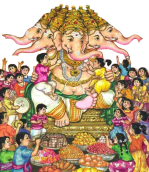
Similarly, we see many write about the “elephant-headed Hindu God, Ganesha” (including Indians writing in English). Fair enough: the deity is indeed elephant-headed. But how come we don’t see anywhere, in reverse, about a divine dead body nailed to a cross. Yet, there is a mental block about saying that: it sounds … odd. That is what I mean by unconscious acceptance of metaphors and memes. There is in fact no reason for Indians to internalise these Western vanities.
There are many such metaphors and clichés that Indians use unwittingly that have no meaning in their context. This shows the extent to which they have been brainwashed into an Abrahamic way of thinking. I do not by means suggest that they should abandon English (it is fairly useful for trade and international exchanges); but let them be aware of the religious and cultural biases that pervade that language, that they have absorbed unwittingly.
This is why an uncompromising stand on language – for example, I believe Prime Minister Modi should read his prepared speeches at the UN, etc, in Sanskrit and it will be interpreted for others – is a proper part of a cultural reawakening and self-assertion. Indians don’t need to be colonised in the mind any more.
Some might accuse me of wanting to deny others the benefits I have received from English, I would suggest they get truly fluent in their mother tongue as well as English. In my defence, I am thoroughly familiar with one language, Malayalam, and it is my language of the heart. It is the works of Vijayan, Pottekkat, Mukundan and their Malayalam cohort that speak to me. With exceptions like Amitav Ghosh’s ‘The Shadow Lines’, the entire corpus of Indo-Anglian literature leaves me a little cold: it is like making love through an interpreter. – Firstpost, 11 June 2014
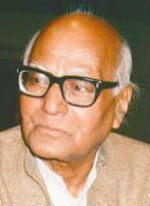
» Rajeev Srinivasan is a management consultant and columnist for Rediff and Firstpost. He lives in Thiruvananthapuram and tweets at @RajeevSrinivasa
Filed under: india | Tagged: christianity in india, colonial legacy, culturally subversive, deracination, english in india |






 BHARATA BHARATI
Great article and true. This is also the task of our leaders to help expedite and decolonise our minds and to inject indianness into us. It is a fight between us and them. And their desire to dictate to us and even the rest of the world.
LikeLike
Well Said. I completely agree with Mr. Nanjappa. It’s the accent which matters the most and not the language as such. I remember a quotation mentioned in the Vedas uttered by KanchiI Mahaswami where he points out that the World was divided into 32 regions based of various factors and one of them is how people pronounce syllables of the same shabhas. This eventually matured into various languages over time. The root of all languages is ONE which we call as the Vedic language and the difference lies in the permutation and combination of these fundamental Vedic shabdhas. There was a research by Prof. Kalyanaraman a while ago which mentions that South India alone had as many as 143 known languages in total (may be even more). Today we hardly have 10-15 at max of which only 4 are the dominant ones. Every official language of a state destroyed these other languages over time.
I have absolutely no qualms with English as a language as long as it’s regionalized. In today’s scenario one simply cannot avoid English which is why even countries which went against it have now started adopting it with one major difference. We adopted English along with it’s values but they adopt it and localize it. Sanskrit once occupied the same position as how English is today. It was the language of literary education in the past. Non literary education was still imparted in the regional language back then. Language and education are two different entities in my opinion. Language has in the past century or two completely hijacked education in our country to the extent that a person who doesn’t know to read/write a language but who has phenomenal work related skills is being branded as dumb and illiterate by our elites. Our skilled labor class have been completely wiped out and the meager one who remain are being branded as illiterates while the fit for nothing English educated graduates are being lauded as elites. The root cause of all this has to do with the British who literally wiped out non-literary education from this country and replaced it with literary black board education system and even in that Sanskrit was replaced by English. I don’t see the English language as a threat as long as we don’t inherit the English values too along with it.
Every language had several accents which were destroyed over the past few centuries. The DK morons have no authority to blame the Hindi imposters. What the Hindi imposters are allegedly said to have done is exactly being done by the DK at the regional level. As the author pointed out they’ve simply imprisoned Tamil. They are imposing language as an identity on the people of TamilNadu which they are not ready to accept. In my opinion the root cause of all this started with linguistic bifurcation of states of India. It is that which led to standardization of languages which in turn killed the diversity of it. Today, in TamilNadu for example the people who speak dialects of Tamil which is not official (as per some pseudo elites) are heavily being made fun of by the so called elites. I think the only solution for this might be to further divide the states of India based on culture and ethnicity than language per-se.
Our scriptures never gave any great prominence to languages. They left it to the masses to decide because our rishis always thought it was insignificant for human enlightenment. This is why there weren’t much conflicts in our nation in the past despite our people speaking hundreds of languages. It’s high time our focus has to shift from linguistics to dharma that’s unique to this nation.
LikeLike
This piece makes a point: any language is used by the rulers of the day for their own advantage! English was imposed in India as the language of Imperialism, as earlier Persian had become the court language under the Mughals. Likewise Telugu became the language of the rulers and also of cultural discourse in the South under Vijaynagar and later Telugu rulers. Telugu reign as the language of the cultured continued even under the Marathas of Tanjore.
Every language has its own peculiarities which influence its native users- those who speak the language and not just learn it as scholars, and who from childhood are pickled in its literature, as Aldous Huxley once wrote., and shape their thoughts. Standardisation of a language and disappearance of its dialects and regional variations represent enormous cultural loss, which the world faces today.
This trend is seen clearly today in two areas: In Tamil Nadu, the Dravidian parties are bringing in their own form or version of Tamil, changing even the script and standardising the usage through the educational system which they control and manipulate to their advantage. And at the national level, Hindi zealots are doing it, imposing a from of Hindi imperialism in the process. Modi speaking Hindi is o.k, provided ministers speaking other languages will also be allowed to speak in their language. Every language spoken in the nation is national language. It will of course be splendid, if Sanskrit could be adopted.
The colonial govt and the missionaries worked in tandem to control the educational system and create a large body of clerical minded Indians.While the English educated Indians became babus, writing beautiful notes, they could not take decisions.This has continued largely so even after Independence, and the three old provinces where English education first took hold still stand witness. Here, knowledge of English is still looked upon as the sign of intelligence. And this language is the old British English, except where Americanisms are forced upon the user through the computer./internet..
But we need not blame the language as such for the ills of the system. Rajaji as the then Prime minister of old Madras presidency proved that English systems could be used to our advantage and purpose.
Three other examples of native Indians using English to our advantage come to mind. Swami Vivekananda was the first Indian to use English to explain Indian philosophy not only to the world, but even to educated Indians, as sister Nivedita pointed out.He organised and consolidated our ideas and presented them in modern idiom , even if Victorian. Then Dr.S.Radhakrishnan lectured and wrote on Eastern religions and western thought, showing the enormous but unacknowledged debt western philosophy, in its various forms owed to Indian thought. He too worked under Victorian mores. This has not been followed up in our academic circles subsequently.
But the greatest original contribution has come from Sri Aurobindo.Few Indians stand comparison with him in the mastery of languages: Greek and Latin, besides English, familiarity with French and German, besides Italian.His contributions to the study and interpretation of Veda.,Upanishads, the Gita are original, strikingly different from both old Indian orthodox systems and the modern views; His interpretation of Vedanta is likewise original.His writings on Yoga, Evolution, history, sociology, and the theme of human unity, his translations from Classical Sanskrit sources and comments, his essays in defence of Indian culture, his writings on language and literature, besides his poetical works- everything is couched in the finest English , as few Englishmen themselves could write., leave alone Indians.( Of course, one is free not to agree with him) His language is happily free from Victorian influences.
Most of our youngsters do not appear to have studied any of these authorities seriously. Of course, our newspapers also do not care to disseminate their ideas and writings..
But the point I wish to make is that language as such cannot be blamed for the limitations of the users..Jawaharlal Nehru had also his education in England, but he became almost an Englishman in his habits of thought and style.. Under him, the old colonial system of govt. continued. Sri Aurobindo was sent to England by his Anglophile father with the idea that he should be brought up without any touch with his native language or influence of its thought, but he became the greatest champion of India and its culture- boldly declaring ‘Sanatana Dharma-that is nationalism for us’ and emerged as the single Indian most feared by the British in the first decade of the last century.
But then is not academic education anywhere in the world based on largely the Book? is not modern mainstream psychology or sociology still largely based on a Freud or Marx? Can language alone change it?
LikeLike
“Or ‘roses in December’: as Vikram Seth said acidly in Diwali, roses actually grow just fine in India in December!”
Roses in December
There is an excellent book by MC Chagla
http://www.goodreads.com/book/show/15832211-roses-in-december
As Minister of Education under Jawaharlal Nehru, Chagla was distraught by the quality of education in government schools:
“Our Constitution fathers did not intend that we just set up hovels, put students there, give untrained teachers, give them bad textbooks, no playgrounds, and say, we have complied with Article 45 and primary education is expanding… They meant that real education should be given to our children between the ages of 6 and 14”
Its the same quote of MC Chagla today. He was cremated.
http://en.wikipedia.org/wiki/M._C._Chagla
From
http://documents.jdsupra.com/8f1bce4c-8fe9-4e33-8784-91c9aa683a1b.pdf
Paying tributes to Shri Chagla on behalf of the judges of the Supreme Court of India, Chief Justice Shri Y.N. Chandrachud succinctly said: “A December Rose has faded, but its fragrance will linger ling.” Of course, Shri Chagla was a full-bloomed, beautiful December Rose. But he was much more. In fact, these beautiful lines which were applied to a great man on the 17th century are clearly applicable on Justice Chagla.
LikeLike
American English is more secular than English English. This is because of the influence of the powerful Jewish lobby in the US (which owns newspapers and TV stations). So the English public media uses must be religion neutral. There is no Merry Christmas in much of US media, only Happy Holidays (as Hanukkah is also celebrated around Christmas time). But in India English usage is different. The convent-educated copy editor of a major English-language daily will not give up his or her Victorian vocabulary. So this morning a headline in The New Indian Express (Vellore edition) reads, “Jaya Christens Six Wild Elephants in Sanctuaries”.
This headline literally means that Jaya made Christian six wild elephants by giving them Christian names. This is what the term ‘christen’ means.
This would never have happen in a US newspaper where the neutral, correct term ‘names’ would have been used to describe Jaya naming six wild elephants.
It is not as if The New Indian Express editors—and editors of the other English-language newspapers in Chennai—were ignorant of their out-dated English usage. They have been told many times over by this writer and others that the term for a Christian naming ceremony, christen, should be abandoned.
But they continue to use it partly because title and caption editors in Indian newspaper offices are as pig-headed as they come, and partly because the news editors at The New Indian Express are Christian and see an opportunity to make a sly sectarian statement.
LikeLike