











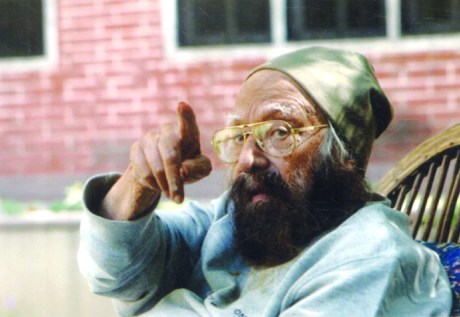
 At long last, shortly before he would turn 100, Khushwant Singh has gone. India loses a pleasant writer and frequently humorous political and social commentator. He was a forthright spokesman of the Nehruvian English-speaking elite, at one time even the direct press chief of Jawaharlal Nehru himself. He also served as an assistant to Sikh leader Master Tara Singh, as novelist and historian of Sikhism, as editor for an array of papers, and as columnist, best known for the title of his long-running column “With malice towards one and all”.
By coincidence, I met Khushwant Singh on the airplane Delhi-Frankfurt some 22 years ago. Frankly, I got a rather good personal opinion of him. It was timely that we met, because I needed to prove my existence. He had just written a newspaper column stating that my book on Ayodhya had been written by Sita Ram Goel using a European name as pseudonym to confer an air of outside objectivity on his pro-temple thesis. Well, that matter was settled then.
We struck up a conversation, of which I distinctly remember that, upon my enquiring, he confirmed that he believed in a separate Sikh identity, as demonstrated by sporting beards and turbans, but that he did not believe in the need for any religion. (In my book Negationism in India, I devote some pages to Khushwant Singh’s argument for the separate identity of Sikhism, and wonder aloud about this contradiction.) For emphasis, he repeated his main point: “No religion.” In a way, this is a classical Hindu position: one’s belonging to a community does not depend on a particular belief, so one can be an unbeliever all while remaining a card-carrying member.
He had always made fun of religion as such (and this without anyone charging him under Art. 295A), lampooning pieties such as “work is worship” with additions like “yes, but worship is not work”. And he did so till the end: as late as 2011 and 2013, he published books against religion and the belief In God, afterlife or rebirth. While Western scholars are now wavering about their long-held thesis of “secularization”, seeing a revival of religion in Russia and China and a demographic explosion among believers, here was one Indian who did see secularization as the wave of the future. He inferred that the development of the “scientific temper”, as enjoined by the Indian Constitution, would necessarily lead to the people’s outgrowing Scriptural beliefs.
Yet he had deplored it when his son came home from the West divested of his turban. The son saw no point anymore in wearing the uniform of a particular religious sect when religion itself made no sense anymore. The simplicity of common sense reasons that religious identity presupposes religion. But the convoluted logic imposed by Indian identity politics and Nehruvian secularism will have none of it. If you manage to sell the identity of your religious community as somehow non-Hindu, ex-Hindu or anti-Hindu, secularists feel honour-bound to defend it. So, even without religion, a Sikh identity must be upheld because it irritates Hindus.
Or that at least is what secularists, in their utter ignorance of Hindu history, think. They do not know that Guru Govind Singh was cent per cent a Hindu and founded the Sikh militant order to serve and defend Hindu Dharma. They have defined Sikhism as a separate religion, and they don’t look any farther than the present legal arrangement, somewhat like foreign tourists who rely on a guidebook to quickly teach them about India. Indeed, the best appreciation of Nehruvian secularism is that it is the uncomprehending tourist view of India’s religions.
Like an obedient secularist, he was very good at getting the Hindus’ goat, e.g. by condemning Shivaji for disposing of his enemy Afzal Khan; but he was not so good at lampooning Islam or Christianity. Yet, unlike other secularists, he did occasionally criticize even Islam and Christianity. But not too much, so he did support the ban on Salman Rushdie’s The Satanic Verses: avoiding the inevitable bloodshed was more important than upholding freedom of speech. In this manner, the religious obscurantists always have their way on condition of credibly threatening violence, for then the secularists will present it as virtuous and wise to drop freedom of speech and give in to the demand for book-banning.
He also did the secularist thing in supporting the Emergency dictatorship. Nehruvian secularism, being a despotism by nature, always disliked unmanipulated democracy. Indeed, it was under the Emergency that the Constitution was enriched with the declaration of India as a “secular, socialist” republic, the only part of the Constitution without genuine democratic legitimation.
Once he fell from his usual anti-Hindu stance. Condemning Congress for the 1984 anti-Sikh riots, he preferred to vote for their most credible opponents, the BJP, in subsequent elections, before the Ayodhya demolition of 1992 made him revert to his more familiar opposition to Hindu nationalism.
But he had the virtue of being able to take a laugh at himself, much in contrast to the pompousness and self-importance of most secularists. As a dabbler in erotic writing, he gracefully accepted the sobriquet “dirty old man” of Indian public life. At least I will vouch for “old man”, and hope to emulate him in remaining active as a writer till age 98. That is when his last book came out: The Good, the Bad and the Ridiculous (October 2013), another argumentation against religion, which he saw as his farewell to writing. And now, on 20 March 2014, he has taken his leave from life, peacefully in his own home in Delhi.
Since he is not going to heaven or hell, and since he is not coming back either, we had better get used to living without Khushwant Singh. For a committed atheist, it would mean nothing to wish him “Fare well” or “God be with you”, so I will only say: “It was nice knowing you.” – Koenraad Elst Blog, 21 March 2014
» Dr. Koenraad Elst is a Belgian writer and orientalist (without institutional affiliation). He was an editor of the New Right Flemish nationalist journal Teksten: Kommentaren en Studies from 1992 to 1995, focusing on criticism of Islam. He has authored fifteen English language books on topics related to Indian politics and communalism, and is one of the few western writers to actively defend the Hindutva ideology.
See also
Filed under: india | Tagged: atheism and agnosticism, authors, india, indian secularism, indira gandhi, khushwant singh, koenraad elst, nehruism, nehruvian secularism, nehruvian socialism, obituary, secularism, sikhism |







 BHARATA BHARATI
Khushwant was epitome of everything pervert stored for centuries and
big banged into worst shadowy world of what is now known as Nehruvian pervert pseudo secular India, continued by pigmy dynastic rule. Pseudo India mocks on Hindus, so was individual pigmy Khushwant, Pseudo India is hard on Hindus and soft on others, so was pigmy individual, Pseudo teaches Shivji was robber, so said pigmy individual, Pseudo India banned Salman Rushdie book, pigmy individual supported the ban. Pseudo India eulogies such person nonchalantly and remaining individual pigmies do the same except in this board, as there hardly some here.
LikeLike
Another encounter, which Elst forgot is available in his own book:
http://koenraadelst.bharatvani.org/books/wiah/ch8.htm
“In order to bolster their separateness from Hinduism, Sikh separatists magnify the Islamic element in Sikhism. An element of this tendency is the replacement of Sanskrit-based terms with Persian terms, e.g. the Hari Mandir, ‘Vishnu temple’, in Amritsar is preferably called Darbâr Sâhib, ‘venerable court session (of the Timeless one)’.15 Another expression of this tendency is the induction of Muslim divines into Sikh history, e.g. the by now widespread story that the foundation stone of the Hari Mandir was laid by the Sufi pîr Mian Mir. After this story was repeated again and again in his weekly column by Khushwant Singh, Sita Ram Goel wrote a detailed survey of the oldest and modern sources pertaining to the construction of the Hari Mandir, found no trace of Mian Mir there, and concluded: ‘I request you to stop propping up a blatant forgery simply because it has become popular and is being patronised by those who control the neo-Sikh
establishment’. Khushwant Singh never mentioned Mian Mir again.”
And further ahead: “So, according to Ram Swarup, other scholars were put to work to rewrite Sikh history in the sense desired by the British: ‘Max Arthur Macauliffe, a highly placed British administrator told the Sikhs that Hinduism was like a “boa constrictor of the Indian forest” which “winds its opponent and finally causes it to disappear in its capacious interior.” The Sikhs “may go that way”, he warned. He was pained to see that the Sikhs regarded themselves as Hindus which was “in direct opposition to the teachings of the Gurus”. The influence of scholarship is silent, subtle and long-range. Macauliffe and others provided categories which became the thought-equipment of subsequent Sikh intellectuals.
**********The “boa constrictor” account is repeated by !!!!Khushwant Singh!!!!, who is very attached to “Sikh separate identity which we are trying to, and perhaps will go on trying to maintain.”********
There is also an interview Khushwant gave to the Sikh times where, after years of harping on the ‘separateness of Hinduism and Sikhism’ he finally admitted that Sikhism was a Vedantic sect within Hinduism.
http://www.sikhtimes.com/bios_021503a.html
J.S.T.: What do you think of R.S.S. chief Sudershan’s statements, which Sikhs find highly offensive?
K.S.: R.S.S. is a communal organization and dangerous to the country’s secular fabric. Look what they did to Muslims in Gujrat. However, they take a different approach with the Sikhs. During the 1984 Sikh pogrom, they did save many Sikh lives. R.S.S. volunteers participated during the tercentenary celebrations of the Khalsa in 1999. They consider the Khalsa to be a military wing of Hinduism and their savior.
J.S.T.: What about the statements that suggest that Sikhs are kes-dhari [sporting unshorn hair] Hindus? You yourself wrote in The Wall Street Journal (Oct. 12, 2001) that Sikhism is a branch of Hinduism.
K.S.: That is correct. Sikhs are kes-dhari Hindus. Their religious source is Hinduism. Sikhism is a tradition developed within Hinduism. Guru Granth Sahib reflects Vedantic philosophy and Japji Sahib is based on the Upanishads.
J.S.T.: Those are loaded statements. You could be accused of blasphemy and summoned to the Akal Takht.
K.S.: They don’t have the guts to summon me. They only go after the weak and the timid. Why don’t they summon Ranjit Singh who claims he is the real jathedar [high priest] of Akal Takht? Pashaura Singh talked to me after appearing before Akal Takhat jathedar. I told him, ‘What is the point now? You should have contacted me earlier.’ [Pashaura Singh’s reaction dated Mar. 21, 2003: ‘I did not meet Khushwant after appearing before the Akal Takht. Maybe, Khushwant is confusing me with Dr. Piar Singh. He certainly spoke in Piar’s defense on television after Piar was awarded religious penance at the Akal Takht. I had written to Khushwant and many other Sikh scholars in 1993 explaining my point of view regarding the controversy over my doctoral thesis. In fact, Khushwant acknowledged my letter and wished me well. But that was well before my Akal Takht appearance.’] No scholar should be summoned to Akal Takht. Is it a religious place or a kotwali (police station)?
*******************************************************************************
All this reminds me of that trite phrase: ‘Too little and too late.’
Elst seems to have gone all soft on Khushwant, and I rather fancy Elst’s earlier hard-nosed edition (see above).
“Thus, if Jain monks want to wear handkerchiefs on their mouths and sweep the ground in front of their feet in order not to kill any tiny animals, that may be a fine application of their concept of non-violence, but it would be absurd if Jains started doing this for no other reason than to affirm Jain identity. It is alright if youth gangs impose on themselves artificial identities with distinguishing marks and signs and rituals, but that is a passing phase. Identity for the sake of identity is a concern of puberty, not more.
“Identitarianism” is but one of the many fashionable ways to misunderstand and misrepresent Hindu revivalism: the Hindu problem is not with identity, it is precisely the anti-Hindu separatists in Sikhism, Jainism etc., who make an issue of identity.”
The fact remains that Khushwant wrote very good English, had a great and often ribald sense of humour, and was obsessed with talking and writing about sex, carefully cultivating the very saleable image of a ‘dirty old man.’ As Dhiren Bhagat put it, ‘Despite the constant harping on sex, Singh probably does not sleep with anything more interesting than a hot-water bottle.’
(http://indiatoday.intoday.in/story/exclusive-extract-from-khushwant-singhs-autobiography/1/289506.html)
He loved his scotch and had tremendous self-discipline in professional terms – not one publisher ever had a complaint about him. Elst scracely skips a beat while recounting Khushwant’s brazen and completely unfounded allegation about Elst being the non-existent alter ego of SRG in search of ‘white’ respectability. Yes, Khushwant as a fellow passenger would be more interesting than the average Joe, but the average Joe doesn’t go out of his way to wantonly vilify people and craft historical and doctrinal fabrications. We have only Elst’s word about ‘settling the matter’ but did Khushwant ever take the time to issue a correction in subsequent articles in the newspaper? I doubt it, and would be happy to be proven wrong.
Elst is confusing between ‘Guna’ (habits, attitudes, learned behavior etc.) and ‘Svabhava’ (intrinisic nature). Pleasantries on the plane arise from the gunas, that society forces on us to some extent in order to make life bearable, enabling Beligans to travel peaceably with Sardarjis, but svabhava must find an outlet somewhere.
Khushwant was a very talented, highly learned and resourceful man, whose unfortunate hobby was denigrating Hinduism and Hindus who had done him no harm; a text-book case of the Indian secularist public intellectual doubling as a public bully, if one was needed. That was his svabhava. If secularism were to be considered a theology (which it is, in India), he was a shining example of “philosophia ancilla theologiae.” The secularists have lost a great champion who came from a ‘minority,’ was serious about ‘identity,’ was a connoisseur of Urdu poetry (like Shri SRG) and could also claim that he was an atheist/agnostic, warding off the ‘pseudo-secular’ label (which sticks to ‘secularist’ Abrahamics), but without ruffling any Abrahamic feathers in the bargain.
LikeLike
As usual, Dr. Elst is original and incisive. Yet he has been much more kinder to Mr. Singh than the latter deserved. Mr. Singh tried to be on the right side of the establishment, but he did not always succeed. To his credit, he opposed Bhindranwale’s terrorism. Like all other secularists, Khushwant Singh’s secularism was exhausted in calling Hindu nationalists communal. He became as soft as wax while dealing with Islam and Christianity. His much acclaimed column was largely a window for self-indulgence where he wrote mostly inane things, inter alia, about himself and about people who met him, knew him or sent him books and gifts including mangoes. His political opinions were fairly predictable, shallow and either laughable or outrageous. If one becomes as blunt as he had been to others, his writings would not be missed much.
LikeLike
Wonderful obit article on Khushwant by the one-and-only Koenraad Elst. Loved it to the hilt. Thanks, Elst ji.
LikeLike
In spite of all, I will always remember Khushwant Singh as a nice grand ‘old man’, who could always laugh even at himself. The account of Dr. Elst’s unexpected brush with him is highly readable. I must thank him very much.
LikeLike