











 “In The Origins of the World’s Mythologies, Michael Witzel misses no opportunity to point out that Gondawana peoples were inferior to Laurasians (present western world), a fact he claims is demonstrated by mythology! This is the genesis of his hatred for Indian traditions—Indians are a Gondwana people!” – Prof. Shivaji Singh
 Myths are integral to any culture; they give life and vibrancy to the cultures in which they are created. Philosopher-historian Peter Munz observed, “Myths and their motifs invariably constitute the leaven of the weltanschauung of a culture and permeate its fabric and identity in the way matter and form inform the world of reality. But like matter again myths, in their own world, cannot be related to time and space. Ipso facto ahistorical, they impart meaning to the intractable mass of unaccounted and unaccountable past by selection, by focusing a few bits of the past which thereby acquired relevance and universal significance” – ‘History and Myth’, Philosophical Quarterly, VI: 1-6, 1956
In fact, cultures are sets of images (bimba-vidhaana). A culture is, therefore, best defined in terms of the metaphors, symbols and images that it uses, and myths play the lead role in the formation of the mental templates that shape these signs and signals.
Myths, motifs, and mythology
But what are ‘myths’? Myths are legends that relate to divine or semi-divine beings, popular stories describing exploits of gods and goddesses and supreme human beings. They are handed down from earlier times and their truth is accepted without any scrutiny.
Two other categories of legends do not pertain to divinities. One is saga (folk tales), the other marchen (a German word, popularised by folklorists, for fairy tales). These also contribute to the formation of a mythology, but it is mostly and primarily out of myths that mythologies are made. That justifies the name ‘mythology’ and also explains why mythology, the discipline dealing with myths, is called devasaastra in India.
The ideas and themes that go to make a myth are called its motifs. Myths are culture specific, but motifs – the building blocks of myths – very often transcend cultural boundaries. The motifs, ‘Sky Father, Earth Mother’, ‘Cosmic Egg’, ‘The Great Flood’, etc., are found equally in Indian mythology and the mythologies of Greece, Egypt, Babylonia, and other countries to various extents.
 From mythology to comparative mythology
This observed commonality of mythological motifs gave rise to comparative mythology. In the 19th century, comparative mythological studies became greatly fashionable, mainly to buttress support to the so-called Aryan invasion theory. This theory, as we know, is in crisis today and despite being reformulated again and again by substituting ‘migration’, ‘trickle-in’, in place of invasion, its validity remains extremely doubtful. However, comparative mythology still continues as a convenient weapon to fight 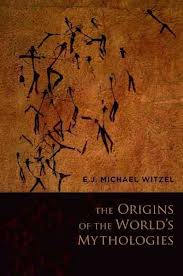 ideological battles. The latest in this genre is Harvard Professor Michael Witzel’s recently published The Origins of the World’s Mythologies (Oxford University Press, 2012).
This is a lengthy offering (686 pages), well organised, with clear-cut thematic chapters, copious references and a systematic bibliography. The concept of myth is tolerably well analysed. The author’s previous work in the field is summarized and the manner in which his approach differs from that of his poorvasuuris explained. But there is a hidden agenda, perhaps originating from the author’s ideological and psychological aberrations and a few other drawbacks such as a demonstrably uncalled for attempt on the part of the author to venture into a field for which he is ill-equipped.
Michael Witzel is currently in a precarious situation. The fast flowing anti-Hindu and pro-AIT winds on which he has been flying his kites high have slowed down considerably. He can either step back and admit that he has been talking nonsense all these years, as some think is advisable, or he can move on.
He has chosen the latter course, thanks to a new development in western academics. The growing corpus of work of archaeologists, geologists and population geneticists has contributed to growing knowledge about the prehistoric past and transformed the atmosphere in the Humanities and Social Science departments of universities. Scholars are now more interested in pre-3000 BCE than in the post-3000 BCE era. Witzel has seized this opportunity to shift to an earlier chronological horizon, and hence the study of the origins of the world’s mythologies.
The problem is that he lacks the academic abilities and expertise for this complex field. Witzel chose mythology under the impression that myths are ahistorical and their space-time coordinates can therefore be easily manipulated. But though the time-frame of myths are unknown, they cannot be pushed back in time beyond a limit, a fact that he clearly did not realise as he set out on his academic adventure.
For instance, leave aside 50 to 60 thousand BCE horizons when our earliest ancestors, Homo sapiens sapiens, started moving out of Africa; coming down to as late as the beginning of the Neolithic Age around 10 to 12 thousand BCE, we find that the father-mother relation was unknown. The women folk had the impression that they become pregnant because of bathing in a particular pond or sitting under a certain tree. How could a ‘Sky-father, Earth-mother’ motif develop before that time? Thus there is indeed a time limit beyond which the origin of a specific motif cannot be placed.
Mythology was a poor choice for Witzel if he desired to roam in the misty pre-10,000 BCE world. The origins of language might have been a better choice, given his claimed linguistic expertise, to investigate how Palaeolithic man’s speaking skills developed over time in tune with tool manufacture and such things.
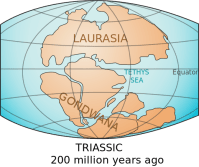 In The Origins of the World’s Mythologies, Witzel misses no opportunity to point out that Gondawana peoples were inferior to Laurasians (present western world), a fact he claims is demonstrated by mythology! This is the genesis of his hatred for Indian traditions – Indians are a Gondwana people!
The Harvard Professor may be excused for his wrong assumptions relating to myths and mythology, he may be pardoned for using discarded models in analysing mythological inter-relationships, but should he be spared for sharing racist ideas? If considering dark-skinned Gondwana peoples as a whole to be inferior to white-skinned Laurasians is not racism, what is racism? Oxford University Press needs to explain its decision to publish such a book. – Vijayvaani, 7 February 2014
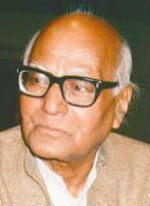
» Dr Shivaji Singh is former Professor and Head, Dept. of Ancient History, Archaeology and Culture, University of Gorakhpur, UP, India
Filed under: india | Tagged: ancient history, comparative mythology, genetics, gondwana, history, india, indians, michael witzel, mythology, psychological warfare, racism |





 BHARATA BHARATI
Some one should write a book or make a website explaining what we the gondwana people taught the laurasians.
LikeLike
Two facts must also be kept in mind: (1) there were (and are) scholars who have studied Indian mythology (as it should be) in the light of Indian tradition such as, for instance, A K Coomarswamy and V S. Agrawala, and (2) even though the colonial paradigm of Indian history is still alive, there are at least four to five more paradigms in the field. In fact, we are passing through a phase of contending paradigms in Indian history. (Refer to Chairman’s address at ICIH 2009 available online: ‘Contending paradigms of Indian History: Did India lack historical agency?’
LikeLike
Ever since the study of history began as a separate discipline, the Western view has dictated the terms and decided the contours, due to its economic and political domination. Though the non-Western societies continued with their cultural traditions almost intact, their study by the so called, self-styled academicians has been based on a complete neglect and negation of traditional sources and interpretations and increasing reliance on their own theories and views.The ideas, understanding and experience of the actual practitioners are discarded, in favour of the opinions and prejudices of the Western scholars. Literary sources which are considerable have been discounted as unreliable or fanciful.Consequently, the academic exercises have little to do with the actual realities of a living tradition.
The study of ancient Indian history has been dominated by Westerners from the beginning, first by some genuine Indologists and then by the colonial and missionary elements, with their own agendas. Over half a century ago, Arnold Tonybee pointed out three ‘roots’ behind this: the egocentric illusion, the illusion of the ‘unchanging East’ and the illusion of progress that proceeds in a straight line: (A Study of History, Abridgement, Vol.1, p.37) This is still unchanged in the academic establishment.
Carl Jung and following him Joseph Campbell saw in mythology great psychological truths, though they could not be reduced to elements of history as academically understood. But even Jung refrained from going the whole hog—that would have taken him beyond psychology to pure spirituality but he was anxious to be counted a scientist, not an advocate of spirituality. Now, isn’t it rather pathetic to see linguists/historians trying to use mythology to advance their racial prejudices?
LikeLike