









 “Hostile forces denounce it as the brahmanisation / sankritisation of the village, when in reality that process was already entrenched in the village worship of many deities and the polytheism of the Veda and worship of a chosen god or goddess in the Agama. The village deities, the grama devatas, are often representative of natural forces, local heroes, or related to Vedic deities.” – Dr. Vijaya Rajiva
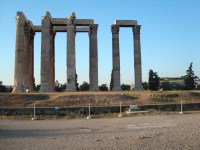 It has been the ancient dream of both Christianity and Islam to overcome Hinduism. Both overran Europe and the Middle East respectively; Europe became christianised in half a century, with the now dead ancient cultures of Greece and Rome are remembered in museums; Iran and its neighbourhood adopted Islam and relinquished their own rich ancient cultures. But despite ruthless invasions and colonial occupation, Hinduism has remained intact, owing to the strength of the Vedic Agamic tradition. Repeated attacks against it have not succeeded.
Monier Williams and his followers such as present day anti-Hindu activists like Arundhati Roy (Christian) have made the mistake of targeting what they call the mighty fortress of Brahmanism. Monier Williams (author of the Sanskrit English Dictionary, 1899) had famously said that when the walls of the mighty fortress of Brahmanism are down then Christianity will win:
“When the walls of the mighty fortress of Brahmanism are encircled, undermined and finally stormed by the soldiers of the cross, the victory of Christianity must be signal and complete” (Modern India and Indians, 1879).
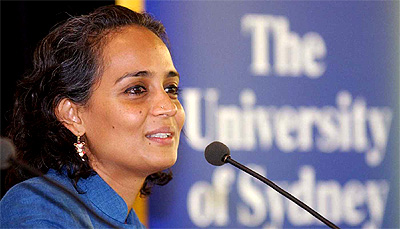 Arundhati Roy frequently mentioned the Brahmanic Hindu state. Had they referred to the Vedic Agamic tradition, they would have been closer to the truth. It is imperative that Hindus do not become apologetic for this tradition. They should not only be proud of it, but also uphold it without any hesitation. The present writer has written about attempts to sever the connection between Veda and Agama by hostile forces (See ‘The Attack on the Vedic Agama Connection’).
A similar attempt has been made and continues to be made by hostile forces trying to detach the village agama from the larger tradition with which it has been intimately connected for several millennia. This is the site for a renewed attack on Hinduism.
 Hostile forces denounce it as the brahmanisation/sankritisation of the village, when in reality that process was already entrenched in the village worship of many deities and the polytheism of the Veda and worship of a chosen god or goddess in the Agama. The village deities, the grama devatas, are often representative of natural forces, local heroes, or related to Vedic deities.
Sometimes there are temples in the village to house these deities, and sometimes they are housed in makeshift structures.
The worship of female deities in the village (called Devis or Devatas) are aspects, if not the basis of Saktism, one of the four formal Agamas which are the Shiva, Vishnu, Shakti and Srauta agamas. Attempts to isolate them from the larger Shakti tradition are inaccurate.
There is an unusual coldness and seeming objectivity and detachment on the part of contemporary scholars such as David Kinsley, whose work is almost an itemisation and tabulation of village deities (See Hindu Goddesses: Visions of the Divine Feminine in the Hindu Religious Tradition, 1988). Evidently the deep connection to the Vedic Agamic tradition can only be captured by those who are actually Hindu. While his work is not exactly in the same category as Whitehead’s The Village Gods of South India (1921), there is a brittle quality about the work, perhaps because it was not written by a Hindu. David Kinsley was a much respected and well liked professor of religion at an American university; the Right Reverend Henry 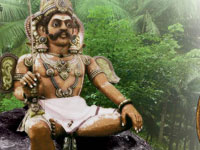 Whitehead was Bishop of Madras during the colonial era. Interestingly, Kinsley does make references to the Whitehead book.
Unlike the Vedic Agamic tradition, the village agama does not always have a formal installation of the deity (prana pratishta), although that situation itself is gradually changing. For instance, the village guardian deity Muniyandi is frequently installed by priests, sometimes even brahmin priests. Swami Devananda Saraswati (aka Ishwar Sharan) recently pointed out that there are basically four types of installations in Hinduism:
- Installation via the use of natural objects such as tulsi; these are of divine natural origin and are called swayambhu or self-generated (not made with human hands or by any known agency). As is well-known, sometimes the object of worship might be a rock formation or a holy tree and these are rubbed with red lead.
- Installation by a saint or holy person (often villagers may approach one and seek their intervention).
- Installation by a trained priest, brahmin usually (although in villages non-brahmin priests do the officiating) in the Vedic Agamic tradition.
- Installation through the personal devotion of an individual ( in the village it often begins as tribute to some departed soul to whom the individual has been attached).
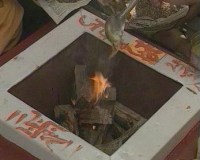 In each case, it is assumed that the deity has been propitiated and is present for the village. The connection with the formal Agama tradition is quite obvious since it has specific installations. However, since the Veda did not have murtis and worship was offered to the Devas and Devatas through the medium of the Vedic sacrifice, the homa (havan), it may seem at first glance that the connection with the village agama is tenuous, since the village does not ordinarily employ homa.
This negative criticism of the link between village agama and the larger Agama and Veda is further intensified by pointing out (as some writers do) that the village Devi is swayambhu, self-born, and does not need a priestly installation to bring the pratima to life. In addition, many natural objects are believed by villagers to be swayambhu and are so worshipped. Hence, there is no need for homa or prana prasthistha (installation of the deity, or rather consecration of the deity).
In the formal Agama the installation of the deity is considered of prime importance.
Hence, the two questions, homa and the phenomenon of swayambhu must be examined.
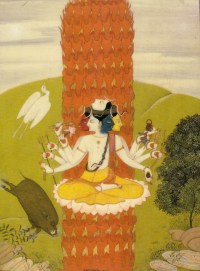 Swayambhu and Homa
In the four Vedas, the existence of naturally sanctified entities is the basis of the hymns. It is not clear how any attentive reader can miss this point. The celestial, atmospheric and terrestrial deities are believed to be naturally sanctified and self-generated entities.
The various Devas and Devatas are swayambhu, even though they may not appear in anthropomorphic forms, such as those associated with Devi in Agama and village agama. Often the Vedic hymns describe the Devas and Devatas in anthropomorphic terms and the descriptions are colourful. It is now known that some types of pratima existed in the Vedic period. Psychologist and writer Shrikumar has made an interesting observation in one of his reflections on the topic:
“…all devas and devatas (that includes gram devatas) are eternally present but have to be identified … the devas and devatas if existing outside of individual consciousness can be viewed as some form of nodes of sentient energy if not identified already as forces of Nature.”
 Whether they appear as anthropomorphic forms or as forces of Nature, Hindus worship all Devas and Devatas as existing outside their consciousness, as objective realities [emphasis added]. The village worships deities that are primarily terrestrial, centred round the village and its boundaries.
The Vedic rishis received their vision of all three categories of deities (cosmic, atmospheric and terrestrial) directly.
Why the homa? The sacrificial fire which is lit during the homa is a worship of the deity which confirms its objective existence (or so the Hindu believes) and which can be prayed to. It is functionally equivalent to the village worship of deities. Mantras are chanted during the ceremony. The village does not use the Vedic mantras, but engages in chanting and music. The use of prayers and music in village rituals are similar acts of worship. The arati is often performed using cloth dipped in oil and signifies the importance of fire for worship.
 The first words of the first hymn of the Rig Veda (to Agni) begin thus: “agnimile purohitam yajnasya devam. . . .”
A point that must be noted is that the Vedic ceremony occurs under the sky at altars which are built for that specific purpose and then dismantled. The village structures also are not usually permanent. The Vedic fire altar uses bricks which are placed in a certain alignment. Both the fire and the wood used for starting and kindling the fire are naturally existing substances (today, only the Namboodiri Brahmins of Kerala conduct Yagna as prescribed by the Vedic texts). The village uses makeshift structures as well as some Agama style small shrines and temples.
The point to be kept in mind is that village ceremonies are close to the natural religion of the Vedas.
 Contemporary Scholarship
Starting with sociologist M.N. Srinivas in the 1960s (Social Change in Modern India, 1966), there has been a trend in Indian sociology to make a distinction between the Veda Agama and village agama. Srinivas used the word ‘Sanskritisation’ to describe what he saw as the process by which lower castes would imitate the manners of the upper castes (or Sanskritised Hindus) to gain upward mobility.
While this may be true of some of their habits, the worship of grama devatas dates back to ancient times and has been linked to the Vedic Agamic tradition in many ways. Srinivas in his Remembered Village invokes the warmth and informality of village worship, while tacitly downgrading the Vedic heritage, as if there was no warmth or beauty or devotion in what he saw as the ‘formal’ worship in the Vedic Agamic tradition.
Since then, many scholars in India and abroad have perpetuated the distinction between what Srinivas called the Great Tradition (Vedic Agamic) and the Little Tradition (Village agama). Hence, it is important that Hindus challenge these and other misconceptions foisted on us by the missionaries, but also by contemporary scholarship. – Vijayvaani, 18 August 2012
» Dr. Vijaya Rajiva is a Political Philosopher who taught at a Canadian university.
See also
See previous articles by Dr. Rajiva
- Attacks against the Vedic Agama connection
- Punya Bhumi: The Homeland of Vedic Agamic Hinduism
- The Upanishads: Happy hunting ground of the ONE god-ists
- Punya Bhumi and the bleak landscape of one god-ism
- Hindu intellectuals must protect the traditional acharyas
- The ONE true god: Some reflections
- Rig Vedic Polytheism and Punya Bhumi
- The Rig Veda and “Hindu Polytheism”
- Social engineering, social reform and protecting the Vedic heritage
- Temple priests and preserving the Vedic heritage
- Prof. Monier Williams and his mighty fortress of Brahmanism
Filed under: india | Tagged: agama, agama, civilization, culture, devi, god, goddess, grama devata, havan, hindu, hindu deities, hinduism, homa, image worship, india, muniyandi, philosophy, religion, rituals, sanatana dharma, sanskrit, sanskrit english dictionary, sanskrit literature, sanskritisation, vedas, vedas, vedic deities, village deities, yagna |





 BHARATA BHARATI
– No problem with the article (though there’s a minor inaccuracy: it’s not only in Kerala that Hindus’ yagnyas continue to be performed as prescribed).
– The issue was only with the image caption being easily interpreted as implying that Mariamman is merely assumed [by Tamizh or any Hindus] to be Kali, when this is not an assumption, it’s a literal fact. The Tamizh Hindus know that she IS Kali (who is Uma=Lalita). That is, the identification is not in their minds, it is a correct identification.
The comment was to undo any credence you (or any readers who saw the caption) might have given to the non-Hindu standpoint that Mariamman could ever be some “individual” Goddess separate from Uma. It was necessary to make the comment because there is a movement — one rather related to the very issue that Vijaya Rajiva has drawn attention to in her article above — which attempts to separate the local manifestations of widely-known Hindu Gods from their correct identification with the main names used for the same Gods (in this case, trying to separate Mariamman from Kali-Uma). This movement then evolves into saying that Mariamman (or else Bhagavati) was “actually” a “Tamizh-only” (or “Malayali-only”) Goddess who was “brahminised” into Uma “when Hinduism invaded the south” or some such nonsense. At times, this movement is then further expanded to say that Mariamman is “actually Mary” or else a “Buddhist” deity or further nonsense (neither of which are possible for obvious reasons, but that never stops the rumour-mongerers: they’ll attempt anything to transfer her devotees away from Hindu religion). With my earlier comment on the subject, I merely wanted to clarify that there can be no split between the Uma known to the Upanishads and Puranas and the Uma manifest as Mariamman all over Tamizh regions or as Bhagavati all over Kerala.
Non-Hindus are waiting for Hindus themselves to start prevaricating on the issue. Therefore never give them the opportunity, such as via an unwary caption that ends up stating the wrong thing. Rather, state self-evidently that “Mariamman is one of the names by which Parvati manifests in Tamizh nadu”.
1. I’ll agree Ayyappa may not be known in, say, Gujarat, although Ayyappa too is specifically a Vedic God (albeit locally known to the south). 2. And Muniyandi and some others are local Hindu Gods but are still very much part of specifically the Hindu pantheon (like some Vedic Snake Gods are locally known to other regions of India). 3. But Mariamman is different from both examples since she is Uma and hence widely known to manifest throughout the subcontinent.
All three examples cases occur with the pantheons of the far east: locally known Gods, locally-known regional Gods, and Gods known nationwide but with specific local manifestations or general manifestations.
“the Goddess Mariamman beloved by Tamils, is identified by her Tamil devotees themselves as being the same as Goddess Kali. It is Tamil devotees themselves who make the association”
Yes. Exactly. That was the very point of my comment, since this valid and important (and relevant to the article!) Hindu POV was specifically not reflected in your image caption. (If this was a non-Hindu site, I’d never have bothered to comment, obviously.)
I found only your caption faulty, not your choice of putting the article here or your overall intention in doing so. You’d surely have a wide readership: what you say matters and influences others. So when you argue the Hindu side, just argue it Hindu all the way. Reading *you* say “Mariamman AKA Kali” (rather than “Mariamman is closely associated with Kali, *because* of [fierce attributes]”) will reinforce Hindu readers, rather than instilling sudden doubts into any weakminded among them.
Will you consider correcting the image caption to reflect the Tamizh Hindu POV?
LikeLike
(Still in response to your comments, IS)
“However, the Great Goddess as Mariamman is by her name and unique forms of ugra worship peculiar to Tamils and Tamil Nadu”
– No different from how Bhagavati temples are often specific to Kerala and border regions. Or various localised Devi temples among Vanavasi Hindu in more northern parts of the subcontinent (Durga-Devi manifesting among Forest and Hill Vanavasis gets special mention in the Devi Mahatmyam and stotras).
– Also, Mariamman’s form (e.g. fire behind her crown, teeth, the implements in her hands) is identical to her counterpart in Shiva manifestations: not just the Aghora Shivas seen in Tamizh Nadu but also the Bhairavas in faraway Kashi. It’s quite the same. Though several of the typically fierce attributes of Mariamman are missing from the image posted, she does carry the typical knife and bhiksha cup that Bhairava also carries (and the trishoola and naga-damaru that Shiva carries).
– In terms of how “ugra” Mariamman is, this is debatable. Only to those who threaten her cubs does the Mother Lioness look fierce. To her cubs she always looks to be made of milk and caring. Her ugra-ness instills confidence and fearlessness in the valiant Hindu villagers, as she protects their homes and families from enemies, as well as diseases and catastrophes.
LikeLike
“All Goddesses are manifestations of the Great Goddess Mahadevi (by whatever name you like–Uma is fine but why not Lalita or Tripurasundari or simply Sri Devi?).”
But I did mention both her names Uma and Lalita in my comment. There is a reason I didn’t mention Shree, though, as that is specifically Lakshmi’s name. The following is not nitpicking, but it is a side-topic you just raised:
– Lalita’s other personal name is Tripurasundari. (So giving a choice between “Lalita OR Tripurasundari” doesn’t make sense, as the full name is “Lalita Tripurasundari” or “Lalita Parameshwari”.) Lalita is the wife of Sadashiva, Parameshwara. She IS Uma (Parvati), as is obvious from Mooka. And Uma/Lalita IS Kali. E.g that Kali and Uma and Lalita are the same (and that she is therefore the wife of Shiva) is obvious also from Kalidasa’s Shyamala Dandakam where Kalidasa repeatedly refers to Kali as “Uma” and “Kalika” too (since all these names refer to the same God) and also describes her with the Karumbu bow and the sacred arrows of Kamadeva (which is that most specific description of none other than Lalita Tripura Sundari).
Mariamman IS therefore Kali=Uma=Lalita TripuraSundari. That is why Tamizh Hindus know to put the Karumbu bow in her hand or sing songs of her being wife of Shiva and mother of Ganapati and Murugan.
– SHRI Devi, however, whom you also mention, is — as seen by her personal name which is prefixed to the “Devi” part — Vishnupatni. She is another one of the Tri-Shaktis, who are the 3 wives of the 3 Gods of the Trimoorti: Shri’s other name is Lakshmi, and she is as “same” or as “different” to Uma or Saraswati or any other Hindu Goddess, as Vishnu of the Trimoorti is the “same” or “different” to Shiva, Brahma or any other Hindu God. That Hindus do frequently note some degree of difference is seen also in Shyamala Dandakam, where Saraswati and Lakshmi are said to also bless those who worship Shyamala (another name for Kali/Durga/Uma who is Lalita), or in Shankara’s Navaratnamalika which describes the subject Lalita as “IndiraaramaNasodari” (Lalita is sister of Indira=Lakshmi’s beloved, i.e. Lalita is sister of Vishnu). Further, the difference in identity is also observed not only in Temples where Lalita stotras are recited for Mariamman same as for Meenakshi etc, and Lakshmi stotras are recited for Shri Devi (but Devi Mahatmyam is recited to all of the Trishakti or any Devi, for obvious reasons, but is specifically for Durga who is Uma, the wife of Shiva: IIRC, from Uma emerges Chandi as per Devi Mahatmyam). But the difference between Uma and Lakshmi is also often maintained by Hindus who have moortis of both Lakshmi (i.e. Shri Devi) and Gowri (i.e. Uma) and who tend to do separate poojas to both. It is true that reciting stotras to please one pleases all Devis.
So, although the Hindus’ Adishakti is indeed the combination of Trishakti (because ultimately the 3 Trishaktis and all Shaktis are related, of course), but unless one wants to say that “all Gods are one” or “everything is Brahman” to prove the point of sameness, in terms of specific identity: Mariamman is particularly Uma, rather than Lakshmi or Saraswati or Gayatri or any of the other Hindu Goddesses.
LikeLike
In your eagerness to find fault, perhaps you have missed the point of both caption and article.
All Goddesses are manifestations of the Great Goddess Mahadevi (by whatever name you like–Uma is fine but why not Lalita or Tripurasundari or simply Sri Devi?).
However, the Great Goddess as Mariamman is by her name and unique forms of ugra worship peculiar to Tamils and Tamil Nadu (and she has been taken to other countries by Tamilians only; has she reached NZ yet?). Therefore in the context of the article above, where village agama worship is being shown to be contiguous of vedic agama worship, the Goddess Mariamman beloved by Tamils, is identified by her Tamil devotees themselves as being the same as Goddess Kali whose worship in Hindustan is not limited to one state or linguistic group but is universal to all Hindus.
It is Tamil devotees themselves who make the association, not this ignorant editor.
LikeLike
2. The “village” Hinduism of every Hindu is very much Vedic religion. From offering food to the Gods (with or without ghee, neivedyam), which is the equivalent of a Vedic Homa, to singing songs to the Gods (the equivalent to the samavedam, sings songs please the Hindu Gods), to reciting stutis praising the Gods (which is equivalent to the Rig Vedam), to additionally covering the Gods with flowers while doing so (a literal Mantrapushpam).
Village Hindus are Vedic Hindus. Pooja is very Vedic. Also, the Vedas know of moortis of the Gods since they speak specifically of Moorti shilpas who make these. The Shilpa Shastras are considered Vedic texts, being expansions to the Vedas.
The Hindu texts called Agamas and Tantras are specifically Vedic (also by their own self-designation, not to mention they carry the same mantras, at times with variations to customise them for the purpose. E.g. one God’s panchakshara mantram seen in the Vedas is also there in the Agamas to the same God in Shadakshara mantra form, which forms the core of that God in his Agamas).
The larger Agamic tradition of temple building, constructing the moorti, installing and inducting the moorti and worshipping the moorties with rituals is identified in the Agamas as the temple being the very yagnyashaala and the moorti is identified as the Vedic fire. Agamic rituals mirror Vedic rites. E.g. Shivalingam is the Vedic fire itself, and pooja to it is offering to Sadashiva who very much includes the Tridasha. The same identification with Vedic yagnya is repeated over and over again in the names within a sahasranama that occurs in a famous Yamala (Agama text). This mirrorring of Vedic rituals becomes more inward in Tantra rituals where the same identification with Vedic yagnya is made even more internally within the Hindu individual (the Vedic fire is the Shivalingam, who is within the Hindu’s own heart). Every Hindu individual who performs pooja at home is *performing* Vedic rituals, but for their individual selves or families usually. Whereas (outward) Vedic yagnyas are performed for *all* of Hindu society.
LikeLike
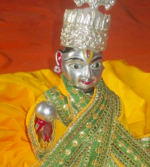
1. This image caption is utterly wrong: “Goddess Mariamman: Every Tamil village has a Mariamman Temple. She is closely associated with Kali because of her fierce attributes.”
She is not “closely associated”. Mariamman IS Uma (minus possibly Renuka Devi, who is also a Shakti, but going I think Renuka Devi is Parashurama’s mother and wife of his father who is a Rishi, I think Jamadagni).
Mariamman in Tamizh regions, like Bhagavati in Kerala, are often *the* Kuladevas for entire clans of Hindus, including local brahmana communities. I know many Tamizh brahmana families whose kuladevam is an ancient Mariamman in Tamizh Nadu or a Bhagavati in Kerala.
And it’s a modern, foreign notion that the various manifestations of Uma as Mariamman “came to be associated” with Uma/Kali because of “fierce attributes” (or any other modern excuses). Every *Hindu* of the region who knows what they’re doing knows that she is Shiva’s Shakti, i.e. his Uma.
Even in the very image with the false caption, she is holding the very snake — with percussion from what I can make out from the image — (that Shiva, e.g. Bhairava has) and a trishoola. Also the moorti in the photo is typically wearing the sacred thread (just like the image of God Muniyandi shows he is wearing not only the bindi on his sacred third eye but covered in veeboothi — which is ash of Vedic homas).
Many Hindu Tamizh villagers also know to put the karumbu bow in Mariamman’s hand when doing alankaram to her Temple moorti (i.e. they know she is Lalita, because they are Shaktas), as is also seen on Kalikamba. Tamizh language stotras and folk songs speak of Mariamman as Shiva’s wife and Mother to Muruga and Ganapati, and as the one who defeated the Mahishasura. They sings songs summarising the Devi Mahatyam in worship of her. So there’s no question who she is. In Sanskrit too, the stotras Tamizh Hindus sing to her include Lalita Sahasranamam. I’m not even going to go into the Carnatic songs about Mariamman composed in Tamizh by local Hindus (including but not limited to Bharatiyar).
LikeLike
See Sruti-Smriti – Srauta-Smarta at http://www.kamakoti.org/hindudharma/part15/chap8.htm
LikeLike